
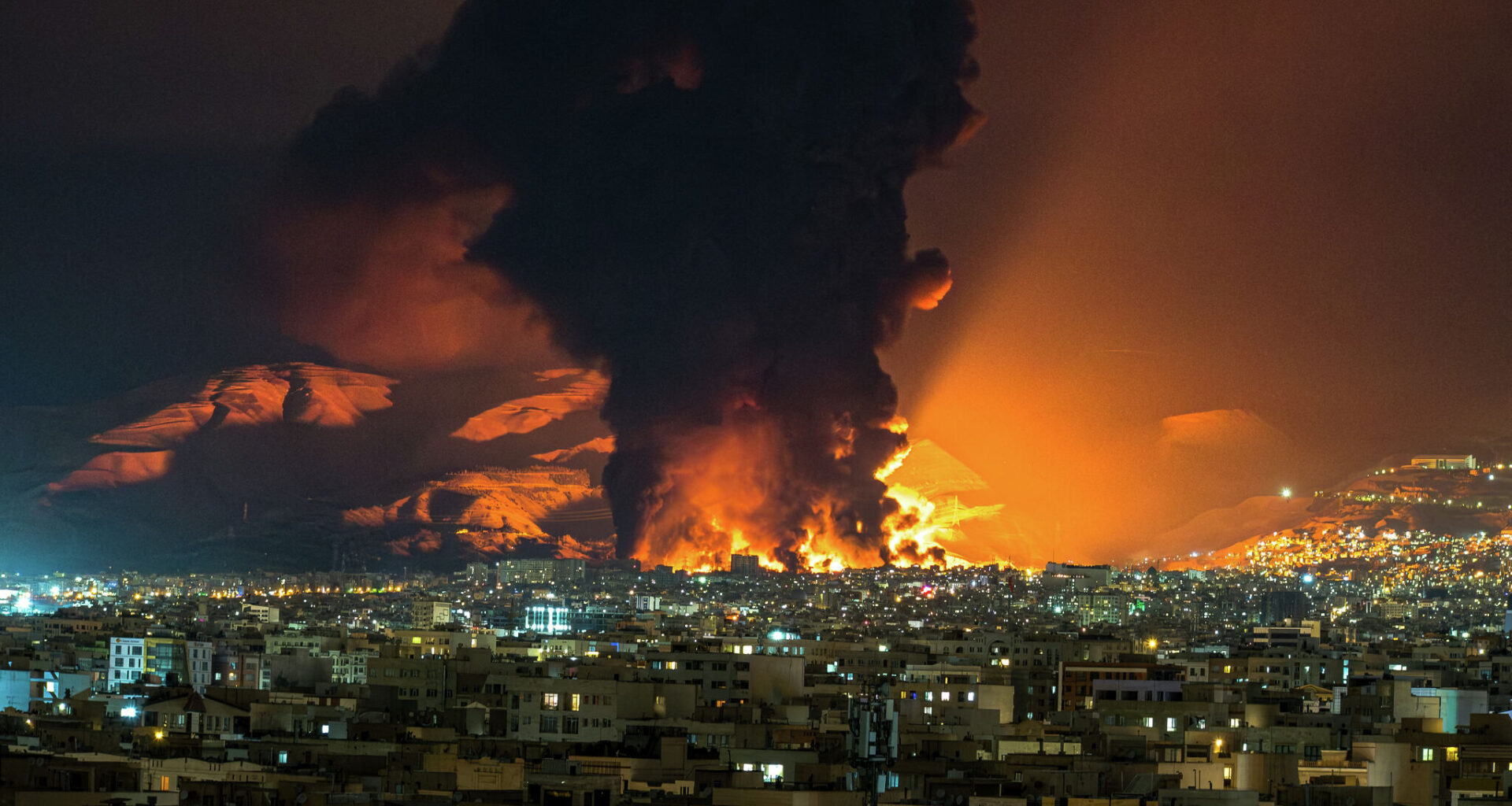
Smoke and flames rise at the site of airstrikes on an oil depot in Tehran on March 7, 2026. The United States and Israel launched strikes against Iran on February 28, prompting Iranian retaliation with missile attacks across the region and intensifying concerns about disruption to global energy and transport. (Photo by Sasan / Middle East Images / AFP via Getty Images)
SASAN/Middle East Images/AFP via Getty
Just over a week after the opening strikes, the U.S.-Israeli war against Iran has moved well beyond a limited military operation.

Iran has kept up retaliatory missile and drone attacks across the region. Oil briefly surged near $120 a barrel Monday, Wall Street slipped, and Iran’s ruling establishment elevated Mojtaba Khamenei, the son of the slain Ayatollah Ali Khamenei, as the country’s new supreme leader.
Article continues below this ad
And in Texas, Gov. Greg Abbott said the state would increase patrols and surveillance at energy sites, ports, the border and downtown Austin, especially after the March 1 shooting in Austin, which the FBI said showed a potential nexus to terrorism as investigators examined whether it was tied to the strikes on Iran.
How did the U.S.-Iran war start?
The war began early Feb. 28, when the United States and Israel launched coordinated strikes inside Iran. A Pentagon fact sheet said Operation Epic Fury started at 1:15 a.m. Feb. 28 and in its first 72 hours targeted command-and-control centers, Islamic Revolutionary Guard Corps headquarters, air defenses, ballistic missile sites, naval assets and military communications. The opening barrage killed Ali Khamenei and other senior Iranian officials.
AT SEA, UNSPECIFIED – MARCH 1: In this U.S. Navy released handout, Arleigh Burke-class guided-missile destroyer USS Thomas Hudner (DDG 116) fires a Tomahawk land attack missile in support of Operation Epic Fury, on March 1, 2026 at Sea. Iran’s Supreme Leader, Ayatollah Ali Khamenei, was confirmed killed after the United States and Israel launched a joint attack on Iran on February 28. Iran retaliated by firing waves of missiles and drones at Israel, and targeting U.S. allies in the region. (Photo by U.S. Navy via Getty Images)
U.S. Navy/Getty Images
On paper, the administration’s stated goals sound narrow: stop Iran from developing a nuclear weapon and cripple the missile and military capabilities that could threaten the U.S., Israel and other allies. President Donald Trump and Defense Secretary Pete Hegseth publicly framed the war around Iran’s nuclear and ballistic-missile programs, and Hegseth later said the Pentagon was focused on destroying Iran’s offensive missiles, missile production and navy while ensuring Tehran could not obtain a nuclear weapon.
Article continues below this ad
But that political message has shifted. Trump initially called on Iranians to “take over” their government, later said the U.S. should help decide who leads Iran next, and on Sunday said ending the war would be a “mutual” decision made with Israeli Prime Minister Benjamin Netanyahu.
Can Trump start a war without Congress?
Legal experts have raised concerns that the campaign is testing the extent of presidential war powers because Congress has not declared war. The War Powers Resolution generally requires either authorization or a response to an actual attack on the United States or its forces.
Article continues below this ad
WASHINGTON DC, USA – MARCH 02: (—-EDITORIAL USE ONLY â” MANDATORY CREDIT – ‘THE WHITE HOUSE’S X ACCOUNT / HANDOUT’ – NO MARKETING NO ADVERTISING CAMPAIGNS – DISTRIBUTED AS A SERVICE TO CLIENTS—-) U.S. President Donald J. Trump sits at a table monitoring military operations during Operation Epic Fury against Iran, with U.S. flags visible behind him, in Washington, United States, on March 02, 2026. (Photo by The White House via X Account/Anadolu via Getty Images)
Anadolu/Anadolu via Getty Images
The Senate still voted 53-47 to block a bipartisan effort to limit Trump’s authority, even as Pentagon briefers told Congress there was no intelligence that Iran was about to attack U.S. forces first.
How is Iran responding to the attacks?
Iran’s response has been to widen the battlefield. Tehran has fired at Israel and at Gulf states that host U.S. bases, while Turkey said Monday that NATO air defenses shot down a second Iranian ballistic missile that entered Turkish airspace in less than a week. Ankara did not invoke NATO’s Article 4.
Article continues below this ad
On Monday, Saudi Arabia, Iraq, Kuwait, Qatar and the United Arab Emirates had all cut or halted some output as shipping traffic seized up and the war disrupted the region’s energy system
TEHRAN, IRAN – MARCH 8: Plumes of smoke rise over the oil depot tanks hit by joint Israel-U.S. over night in a station north west of the capital on March 8, 2026 in Tehran, Iran. The United States and Israel continued their joint attack on Iran that began on February 28. Iran retaliated by firing waves of missiles and drones at Israel, and targeting U.S. allies in the region. (Photo by Kaveh Kazemi/Getty Images)
Kaveh Kazemi/Getty Images
The conflict is also spilling into Lebanon. UNICEF reported Monday that nearly 700,000 people have been displaced there, including about 200,000 children, as Israel’s campaign against Hezbollah intensifies.
Lebanese authorities say more than 400 people have been killed, including at least 83 children, while Reuters’ regional death tally says seven U.S. service members have been killed since the war began.
Article continues below this ad
How have Texas leaders responded?
Texas officials reacted largely along party lines after the strikes, with leading Republicans including Abbott, Sen. John Cornyn and Sen. Ted Cruz backing Trump’s decision, while some Texas Democrats argued the president had acted without congressional authorization. Abbott also moved to cast the war as a Texas security issue, saying he had ordered increased patrols and surveillance at key sites across the state.
AUSTIN, TEXAS – DECEMBER 8: Texas Governor Greg Abbott speaks at a press conference at the Governor’s Mansion on Monday, Dec. 8, 2025 in Austin. Governor Abbott and Lieutenant Governor Patrick announced a new effort to encourage the increase of the number of Turning Point USA chapters in Texas schools. (Photo by Aaron E. Martinez/The Austin American-Statesman via Getty Images)
Austin American-Statesman/Hearst/The Austin American-Statesman vi
Texas stands with President Trump in sending a clear message to Iran: its aggression toward America and the West will no longer be tolerated,” Abbott said. “These joint operations with our allies in the Middle East are a clear demonstration of American resolve to neutralize threats from rogue regimes that endanger our troops, our allies, and global stability.”
Article continues below this ad
After the March 1 shooting in downtown Austin, Abbott said he had activated Operation Fury Shield, increasing patrols at energy facilities, ports, the border and Austin’s Sixth Street district, and added cybersecurity staff and unmanned aerial surveillance to protect critical infrastructure. The FBI said that the attack remained under investigation, and while they are examining possible terrorism and Iran-related motives, they said it was too early to draw firm conclusions.
Who is Iran’s new leader and why does it matter?
Iran’s decision to elevate Mojtaba Khamenei points to continuity rather than compromise.
He is a hard-line cleric with close ties to the Revolutionary Guards, the force that sits at the center of Iran’s military and political system.
Article continues below this ad
Trump has at times framed the war as more than a military campaign, including by urging Iranians to “take back” their country. But outside strikes alone are unlikely to bring down Iran’s government.
The Council on Foreign Relations says the Islamic Revolutionary Guard Corps is deeply tied not only to Iran’s military, but also to major parts of the country’s economy, including construction, banking, shipping and oil-related businesses. That reach gives the force influence across much of Iran’s power structure, making the state harder to quickly destabilize through airstrikes alone.
Why are oil and gas prices suddenly rising?
The fastest way to understand why the war is shaking global markets is to look at the Strait of Hormuz.
Article continues below this ad
A person fills up their car at a gas station in Montreal on Thursday.
Christopher Katsarov/AP
The U.S. Energy Information Administration says about 20 million barrels a day moved through the strait in 2024, equal to about 20% of global petroleum liquids consumption, and roughly one-fifth of global liquid natural gas trade also passed through it. Reuters reported Monday that traffic into and out of the Gulf was at an almost complete standstill and that hundreds of tankers were sitting idle near Hormuz.
That bottleneck is already hitting consumers. Brent crude, a global benchmark for oil prices, briefly climbed above $119 a barrel Monday before easing. AAA listed the national average for regular gasoline at $3.478 on March 9, up from $2.997 a week earlier — something reflected in the rising gas prices in Austin and across Texas.
G7 finance ministers discussed whether to release emergency oil reserves, but had not done so as of Monday, and the IEA said member countries hold more than 1.2 billion barrels of public emergency stocks plus another 600 million barrels held by industry under government obligation.
Article continues below this ad
Did the strikes actually stop Iran’s nuclear program?
The nuclear question, meanwhile, is still unresolved. Before this latest war, the International Atomic Energy Agency estimated Iran had 440.9 kilograms of uranium enriched up to 60% purity, enough, if enriched further, for about 10 nuclear weapons by the agency’s yardstick, according to Reuters.
TEHRAN, IRAN – MARCH 8: Plumes of smoke rise over the oil depot tanks hit by joint Israel-U.S. over night in a station north west of the capital on March 8, 2026 in Tehran, Iran. The United States and Israel continued their joint attack on Iran that began on February 28. Iran retaliated by firing waves of missiles and drones at Israel, and targeting U.S. allies in the region. (Photo by Kaveh Kazemi/Getty Images)
Kaveh Kazemi/Getty Images
The IAEA has still not been allowed into the most sensitive bombed sites and that a large stock of near-weapons-grade uranium remains unaccounted for, including material believed stored at an Isfahan tunnel complex.
Article continues below this ad
What happened in the Minab school strike?
One of the clearest flashpoints of the war has been the Feb. 28 strike on the Shajareh Tayyebeh girls’ primary school in Minab, in southern Iran. Iran’s ambassador to the United Nations in Geneva said the strike killed 150 students, while U.N. experts later cited reports that more than 160 children were killed.
In recent days, Reuters reported that a U.S. military investigation is leaning toward a preliminary assessment that American forces were likely responsible, even though officials said the inquiry is not complete and new evidence could still point elsewhere. Reuters reported that the school sits next to a compound operated by the Islamic Revolutionary Guard Corps.
Newly circulated footage, first analyzed by the investigative group Bellingcat, appeared to show a Tomahawk cruise missile striking a nearby compound, and Tomahawks are only known to be in U.S. hands in this war.
Article continues below this ad
Secretary of State Marco Rubio and Defense Secretary Pete Hegseth have both said the United States does not deliberately target schools and is investigating the incident.
How could this war end?
Trump says the end of the war will be decided with Netanyahu, Iran has put a hard-liner at the top of its system, and the conflict is already touching NATO territory, Gulf energy infrastructure and global inflation fears.
Article continues below this ad
Even if direct fighting eased soon, damaged facilities, disrupted logistics and shipping risk could keep fuel markets distorted for weeks or months.