
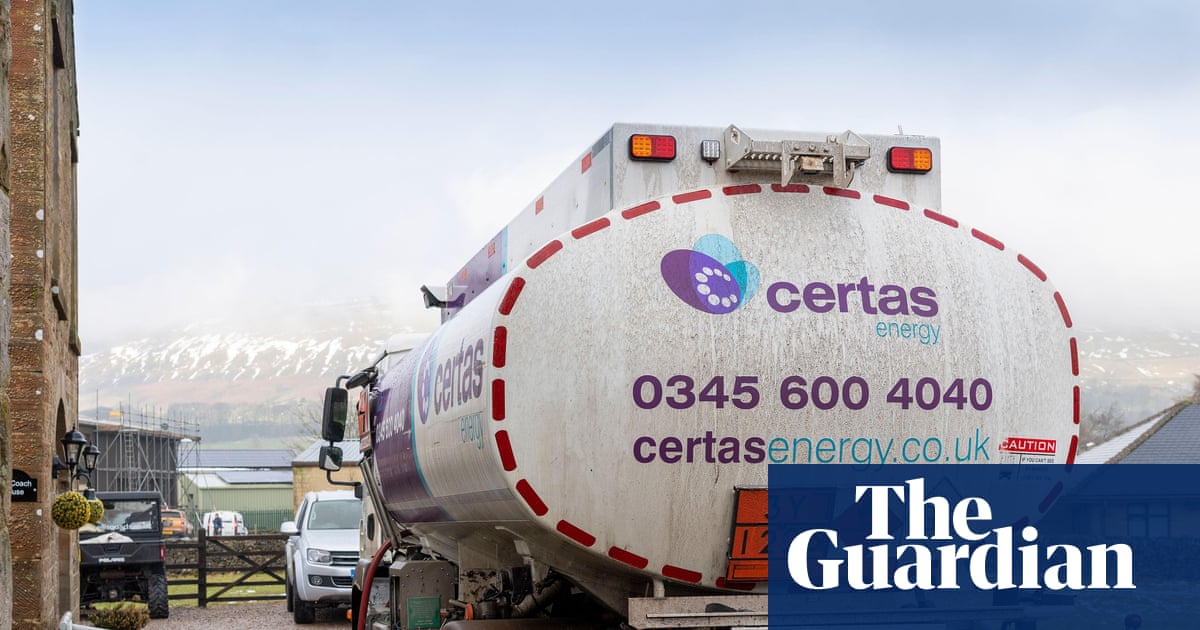
Rural households that rely on heating oil to warm their homes and provide hot water are facing a “sudden and frightening” surge in their bills, with prices almost trebling since the start of the Iran war.
The cost of heating oil is not covered by Ofgem’s energy price cap and varies between suppliers. In examples seen by the Guardian, customers who were typically paying 62p a litre before the war are now being quoted about £1.73.
The prospect of government help was raised when the chancellor, Rachel Reeves, told parliament she recognised households that used heating oil faced “unique challenges”. She said officials would meet rural and Northern Ireland’s MPs on Wednesday to explore “further action”.
Across the UK, an estimated 1.7m households rely on heating oil, and in Northern Ireland it is the primary heating source for two-thirds of households. It is typically a form of kerosene so prices are linked to the cost of jet fuel.
As wholesale prices have risen, some customers have had orders cancelled, leaving them to try to rebuy at a higher price. Others have struggled to find suppliers willing to deliver to them.
Emma Simpson, the chief executive of Rural Action Derbyshire, a charity that runs an oil-buying scheme, said its supplier was limiting orders to 500 litres a household because of the volatility. Usually that is the minimum order people can place.
She said: “People who rely on heating oil are facing a sudden and frightening surge in cost. We may be heading into spring, but anyone running low on oil right now doesn’t have the luxury of waiting for prices to fall.
“For some, the decision to order or not will come down to whether they can realistically afford it, and that is a really hard position to be in.”
Simpson said panic buying was adding to the pressure on prices, which would usually be starting to drop as the warmer months approached.
One woman in Hampshire said she had attempted to get a quote for 1,000 litres of oil via the online broker BoilerJuice, but had been told that because of high demand it could not give her a quote.
She used to fill up the tank every summer but had moved to be part of a syndicate and was due to place an order soon. The syndicate wrote this week to members saying its supplier was not taking bulk orders.
“I’m watching the level very carefully,” she said. “I don’t want to run out – I’m not sure that we’d be able to get someone to come in the next 24 hours if we did.”
Another heating oil user, Jo Teather, said the cost of buying 500 litres to be delivered to her home in Cornwall had gone up from about £340 at the start of last week to £858.
Since a similar hike four years ago after Russia’s invasion of Ukraine, Teather has kept watch on prices and a fund so she could move quickly if they started to rise again. She placed an order the day after the US and Israel began airstrikes on Iran.
“It went up to over £1,000 for 500 litres after Ukraine,” Teather said. “Last Sunday I thought: ‘I’m just going to buy it now’… I’m so glad we bought when we did.”
Some BoilerJuice customers have posted on the Trustpilot website saying their orders have been cancelled.
Under their comments, the company has apologised, saying: “We’re currently seeing a higher-than-usual number of cancellations from our suppliers, and we’re truly sorry your order was one of them. We’re working closely with all our delivery partners to improve communication and ensure that any cancellations or changes are communicated to customers as quickly as possible.”
UKIFDA, a trade body for distributors, said prices were being driven up by the high price of jet fuel in Europe. It said suppliers bought fuel “almost daily” so rises were quickly being reflected in what customers were paying.
The Competition and Markets Authority has told suppliers they must treat customers fairly. Emma Cochrane, the acting executive director for consumer protection at the regulator, said: “Generally, we would expect that customers who have placed orders for heating oil should receive it at the agreed price. Suppliers should be clear what they are charging and terms must be fair.
“We won’t hesitate to take action if we suspect that consumer or competition law is being broken.”