
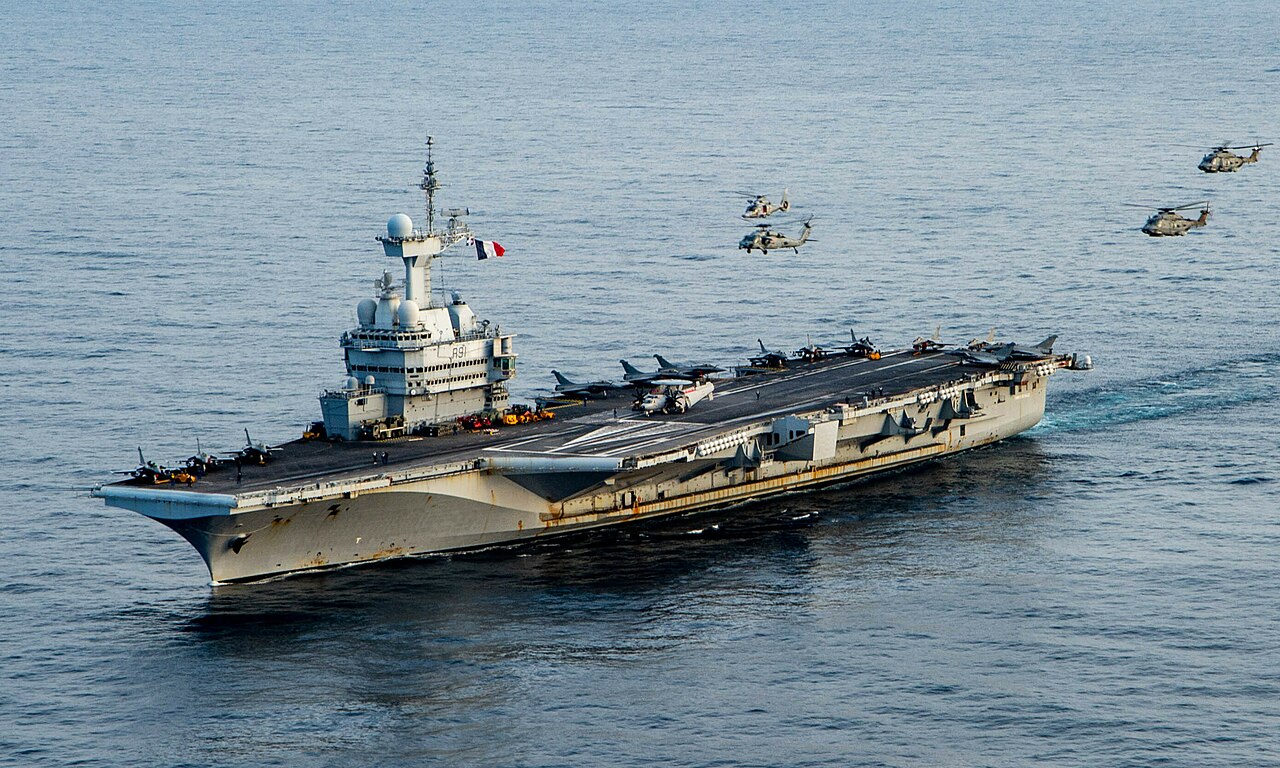
France’s nuclear-powered aircraft carrier Charles de Gaulle has been deployed to the eastern Mediterranean as part of a wider French naval response to rising tensions linked to the conflict involving Iran.
The carrier and its accompanying strike group were directed south after the situation in the Middle East escalated, with Paris seeking to reinforce European security and contribute to the protection of maritime traffic in the region. The deployment forms part of a wider French naval presence that includes additional frigates and support vessels operating across the Mediterranean and Red Sea. France has also indicated that naval forces may support efforts to safeguard commercial shipping routes if the situation deteriorates further.
French President Emmanuel Macron said the naval deployments are intended to help maintain maritime security and stability as tensions have increased across the region. The move followed growing concern about threats to shipping and regional infrastructure, including a recent drone strike on Cyprus which prompted European governments to review security arrangements in the eastern Mediterranean.
Operating from international waters, the carrier provides France with the ability to deploy combat aircraft and surveillance assets without relying on land bases. Aircraft embarked on the ship can conduct air defence patrols, reconnaissance missions and strike operations while supporting allied naval forces in the area.
Commissioned in 2001, Charles de Gaulle is the flagship of the French Navy and the only nuclear-powered aircraft carrier in service outside the United States Navy. The vessel measures around 261 metres in length and displaces roughly 42,000 tonnes at full load. Nuclear propulsion allows the ship to operate for extended periods without refuelling, giving it significant endurance and operational reach.
The carrier can embark an air wing of up to around 40 aircraft, typically centred on Rafale M multirole fighter jets supported by E-2C Hawkeye airborne early warning aircraft and naval helicopters. The ship uses a catapult-assisted take-off and arrested recovery (CATOBAR) system with steam catapults and arrestor wires, allowing conventional fixed-wing aircraft to operate from the flight deck.
Defensively, the carrier is equipped with Aster 15 surface-to-air missiles, Mistral short-range missile systems and close-in guns designed to counter aircraft and missile threats. Sensors and electronic warfare systems provide air search and tracking capabilities as part of a layered defensive network alongside the ship’s escorts.
Like most aircraft carriers, the vessel normally operates as the centrepiece of a wider carrier strike group. This typically includes air defence and anti-submarine frigates, a nuclear-powered attack submarine and support ships, forming a task group capable of sustained maritime and air operations.