
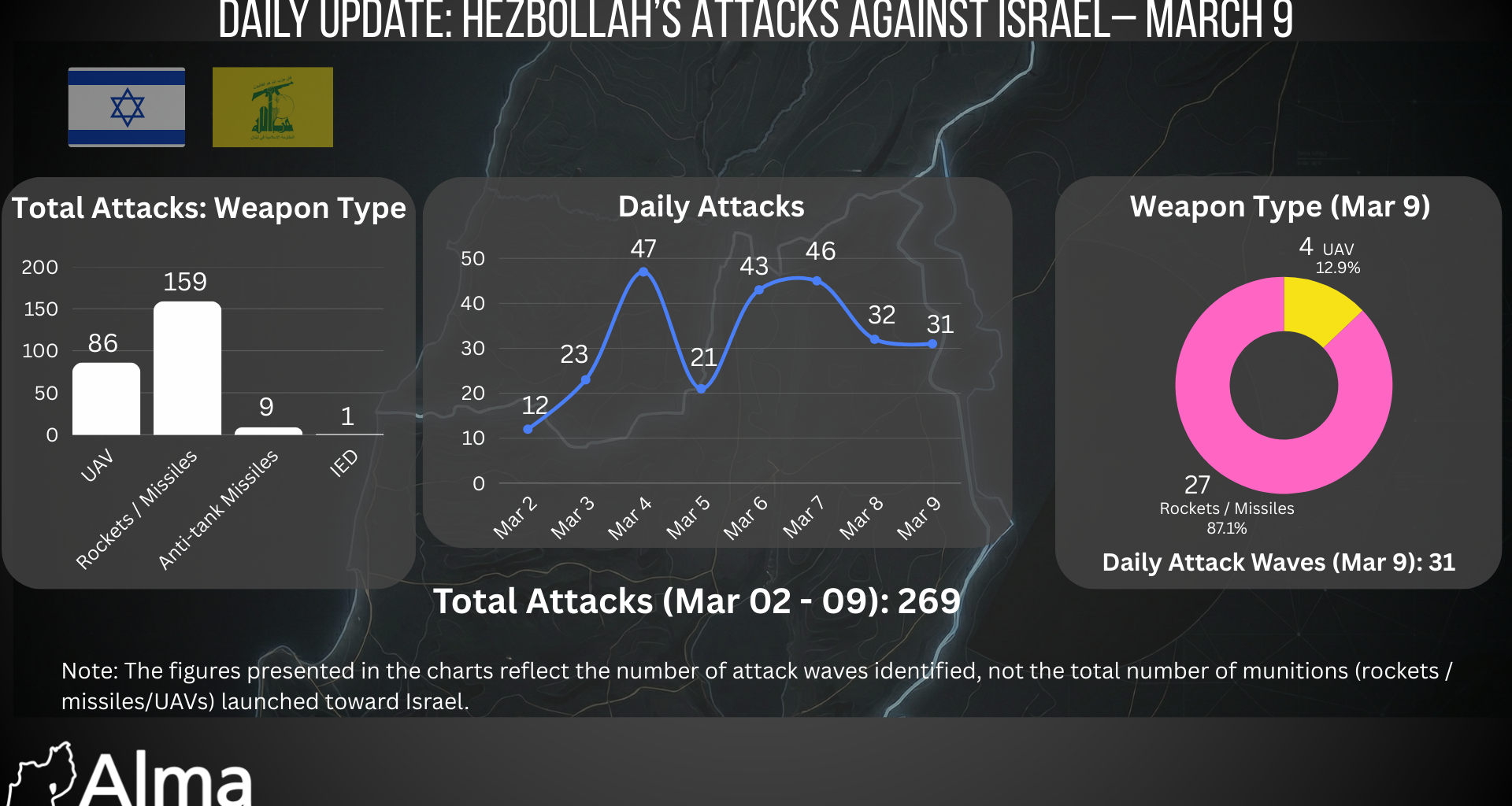
During March 9, Hezbollah carried out 31 attack waves against Israel, making significant use of rockets, missiles, and UAVs. The prominent trend on March 9 was the extensive use of rocket weaponry, with 27 of the waves (87.1%) carried out using rockets and missiles, while the number of attack waves involving unmanned aerial vehicles was relatively low—only 4 (12.9%). Examining the daily trend, it appears that after several days of fluctuations in the scope of attacks, Hezbollah’s level of activity stabilized on March 8 and 9 at approximately 30 attack waves per day. Hezbollah has focused its attacks mainly on northern Israel, particularly border communities, the Galilee, and the Haifa area. However, on March 9, launches were also carried out toward the Tel Aviv region, in which a long-range Fateh-110 missile (with a range of up to 350 km and carrying approximately half a ton of explosives) was apparently used and equipped with precision capability. One of the impacts occurred in Ramla, where a kindergarten was hit. According to Hezbollah’s claim, the fire was directed at military bases, but in practice one of the impacts occurred in a civilian area. Since Hezbollah joined the war (March 2), it has carried out a total of 269 attack waves toward Israeli territory. The primary weapon used by Hezbollah has been rockets and missiles, accounting for 159 attack waves, alongside 86 attacks using UAVs, 9 attacks using anti-tank missiles, and one incident involving the use of an explosive device (based on Hezbollah’s own publications).
