
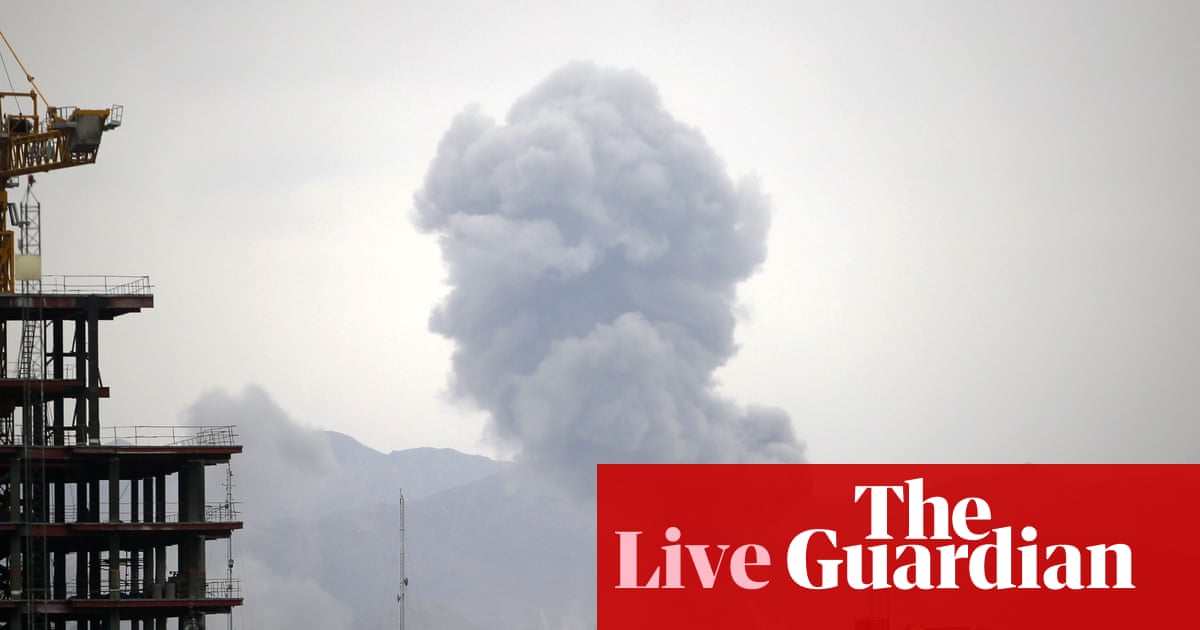
Hegseth says today will be the ‘most intense day of strikes’ in war against Iran as US intensifies attacks
Hegseth adds that today will be “the most intense day of strikes”, while Iran has fired its lowest number of weapons in the past 24 hours.
General Dan Caine opens his remarks by paying tribute to the American servicemen who have died as a result of Trump’s war on Iran.
Updating on the progress in the conflict, he says the joint force remains focussed on its three main objectives – destroying missiles and drone capability before it can threaten American interests, strike and degrade the Iranian navy and prevent the regime from being able to attack the US and its partners “for years to come”.
Caine adds:
double quotation markBallistic missile attacks continue to trend downwards, down 90% from when we started.
He adds that the US is striking Iranian mine-laying missiles. The general says “this is gritty and tireless work” and expresses his pride in the performance of the joint force throughout the campaign.
Updated at 08.40 EDT
Key events
Show key events only
Please turn on JavaScript to use this feature
Denmark and the Netherlands announced Tuesday that they are relocating their respective embassy staff in Tehran to Azerbaijan.
The move follows Spain, Austria and Italy, which are among the countries to have temporarily closed and relocate their embassies to Baku in recent days as the US-Israel war on Iran continues.
“Due to the growing security risks for our employees, it has been decided to temporarily transfer the activities of the Dutch embassy in Iran to Baku, Azerbaijan,” Dutch foreign minister Tom Berendsen said on X.
“If the security situation allows, we will decide when and in what form our embassy in Iran can resume its activities in Tehran,” he added.
Iran’s intelligence ministry announced on Tuesday the arrests of 30 people accused of spying, including one foreigner, on the 11th day of the Middle East war.
The foreigner, whose nationality was not revealed, “was spying on behalf of two Persian Gulf countries in the name of the American-Zionist enemy” and was arrested in northeastern Iran, the ministry said in a statement published by the judiciary’s Mizan Online news portal.
Share Hannah Ellis-Petersen
On Tuesday, the United Arab Emirates reported intercepting another eight missiles and 26 drones over their territory as Iran continued its barrage of the Gulf state. But as the war dragged into its eleventh day, life in the UAE’s biggest and flashiest city of Dubai had mostly returned to normal.
Though emptied of thousands of tourists who initially fled in fear, people still flocked to the beaches, malls and rooftop bars in their droves. Commercial flights also restarted as the country’s airspace tentatively reopened, even as UAE’s leaders condemned the ongoing “blatant Iranian aggression”.
Many of the 4 million residents of the desert metropolis appeared quite unphased by the ongoing conflict, deeming it low risk to their lives. So far, six people across the UAE have died from falling missile debris, but the country’s defence systems have mostly proved effective and there’s been no substantial damage to Dubai’s lofty skyline.
“They say it’s a war but it’s caused no problem for us, we don’t really see it at all,” said Nader Farid, 30, who moved from Egypt to Dubai five months ago to work in real estate, as he sat on the beach.
“The first day was scary when they warned about incoming missiles. But now it’s been more than a week and life here just goes on, only business is a bit slower. I’m from Egypt, I know that nowhere is safe from war. But this one does not feel bad. We are very protected here.”
Stranded holidaymakers such as Trish Patton, 62, from Glasgow, said she and her partner had been stuck in Dubai for nine days waiting for a flight home. They had been due to fly back the day the war broke out.
“It’s been very surreal and very scary at times,” she said. “Especially when we got the alerts on our phones, saying there may be missiles in your area, it’s pretty terrifying. On the first day it started, there were three drones right above us and we heard the explosions of them being shot down.”
After a week of trying, the couple finally had a flight back to Glasgow on Wednesday. “I’m happy to have survived and I’ll be even happier to be home,” said Patton. “I hope for everyone’s sake this war is over soon.”
Here are some images coming out of Lebanon today:
Smoke rises after an Israeli strike on Beirut’s southern suburbs in Lebanon on 10 March 2026. Photograph: Mohamed Azakir/ReutersDisplaced women who fled Israeli strikes in southern Lebanon look through a classroom window at a school turned into a shelter in Beirut, Lebanon on 10 March 2026. Photograph: Hussein Malla/APA displaced child, Hussein, 5, sits on a chair at a school hosting displaced people in Beirut, Lebanon on 10 March 2026. Photograph: Raghed Waked/ReutersA displaced woman shelters in a stadium in Beirut, Lebanon on 10 March 2026. Photograph: Claudia Greco/ReutersA bulldozer removes the wreckage of a destroyed building that was hit by an Israeli airstrike in Dahiyeh, Beirut’s southern suburbs, Lebanon on 10 March 2026. Photograph: Hussein Malla/APShareIran accuses US and Israel of ‘manifest environmental crime’ Damien Gayle
Iran has appealed to the UN to condemn the US and Israel for a “manifest environmental crime” over the bombing of fuel storage facilities in Tehran and other cities over the weekend.
The attacks led to the falling of acid rain across Tehran, as well as the spreading of clouds of smoke so thick they blocked out the sun and caused respiratory problems and skin irritation to residents.
Residents look on and take pictures as flames and smoke rise from an oil storage facility struck as attacks hit the city during the U.S.–Israeli military campaign in Tehran, Iran on 07 March 2026. Photograph: Alireza Sotakbar/AP
In a letter passed Monday to senior officials at the UN, including secretary general Antonio Guterres, Saeed Iravani, Iran’s UN ambassador, said the explosions had “released large quantities of hazardous compounds including hydrocarbons, sulphur, and nitrogen oxides” creating “severe air pollution and serious health risks”. Subsequent rainfall led to the “dispersion and deposition of these pollutants through highly acidic precipitation”.
“Such developments may result in severe respiratory harm to the population and extensive environmental degradation, including the contamination of water resources and damage to ecosystems and living organisms.”
In response, all medical in Tehran province had been placed on high alert, while Iran’s environment department had advised residents to remain indoors, Iravani said.
“These attacks constitute a clear violation of international obligations arising under multilateral environmental agreements, including the United Nations Framework Convention on Climate Change and the Convention on Biological Diversity, which underscore States’ responsibility to protect the global environment and to refrain from actions that may cause widespread environmental harm.
“The Government of the Islamic Republic of Iran calls upon the United Nations and its relevant bodies to urgently address these developments and to undertake appropriate measures, including condemning environmentally destructive acts and pursuing accountability for those responsible for this manifest environmental crime.”
The Israeli military have launched a warning strike on Beirut’s southern suburbs in Lebanon, the state-run National News Agency reports.
The strike comes after the Israeli military warned that it will be targeting Hezbollah infrastructure in the area of Tyre and Sidon on the western coast of southern Lebanon, and that it would be operating in the area south of the Litani river, about 74 kilometres (46 miles) south of the capital. The IDF reiterated its earlier evacuation orders and urged those in the area to leave.
ShareUNHCR: More than 100,000 displaced in one day in Lebanon
More than 100,000 people in Lebanon have registered as displaced on the government platform in the past day, the United Nations High Commissioner for Refugees said Tuesday.
More than 667,000 people total have registered as displaced since the country was pulled into the US-Israeli war on Iran when the Iran-backed Hezbollah launched missiles into Israel and the Israeli military struck back, the UNHCR said.
“During a visit yesterday to a shelter in Beirut, I met a woman in her 90s who had lost 11 members of her family during the 2024 attacks,” Karolina Lindholm Billing, the UNHCR representative in Lebanon, said in a statement. “She is now displaced again, staying in the same school that was turned into a shelter. Stories like hers illustrate the fear, uncertainty and repeated trauma families are facing.”
The airstrikes have resulted in urgent movement into Syria, Lindholm Billing said, with Syrian authorities reporting that more than 78,000 Syrians have entered Syria from Lebanon since the airstrikes began, some of whom were Syrian refugees who ha planned on returning in the coming months but were forced to do so soon because of the conflict. More than 7,700 Lebanese joined them in entering Syria, Lindholm Billin said.
The United Arab Emirates’ air defences intercepted eight missiles and 26 drones on Tuesday, the UAE defence ministry said on X. A ninth missile fell into the sea while nine more drones fell into the country’s territory.
In total, UAE air defences have identified 262 ballistic missiles, eight cruise missiles and 1,475 drones heading toward UAE territory, the UAE defence ministry said.
These attacks killed six people and injured 122.
ShareThe day so far
US defence secretary Pete Hegseth said attacks on Iran will ramp up Tuesday with the heaviest strikes since Washington launched the war 10 days ago. “Today will be yet again our most intense day of strikes inside Iran,” Hegseth told a news conference at the Pentagon.
Israel’s military announced it had begun a fresh wave of attacks on Tehran as it reiterated evacuation orders for parts of southern Lebanon, where Israel has extended its campaign against the Iran-backed militia Hezbollah.
Meanwhile, Iran launched new attacks at Gulf countries on Tuesday. Incoming missile sirens sounded early in the morning in Dubai in the United Arab Emirates and in Bahrain, and Saudi Arabia said it had destroyed two drones. Kuwait’s National Guard said it had shot down six drones.
Iran’s Revolutionary Guards said they would not allow “one litre of oil” to be shipped from the Middle East if US-Israeli attacks continued. Trump responded by saying the US would hit Iran “20 times harder” if it blocked tanker traffic through the strait of Hormuz, which handles a fifth of the world’s oil supply.
But oil prices fell and stocks rebounded after US president Donald Trump said the war with Iran would end “very soon’. On Monday, the US president also suggested that while he was not yet declaring the US mission accomplished, the war was “very complete, pretty much”. “We’ve already won in many ways, but we haven’t won enough,” he said.
Trump also said that the US would waive oil-related sanctions on “some countries” to ease the shortage, after speaking with Russian president Vladimir Putin.
On Tuesday, Trump told Fox News that it’s possible that his administration could begin peace talks with Iran once again but it depends on the terms – and he noted that he “sort of” doesn’t need to talk to them anymore. Meanwhile, Abbas Araghchi, Iran’s foreign minister, told PBS News Hour in an interview aired Monday that “I don’t think the question of talking with Americans or negotiation with Americans once again would be on the table, because we have a very bitter experience of talking with Americans”.
Updated at 08.54 EDT
An Israeli ground invasion of Lebanon would be a “tremendous” mistake, Spanish foreign minister Jose Manuel Albares warned on Tuesday.
Albares, who also said Madrid demanded Lebanese militia Hezbollah cease its rocket launches toward Israel, announced Spain would send humanitarian aid worth 9 million euros ($10.5 million) to Beirut.
Hegseth says the aftermath of the conflict is “going to be in America’s interests” and says it “will not live under a nuclear blackmail” from Iran.
It comes shortly after the defence secretary reiterated president Donald Trump’s claim that if Iran does anything to prevent the flow of oil in the strait of Hormuz, it will be hit “twenty times as hard”.
That concludes the press conference.
Asked what measures the Pentagon is taking to minimise loss of civilian life in Iran, Hegseth says “no nation takes more precautions to ensure there is never targeting of civilians than the USA”.
“Where things happen that need to be investigated, we will investigate,” he says. “Open-source is not the way to determine what did or did not happen.”
He goes on to paint Iran as a regime that targets civilians and says it has moved military infrastructure into civilian areas.
Asked about the Iranian government’s assertion that is is prepared for a “long war” and America’s ability to defend its personnel, Hegseth says the US is giving every possible resource to its troops on the frontline to ensure they are “properly defended”.
US defence secretary Pete Hegseth Photograph: ReutersShare
Updated at 08.34 EDT
Hegseth: Iran made a ‘big mistake’ targeting its neighbours
General Caine says US forces are able to move around with “relative impunity” but acknowledges “there is always a risk”.
Commenting on Iran’s attacks on fellow Gulf states, Hegseth says:
double quotation markBig mistake by the Iranian regime in attacking it’s neighbours, right away … flailing recklessly.
He says it demonstrates a miscalculation of the Iranian regime by pushing other countries into supporting the US campaign.
Hegseth says the new leader of Iran “would be wise to heed the words of our president not to pursue nuclear weapons”.
He was asked by a reporter if he can comment on the new supreme leader’s status amid reports he had been injured but Hegseth says he cannot talk about that.
“This is not endless, this is not protracted,” Hegseth says. “It’s not for me to posit whether it’s the beginning, middle or the end – that’s up to him [president Trump].”