
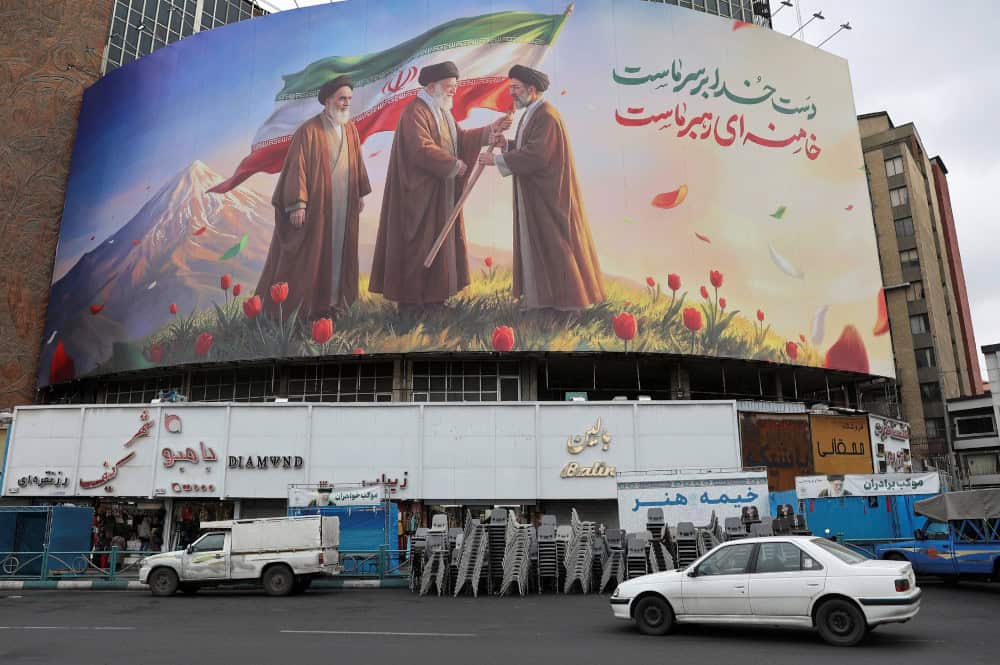
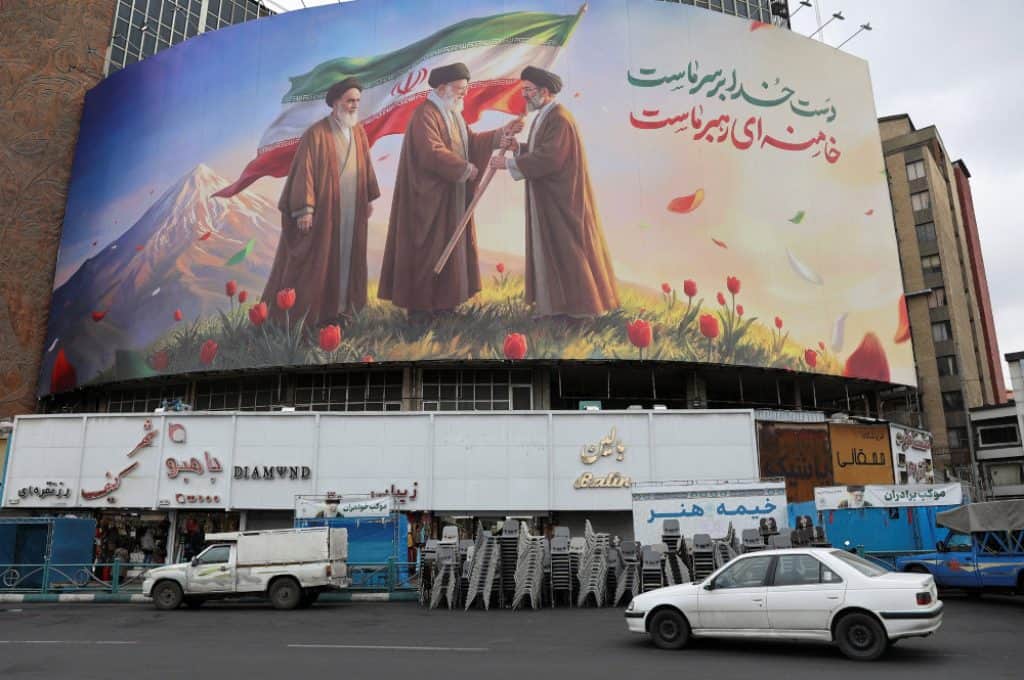
 An image posted by the IRGC-affiliated Tasnim news shows a banner in Tehran that depicts Mojtaba Khamenei, son of the former supreme leader, receiving the regime’s flag from his father with a caption reading, “God’s hand us above us, Khamenei is our leader.” Ruhollah Khomeini, the first supreme leader of Iran, is shown on the left.
On March 10, marking 10 days of Operation Epic Fury, US Central Command (CENTCOM) said that more than 5,000 targets in Iran have been struck, including command-and-control centers, Islamic Revolutionary Guard Corps (IRGC) headquarters, IRGC intelligence sites, integrated air defense systems, ballistic missile sites, Iranian naval ships and submarines, Iranian air defense systems, anti-ship missile sites, military communications capabilities, and ballistic missile and drone-manufacturing facilities.
CENTCOM’s update also highlighted the main categories of assets used in the operation, including strategic bombers and fighter aircraft, drones, intelligence and reconnaissance platforms, missile-defense systems, long-range rocket artillery, naval strike groups, electronic warfare systems, and aerial refueling and logistics aircraft.
Amid the chaos, the Islamic Republic selected Mojtaba Khamenei, the son of former Supreme Leader Ali Khamenei, to succeed his father as the country’s new supreme leader on March 8. A large banner displayed on a building in Tehran on March 10 depicts Ali Khamenei handing the Iranian flag to Mojtaba Khamenei while Ruhollah Khomeini, the first supreme leader of Iran, looks on.
While the regime installed a new leader, some of its officials are fleeing the region. Reuters reported on March 7 that more than 150 Iranian nationals, including diplomats and their families, were evacuated from Lebanon and flown to Russia on a Russian aircraft, according to a senior Lebanese security source.
Israel increases outreach to the people of Iran
On March 10, Israeli Prime Minister Benjamin Netanyahu addressed the people of Iran, saying that Israel is facilitating a “unique opportunity for you to overthrow the regime,” adding, “In the coming days, we [Israel] will create the conditions for you to take your destiny into your own hands.” The speech also reaffirmed that Jerusalem respects Iranian “territorial integrity,” hinting at a possible rejection of past claims about backing Kurdish separatists against the regime.
Israel’s Persian-language Foreign Ministry X account posted the phrase “We provide the conditions for you” on March 9, alongside an image showing a destroyed Iranian law enforcement building. The next day, the account posted a photo showing a strike on the Tehran Law Enforcement Special Units command center, writing that it had been the “operations room for repression in Tehran” and adding that a free Iran is within reach.
Tehran backpedals on regional strikes
Iran and its regional proxies launched drones toward Azerbaijan’s Nakhchivan exclave on March 5, fired missiles toward Turkey that were intercepted on March 4 and March 9, and sent Shahed-type drones toward Cyprus, which included a strike on the RAF Akrotiri base on March 1.
Despite the attacks, Iranian Foreign Ministry spokesman Esmail Baghaei said on March 9 that Tehran denies responsibility for missile and drone attacks on Turkey, Azerbaijan, and Cyprus, claiming that the incidents were false-flag operations.
Tehran has yet to deny any of its attacks against Persian Gulf states, however. Saudi-based Al Arabiya reported on March 9 that nearly 3,000 Iranian missiles and drones have been launched since the war began, targeting Saudi Arabia, Bahrain, Kuwait, and the United Arab Emirates, with many aimed at civilian infrastructure. The Gulf Cooperation Council has condemned the attacks, warning they threaten regional stability and calling on the international community to halt Tehran’s escalation.
The status and assassinations of regime officials
As the joint campaign has eliminated numerous Iranian military and political figures, questions remain about the whereabouts of Esmail Qaani, the head of the Islamic Revolutionary Guard Corps Qods Force (IRGC-QF). France 24 reported that unconfirmed rumors circulating in regional media claim that Qaani allegedly left a meeting shortly before an Israeli strike that killed several senior IRGC commanders, fueling speculation he could be an infiltrator working on behalf of Iran’s enemies. The outlet also noted that Qaani had previously faced suspicions within Iran’s security circles and emphasized that he has not appeared publicly since the bombing, leaving his status unclear.
The latest eliminations of regime officials include:
The Iranian press reported on March 10 that IRGC Colonel Majid Kashefi was killed by a US or Israeli airstrike.
Iranian state media reported on March 10 that Asadollah Badfar, the head of the Basij internal security force at the General Staff of the Armed Forces, was killed in a US or Israeli strike.
The Israeli Air Force killed Abolghasem Babaeian in Tehran on March 8, the head of the supreme leader’s military office and the chief of staff of Iran’s Khatam al Anbiya central command.
Mohammad Mehdi Farhadi Ramin, an Iranian cyber operative wanted by the FBI since 2020 for alleged cyber intrusions targeting US and foreign entities, was killed in Hamadan during joint US–Israeli strikes.
Latest kinetic developments
On March 10, strikes were reported in Tabriz and Kerman, two Iranian cities nearly 900 miles apart. Footage circulated online shows hits on an Intelligence Ministry office, police facilities, and IRGC sites in Tabriz, and smoke rising near Kerman’s airport and Law Enforcement Command headquarters.
Simultaneous strikes in Tehran and Tabriz targeted multiple regime security headquarters, the IDF said on March 10, including the Special Units command in Tabriz, an IRGC military complex in Tehran, a security unit responsible for ballistic missile launches and artillery fire, the Public Security and Intelligence Police headquarters in Maragheh Province, and a large Basij complex in Tabriz.
The IDF’s Persian-language account stated on March 9 that it continued deepening strikes on internal security and Basij infrastructure, including a provincial IRGC headquarters, the regime’s internal security command in Isfahan, another base used by the IRGC and Basij, and an IRGC police headquarters.
Additional strikes include:
Morteza Heydari, deputy governor of Qom Province, said that on March 8, buildings belonging to one of Qom’s seminaries were targeted in an attack.
A series of small explosions was seen along Shahran Boulevard in Tehran in the early hours of March 8, according to videos shared on social media. Residents claimed that the blasts may have resulted from gasoline spilling after a strike on the Shahran fuel depots.
Flames burning at the Shahran oil depot in Tehran were captured in close-range footage posted on social media on March 6.
Reports from residents indicate heavy strikes across Isfahan on March 9, including a reported hit on the IRGC-affiliated Amir al Momenin University in Sepahan Shahr. Explosions were also reported in Dowlatabad, Malek Shahr, Kaveh, Shahin Shahr, Zarrin Shahr, Mahmoudabad, and Najafabad, as well as near the Isfahan steel complex, Mobarakeh Steel, and various defense industry facilities.
Videos circulating on social media show a strike on the Law Enforcement Command building in Abdanan, Ilam Province, on March 8, a city that was an early center of protests and where several residents were reportedly killed by security forces during demonstrations.
Tehran regime’s internal repression intensifies
Iran’s Ministry of Intelligence claimed on March 10 that it had identified and arrested 30 alleged “spies and mercenaries” accused of communicating with the “enemy.” According to the regime, the individuals include one foreign national allegedly spying “on behalf of” the United States and Israel, and another suspect in Sistan and Baluchestan accused of sending information on military and police deployments and air defense sites to Iran’s adversaries.
Iranian media have largely stopped publishing images, videos, and reports of US and Israeli strikes across the country after the judiciary warned that sharing footage of impact sites could be treated as a criminal offense.
Ahmad-Reza Radan, Iran’s national police chief, warned citizens against protesting, stating that if people take to the streets, authorities will treat them the same way they treat “the enemy.” He added that security forces’ “hands are on the trigger,” an explicit threat of lethal force against demonstrators.
Video posted online on March 7 shows the commander of a local special anti-riot police unit in Tehran’s Tajrish area addressing his forces, referencing Khamenei’s death in the attacks and stating that the regime will not back down.
Footage circulating on social media on March 6 shows a convoy of regime forces moving along Shariati Street in Tehran, accompanied by armored vehicles and loudspeakers broadcasting government messages, as citizens report nighttime patrols meant to intimidate residents.