
In an 1100-word piece weighing the energy shock Trump’s illegal war on Iran has caused in terms of White House worries (and so implicitly, politics), Politico grants anonymity to someone describing what is happening to the oil market as “little gyrations.”
A former Trump administration official added that the administration needs a “consistent, multiweek read” of oil prices before it shifts its approach.
“These temporary little gyrations are not what they’re going to be basing their policy on,” the official said. [my emphasis]
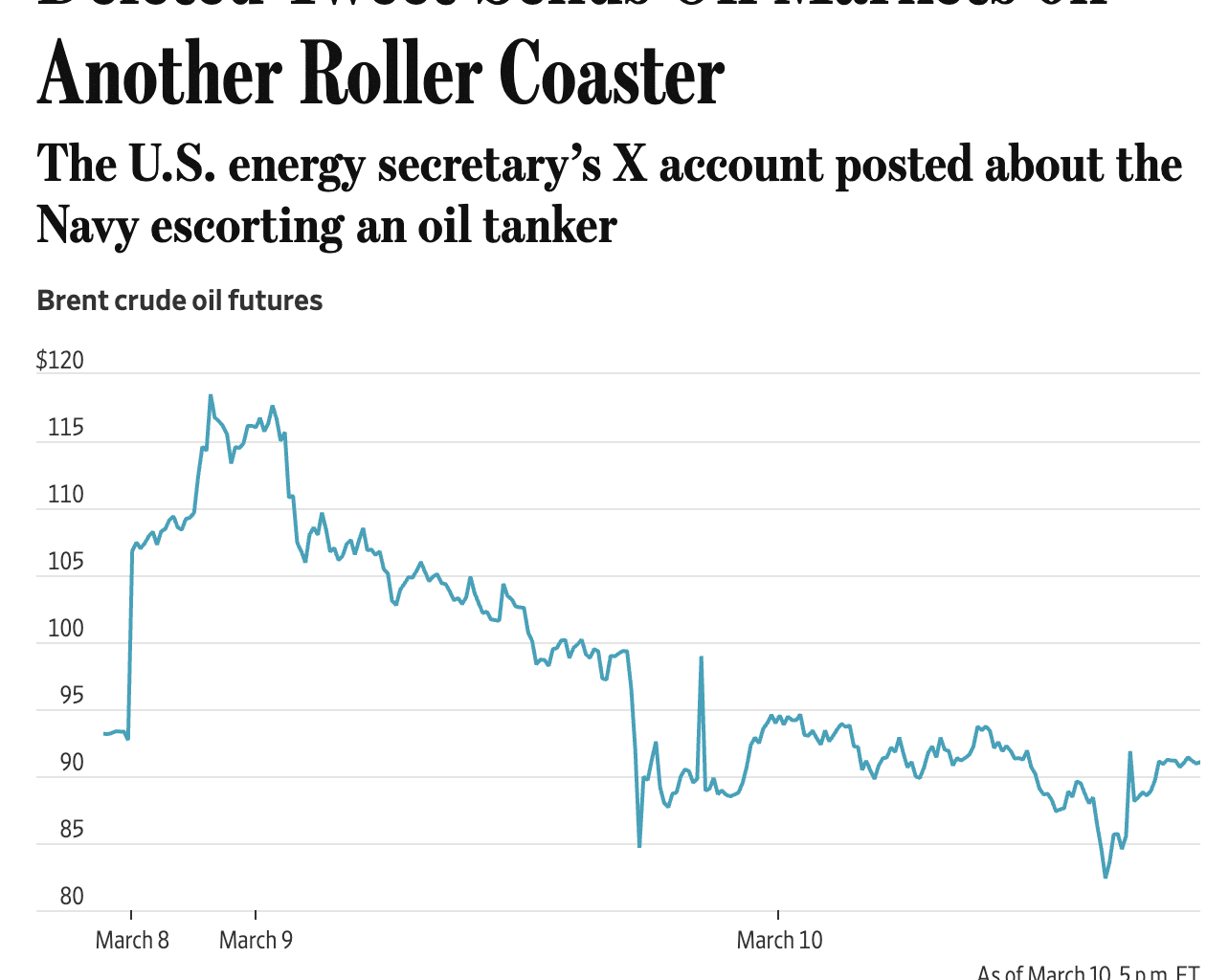
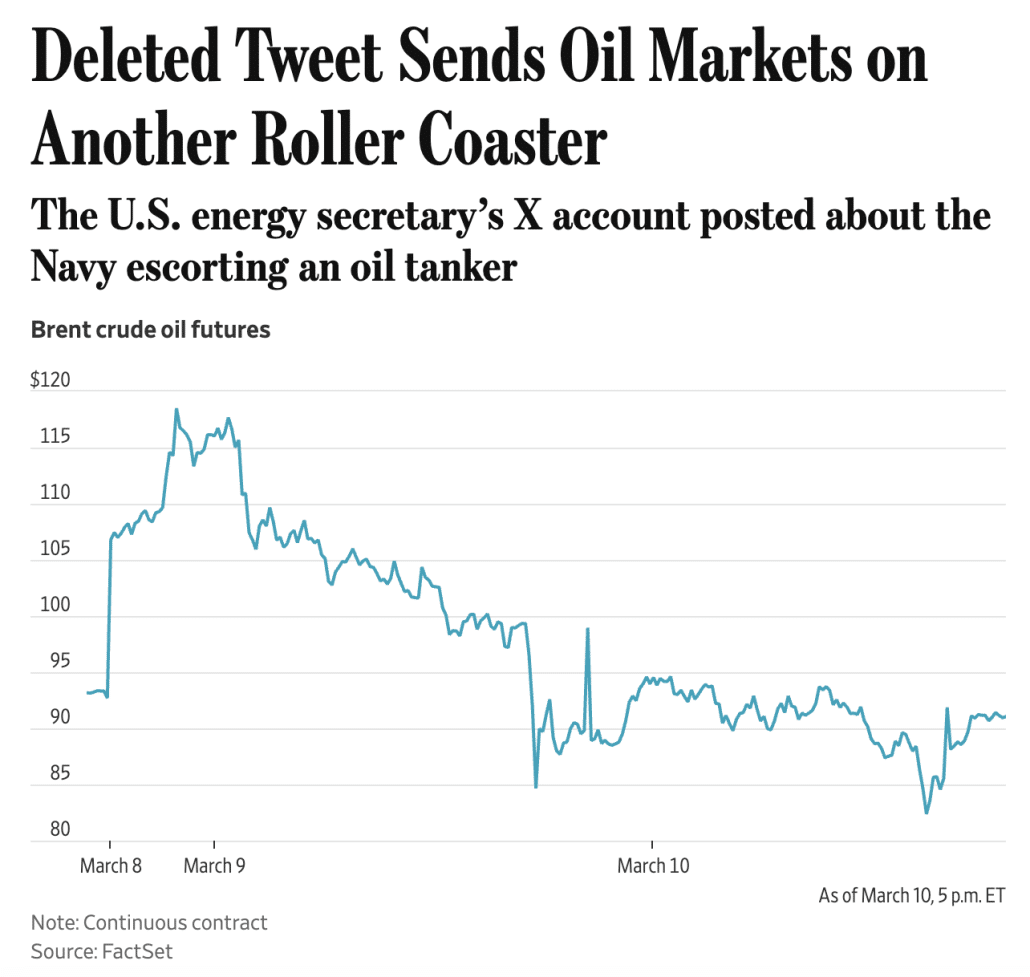
Nowhere in that story (which bears a publication date of March 11) do they mention the “little gyration” caused by Energy Secretary Chris Wright’s tweet falsely claiming the US was now escorting tankers through the Strait of Hormuz, a story which led the WSJ for a period yesterday (while attributing all agency to the tweet, not to the cabinet secretary).
In fact the only mentions of Hormuz in the Politico article — starting in ¶16 — come from other people: a Biden official and spooks worried about mines.
Still, it’s not clear that oil prices will immediately return to their prewar levels. When it comes to oil prices, there’s the market psychology and there’s reality, including how long it takes Gulf countries to restart production if problems in the Strait of Hormuz force them to shutter operations, said Ilan Goldenberg, a former Biden administration official who dealt with the Middle East.
“I have very little confidence in this White House, given how little they planned for the outcome of this war, that they have mapped out all the second- and third- order effects to oil supplies and the oil markets,” Goldenberg said.
U.S. intelligence has also started to see signs that Iran is preparing to deploy mines in the Strait of Hormuz, according to CBS News, which could further complicate a return to normal oil production post-war. Trump said Tuesday he has seen no official reports that Iran is doing that.
Perhaps because Politico treats this as a political problem, one measured in terms of election cycles, they don’t consider whether Goldenberg’s comment about a reality of petroleum production that underlies market psychology suggests their entire premise is wrong. That is, Politico accepts the claim that this is nothing more than gyrations, and in the process may badly misunderstand the possible effect on politics in the US.
A NYT story attempting to explain how the Trump Administration failed to plan to protect Hormuz quotes Wright in the first two paragraphs, calling price fluctuations in response to US-Israeli strikes last summer as “blips.”
On Feb. 18, as President Trump weighed whether to launch military attacks on Iran, Chris Wright, the energy secretary, told an interviewer he was not concerned that the looming war might disrupt oil supplies in the Middle East and wreak havoc in energy markets.
Even during the Israeli and U.S. strikes against Iran last June, Mr. Wright said, there had been little disruption in the markets. “Oil prices blipped up and then went back down,” he said. Some of Mr. Trump’s other advisers shared similar views in private, dismissing warnings that — the second time around — Iran might wage economic warfare by closing shipping lanes carrying roughly 20 percent of the world’s oil supply. [my emphasis]
It does describe Wright’s fuck-up yesterday, but before it gets there, it describes Senator Chris Murphy’s description that no one in the Administration has a plan for getting Hormuz open again, the growing recognition in the Administration that they have no strategy for ending this thing (but don’t tell the Mad King that), Trump’s flailing in the face of problems he dismissed by preparing for the symptom — a temporary spike in prices — but not the cause: the throttling of world trade with the threat of cheap drone strikes.
After Trump administration officials gave a closed-door briefing to lawmakers on Tuesday, Senator Christopher S. Murphy, Democrat of Connecticut, said on social media that the administration had no plan for the Strait of Hormuz and did “not know how to get it safely back open.”
Inside the administration, some officials are growing pessimistic about the lack of a clear strategy to finish the war. But they have been careful not to express that directly to the president, who has repeatedly declared that the military operation is a complete success.
[snip]
Mr. Trump has displayed growing frustration over how the war is disrupting the oil supply, telling Fox News that oil tanker crews should “show some guts” and sail through the Strait of Hormuz.
Some military advisers did warn before the war that Iran could launch an aggressive campaign in response, and would view the U.S.-Israeli attack as a threat to its existence. But other advisers remained confident that killing Iran’s senior leadership would lead to more pragmatic leaders taking over who might bring an end to the war.
When Mr. Trump was briefed about risks that oil prices could rise in the event of war, he acknowledged the possibility but downplayed it as a short-term concern that should not overshadow the mission to decapitate the Iranian regime. He directed Mr. Wright and Treasury Secretary Scott Bessent to work on developing options for a potential spike in prices.
[snip]
Mr. Wright, the energy secretary, caused a market commotion Tuesday when he posted on social media that the Navy had successfully escorted an oil tanker through the Strait of Hormuz. His post drove up stocks and reassured oil markets. Then, when he deleted the post after administration officials said no escorts had taken place, markets were once again thrust into turmoil.
That is, the gyrations Wright caused come after abundant evidence that the Administration, as a whole, sees this as nothing more than a performative measure, one that can be bullied into shape by another con.
But even NYT’s far more sophisticated piece allows Trump’s people to frame this as about oil prices, still the symptom rather than the underlying cause.
Of course, there are far more products that are being choked off in Hormuz: fertilizer (and food products coming into the Gulf), aluminum, helium, sulphur. Various kinds of petroleum products, like jet fuel and diesel, are being affected more quickly than others, and both of those create immediate downstream problems in the transportation industry. Then there are the other impacts of Iran lobbing cheap drones at its Arab neighbors, on flights connecting through airports still being targeted, on tourism, on data centers. Plus, for a variety of reasons, the US is less exposed to this crisis than much of the rest of the world, so measuring it in terms of the impact on November’s midterms in the US won’t really measure its full effect.
The longer this crisis goes on, the longer it’ll take to recover from it.
Trump and his advisors think this is just about gas prices — that same NYT article even describes him claiming Venezuelan petroleum could replace what is lost in the Gulf! — which may be one reason they seem incapable of understanding the problem they’ve created.
And even assuming they could find a way to reopen the Strait, there will be no putting this genie back in the bottle: because of Trump’s recklessness (abetted by Bibi Netanyahu), the Iranians were able to endanger the economic security of Gulf states that have relied on the US for decades, shatter the illusion of utopia the Emirates has tried to sell, and in the process disrupted markets around the world.
They did so using cheap weapons that forced the US to renege on reckless promises of protection. The power of asymmetric resistance against US might was laid bare in both Afghanistan and Iraq. But that was about sovereign state power. This is about global power.
By claiming it had existential control over Iran, the United States provided Iran an opportunity to demonstrate how limited the United States power really is (particularly when that power is being wielded by fucking incompetents), and the Mullahs obliged.
Back when the National Security Strategy came out in December, Defense One published a (possibly apocryphal — no one else ever matched it) story about a longer version, one which disclaimed the very real hegemony that the United States had enjoyed since at least the collapse of the Soviet Union.
“Hegemony wasn’t achievable”
The full NSS also spends some time discussing the “failure” of American hegemony, a term that isn’t mentioned in the publicly released version.
“Hegemony is the wrong thing to want and it wasn’t achievable,” according to the document.
In this context, hegemony refers to the leadership by one country of the world, using soft power to encourage other countries to consent to being led.
“After the end of the Cold War, American foreign policy elites convinced themselves that permanent American domination of the entire world was in the best interests of our country,” the NSS states. “Yet the affairs of other countries are our concern only if their activities directly threaten our interests.”
Yet the Trump Administration wanted to replace hegemony with something else: Unconstrained power, with no commitments. That was never achievable in any case; America’s commitments in the Middle East go well beyond the unquestioning support of Israel that dragged the US into this.
And what Iran has demonstrated already is that that power is every bit as vulnerable to asymmetric strikes as US power in Iraq was. Indeed, it may be some time before Trump’s advisors understand how badly they are misunderstanding the dynamics here, and by then the rest of the world will have had to find their own solutions.
The US may yet find a way to subjugate Iran. Hormuz will be reopened, even if it means others force US capitulation to Iran (and the longer this goes on, the more likely that becomes).
But the damage that Trump’s flailing and his advisors’ ignorance are doing to the rest of the world will forever change how US power is viewed.