
(Bloomberg) — President Donald Trump said the massive release of emergency oil reserves approved by the International Energy Agency would ease energy price pressures while the US seeks to “finish the job” in its campaign against Iran.
Speaking in Kentucky on Wednesday evening, Trump said the move would “substantially reduce oil prices as we end this threat to America and this threat to the world.”
Most Read from Bloomberg
The confirmation did little to calm volatile markets. Brent crude jumped above $100 a barrel after Oman cleared all vessels from its key export oil terminal as a precautionary measure and two tankers were attacked in Iraqi waters — underscoring risks to shipping beyond the Strait of Hormuz, which remains effectively closed.
Hours after the president spoke, Energy Secretary Chris Wright announced that the administration planned to release 172 million barrels from the US emergency oil reserve. The release would take about 120 days to fully deliver, Wright said.
There was no letup overnight in the Middle East, with strikes hitting energy infrastructure. The attacks on oil tankers off Iraq’s coast killed at least one person, Agence France-Presse reported. Bahrain said Iran targeted fuel tanks, Dubai reported a drone strike on a building, and Saudi Arabia cited another incursion.
Trump repeated his assertion that the war would end soon, though also suggested American forces would stay as long as it takes to finish their objectives. “We don’t want to leave early, right?” he told the crowd.
Asked earlier Wednesday whether Iran had laid mines in the Strait of Hormuz, Trump told reporters, “We don’t think so.” The Islamic Republic has placed about a dozen mines in the waterway, Reuters reported Wednesday, citing people familiar with the matter.
In the Kentucky speech, Trump praised the US military’s prowess in the conflict. “They don’t know what the hell hit them,” he said. “They didn’t expect anything like this.”
Earlier Wednesday, the IEA approved its largest-ever release — 400 million barrels — more than double the 182 million barrels released after Russia invaded Ukraine in 2022. French President Emmanuel Macron said the discharges would be organized in the coming days.
The Strait of Hormuz has been all but impassable since the opening salvos of the war, which continued for a 12th day. Several energy giants have curbed production.
A one-month closure of the waterway would drive Brent toward $105 a barrel, while a three-month shutdown could push peak prices near $164, according to a model of a prolonged halt in traffic from Bhargavi Sakthivel and Ziad Daoud, economists at Bloomberg Economics.
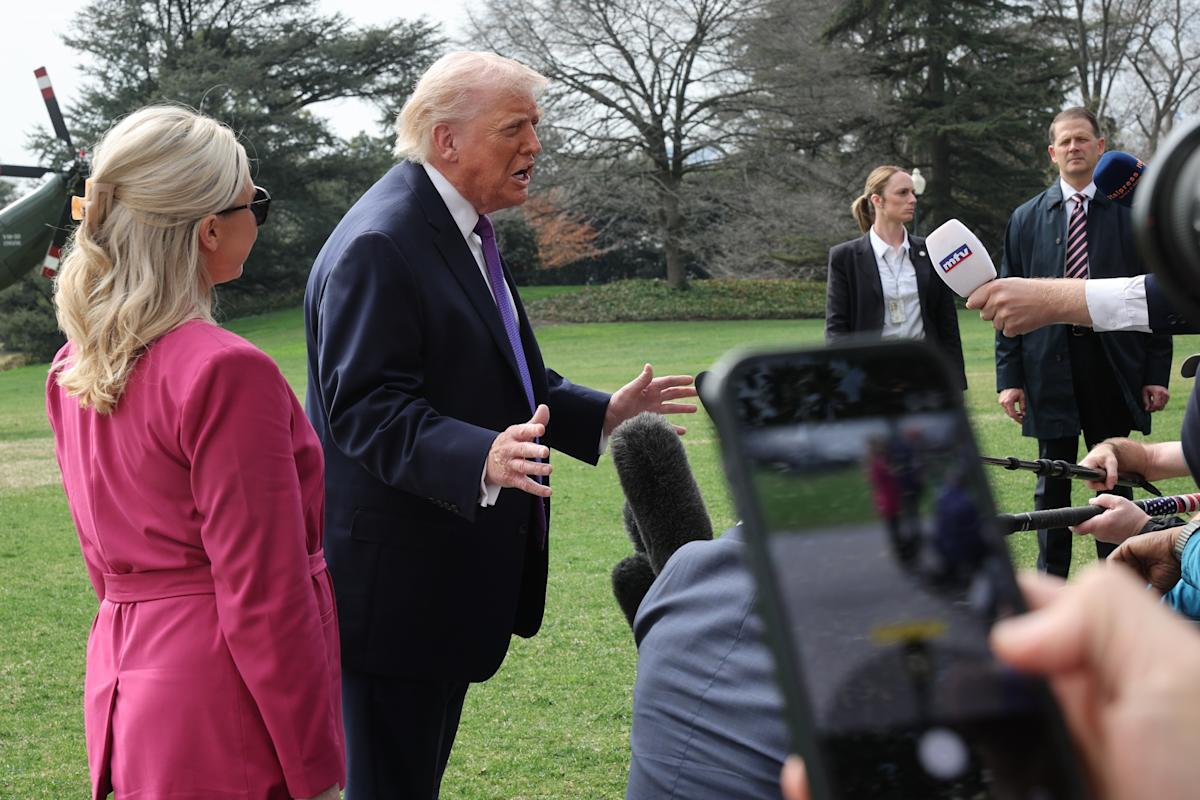
 Photographer: Bing Guan/Bloomberg
Meanwhile, the US national average cost for a gallon of gasoline rose to $3.58 on Wednesday, its highest since May 2024, according to AAA data.
“Prices are coming down very substantially. Oil will be coming down,” Trump said, adding that it’s “just a matter of war.” Prices rose “less than we thought” and will retreat “more than anybody understands,” he said.
Trump is preparing to invoke Cold War-era powers to clear the way for renewed oil production off the southern California coast, according to a person familiar with the matter. The US International Development Finance Corp. also announced that Chubb Ltd. is partnering with the agency on a $20 billion reinsurance backstop aimed at reviving shipping in the Strait of Hormuz.
Trump told Axios the war would end soon because there is “practically nothing left to target” in Iran, though Defense Secretary Pete Hegseth has said there is no timeline for total defeat. Iran has told intermediaries a ceasefire would require guarantees from the US and Israel against future attacks, according to several officials familiar with the matter.
Switzerland, which serves as the protecting power for the US in Iran, temporarily closed its embassy in Tehran due to increased security risks, though it said it would continue its mandate.
The UK Navy said three vessels were hit with suspected projectiles in the Strait of Hormuz and the Persian Gulf. Oman reported that a Thai-flagged cargo vessel was also targeted.
US Central Command in a social media post warned civilians to “immediately avoid all port facilities where Iranian naval forces are operating” along the strait.
Iran staged more strikes against Israel, the United Arab Emirates, and other Gulf countries on Wednesday. Dubai International Airport briefly halted operations after drones struck the facility, resulting in four injuries at the world’s busiest international hub.
The US and Israel continued strikes in Iran. Israel’s defense minister, Israel Katz, said the campaign would continue until “victory is achieved.” While the US and Israel remain publicly united and their militaries are working in tandem, officials have acknowledged that a prolonged campaign may start to drive a wedge between Trump and Prime Minister Benjamin Netanyahu.
More than 2,440 people have died since the war began, with Iran and Lebanon accounting for most fatalities. The New York Times reported that an ongoing military investigation found that the US was responsible for a deadly strike on an Iranian school. Iran said 175 were killed.
US officials say Iran’s attacks are down more than 80%, though Tehran continues targeting military and energy sites and retains key leverage over the Strait of Hormuz.
Saudi Arabia, Iraq, the UAE and Kuwait have all cut production because of Hormuz’s de facto closure. Saudi Aramco Chief Executive Officer Amin Nasser warned the impact on global petroleum markets could be “catastrophic.”
Any attempt by the US and Israel to dislodge Iran’s conservative clerics and the well-armed Islamic Revolutionary Guard Corps would be a formidable task. The IRGC — separate from the regular military — has around 200,000 active troops and another 600,000 volunteers, including the Basij paramilitary militia, US assessments show.
At least 1,787 Iranians have been killed in the war so far, according to the Human Rights Activists News Agency.
Mojtaba Khamenei was named Iran’s supreme leader after his father, Ali Khamenei, was killed in the initial wave of strikes. Iranian state television has reported that the younger Khamenei had been injured, but the semi-official Iranian Students’ News Agency cited Yousef Pezeshkian, a son and adviser of Iran’s president, as saying he’d been told he was in good health.
At least seven US service members have died, most of them in the first two days of fighting. There have been several deaths in Gulf countries and Israel.
–With assistance from Michelle Jamrisko, Meghashyam Mali, Jon Herskovitz, Michael Heath, Hadriana Lowenkron, Tony Capaccio, John Bowker, Devika Krishna Kumar, Mike Cohen and Jeff Mason.
Most Read from Bloomberg Businessweek
©2026 Bloomberg L.P.