
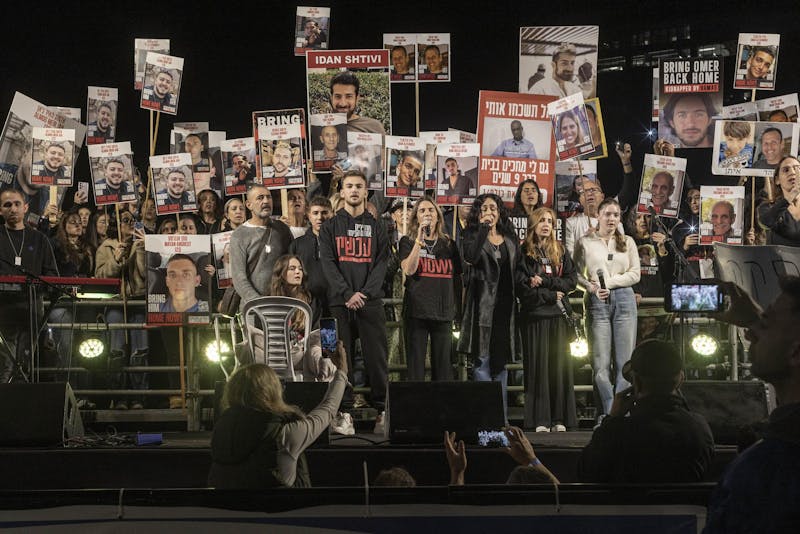
Maya Regev, a survivor of the Oct. 7 Hamas-led attacks and former Hamas hostage, spoke at an event hosted by Cornellians For Israel on Monday. Addressing a packed auditorium, Regev recounted her flee from the Supernova music festival attacks, her capture by Hamas and the determination that sustained her through nearly two months of captivity.
On Oct. 7, 2023, Hamas, which has been designated as a terrorist organization by the U.S. Department of State since 1997, led attacks in southern Israel that killed approximately 1,200 people, including approximately 400 people at the Supernova music festival.
Regev, one of 251 hostages captured by Hamas during the attacks, spent 50 days in captivity after being shot in both legs while fleeing the festival.
Since her release from captivity, Regev has traveled internationally to share her story and advocate for the hostages who still remained in captivity. Regev told the audience that she did not feel fully safe “until every hostage was home.”
Near the end of her talk, Regev addressed those who deny or minimize the events of Oct. 7, asserting that the attacks were not an abstract political debate, but a lived reality for many people.
“I want you to know that, for me, October 7, it’s not a debate,” Regev said. “It’s not something that I saw on social media. It’s not something that I read about online. It’s something that changed my life forever. And I want you to know that for every headline and every hashtag that you see, there are people behind it.”
Regev, who was 21 at the time of the attacks, and her brother, Itay Regev, who was 18 at the time, attended the music festival with friends after returning from a family trip to South America. The festival, which coincided with Sukkot, a weeklong Jewish holiday, drew more than 3,000 attendees. The event was meant to celebrate music, freedom and life, Regev said. And for a few hours, she said it did just that.
“It was the best four hours of my life,” Regev said — but the celebration was violently interrupted.
In the midst of the festival, sirens warning of incoming missiles from Gaza began sounding across the area. Having grown up in Israel, Regev said the alarms initially did not worry her.
“We didn’t find it to be such a big deal because it’s not the first time something like this had happened in Israel,” Regev said.
Soon after the sirens, the situation escalated. Police officers entered the festival grounds telling attendees that terrorists had crossed the border and informing them that they needed to flee immediately, Regev said.
Chaos followed as thousands of attendees attempted to escape at once, she said. Traffic bottlenecked on the only road providing exit from the festival grounds, and many people abandoned their cars to run on foot. Regev, her brother and their friend Omer Shem Tov were among those who fled across open fields, trying to get to safety.
“We heard people everywhere screaming that their friends got killed, got shot in the head, trying to escape,” Regev said. “We felt like something really big was happening.”
For more than 90 minutes, the three ran while gunfire erupted around them. Regev recalled people collapsing mid-run as bullets struck nearby.
“It was like Russian roulette,” Regev said.
Eventually, they spotted a man they had met the night before at the festival, Ori Danino. Danino reached safety minutes prior but returned with a car to rescue Regev, her brother and Shem Tov. As they attempted to drive away, their path was blocked by Hamas pickup trucks filled with armed militants.
At the time, Regev was on the phone with her father. She played the recording of that call for the audience. In the audio, she and her brother can be heard screaming and pleading for their lives in Hebrew.
Both Regev and her brother were shot during the encounter and were separated soon after, when they were both thrown into the back of Hamas vehicles. Maya described one of the terrorists smiling at her while holding a gun to her head.
As they crossed the border into Gaza, Regev recalled seeing crowds in the streets dancing and celebrating the attack.
“All of a sudden I feel a hand grabbing my hair,” Regev said. “The terrorist next to me is telling me, ‘Look outside, look, we won.’”
Regev was initially held with her brother and Shem Tov in a small storage unit in Gaza. She was suffering from severe injuries, including the gunshot wound that had shattered a bone in her leg. In that moment, she said, she made a conscious decision that she would survive.
“I said to myself that no matter what happened, no matter if it will be painful, no matter if I lose my leg, no matter what, I’m going to stay alive for my family, for myself,” Regev said.
After a short time, Regev said that her captors took her to a hospital in Gaza, where the captors disguised her as an Arab woman and warned her not to reveal her identity, telling her she would be “lynched” if anyone discovered she was Jewish.
For the next 45 days, Regev remained alone in her hospital bed, living in what she described as “24/7 fear.” During this time, her captors repeatedly verbally abused her, poured apple cider vinegar and alcohol on her wounds, and left her in total isolation for weeks.
Maya took the audience through how she endured the isolation. In her head, she said that she would imagine the white ceiling as a screen, onto which she would project scenes from her life, images of her family and memories of a past life that seemed almost unrecognizable to her.
Throughout this time, Regev said her faith helped sustain her. Rather than questioning why these events had happened to her, she said she believed she had been chosen because she was strong enough to endure them.
“I know that it’s me and not a different woman, because I know that I can make it out alive,” Regev said. “I trust myself, and I know that He trusts me. That’s what gave me faith.”
Both Regev and her brother were released in November 2023 as part of a weeklong ceasefire.
Shem Tov was released on Feb. 22, 2025 after 505 days in Hamas captivity as part of a temporary ceasefire agreement.
Danino, who had come back for the siblings and Shem Tov on Oct. 7, was killed in captivity.
Through her continued advocacy, Regev hopes to ensure that the events of Oct. 7 will never be repeated nor forgotten. She said that she feels a responsibility to keep telling her story so that the memory of what happened remains present in the public consciousness.
“Now all the hostages are back home, but we still need to remember,” Regev said. “The world can forget about what happened — you just need to talk about it. We spread it so it won’t happen again. This time [it] was us, the next time, it’s not Israel, it’s somewhere else.”
Reflecting on life after captivity, Regev encouraged the audience to approach hardship with resilience and gratitude.
She reminded the audience to hold close the people they love, urging them to “hug your family, hug your parents, hug your friends. Appreciate what you have.”
“Don’t wait for something terrible in your life to happen in order to appreciate little things in life,” Regev told the audience.
Vivienne Cierski
Vivienne Cierski is a freshman in the College of Agriculture and Life Sciences. She is a Sun Contributor and can be reached at vsc38@cornell.edu
Read More