
My aunt dropped me off at my hotel adjacent to the Tel Aviv boardwalk – or tayelet in Hebrew. After checking in and disposing of my luggage, I took her to dinner, which was the least I could do.
That is when my neverending love affair with one of Israel’s aspects continued: food.
Israel’s cuisine is one of new and typically Israeli dishes – such as the divine schnitzel in a pita, complete with fixings, or sabich – and food brought back from the Diaspora. It makes me chuckle when Arab nationalists scold Israel for “stealing” dishes, such as falafel. Of course, falafel is not an Israeli creation, but is there a patent I have missed? Moreover, this food is part of Israel, as it was consumed by many Mizrahi Jews, as well as Israel’s Arab population. To make matters funnier, falafel is claimed by Palestinians, Lebanese, and Egyptians as their own. Even food is politicized in the Middle East.
At the restaurant, which employs Israelis with slight Russian accents, a nice fettucine carbonara is served with beef. It is followed by a Russian grandmother’s dessert, which somewhat resembles profiteroles – very tasty.
This is simply the first stop on a culinary journey that is not always good for the diet and certainly not for the wallet – still, worth every calorie and shekel.
For the rest of the week, I will enjoy the impossible to resist Israeli breakfast. Think shakshuka, salads, and all kinds of other treats. It will be supplemented with pizzas, Russian beef stew, more pastas of different varieties, Hamantaschen, excellent tacos, challah, and hummus. Even the hamburgers provided by a certain restaurant with golden arches are so massive, that they would make their Dutch colleagues frown.
In Israel, you live to eat; and I thoroughly love to indulge myself.
Of course, I visited certain locations during my stay. And on Tuesday, I decided to visit a memorial in Ramat Gan.
This city across from Tel Aviv just happens to be my place of birth. Ironically, this city was fitting, as it was once called “Little Baghdad.”
The city has grown tremendously, since its inception. By now, its skyline contains numerous skyscrapers. That is not uncommon for a small country, such as Israel. Everywhere you go, highrises are built. When land is scarce, the preferable way is up.
After going on my search and Google Maps almost sending me in the wrong direction, my family in the Netherlands offers me some useful information. Finally, I found him: an old, bearded gentleman.
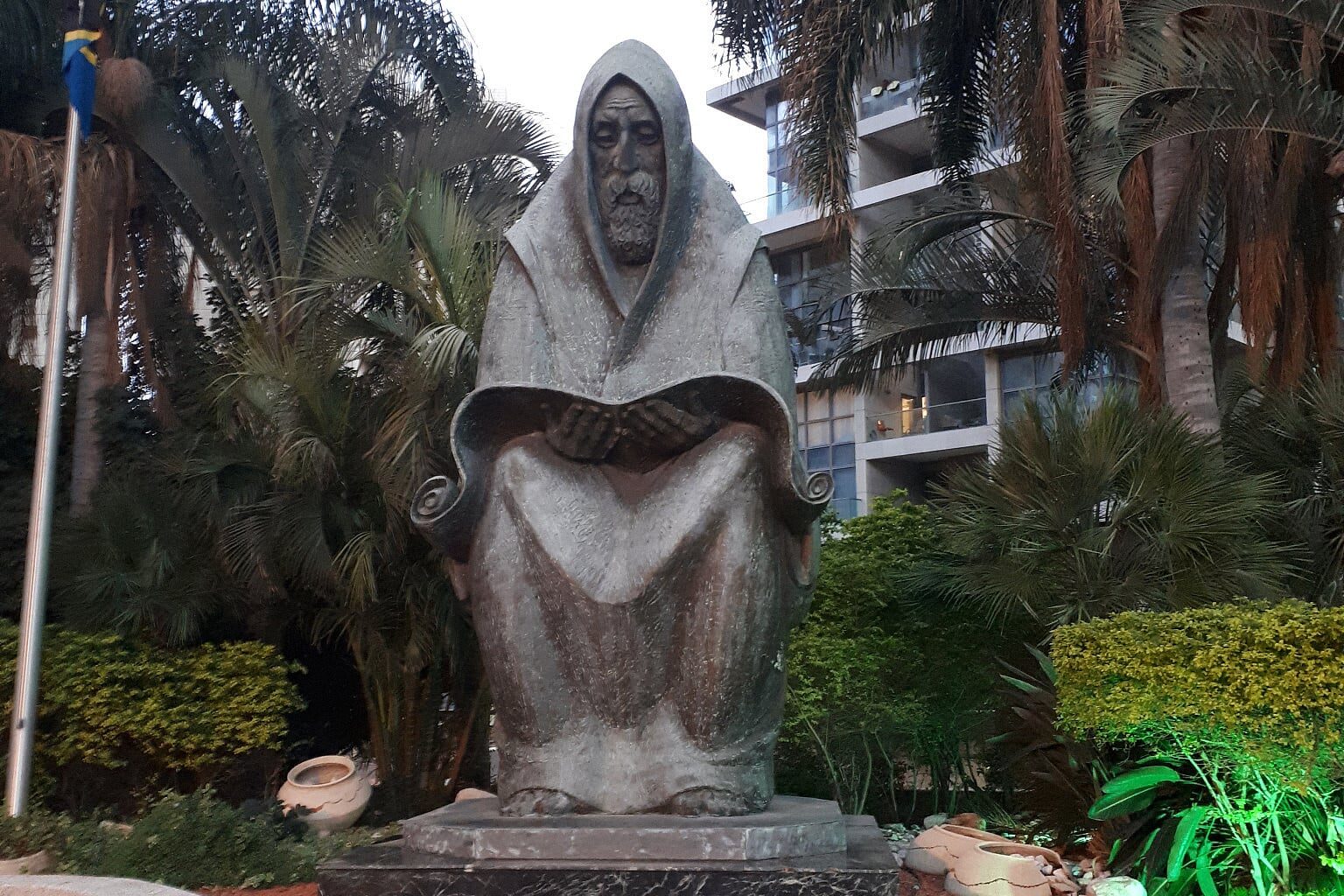
It is the Farhud memorial. The towering man sits, holding a scroll, at which he gazes with a somber look on his face. He is surrounded by even larger towers, that seem to be protecting him.
As I take my pictures of him, I am gripped by a sense of sadness. That feeling is the product of thinking of the details of one of the most horrifying pogroms against Jews in the MENA region. But it is amplified by something else: the monument stands in Israel.
Do not get me wrong, I am grateful that Israel acknowledges the suffering. It is beautiful that this monument has been erected, so the pogrom will not be forgotten. But it was carried out in Baghdad; and the modern State of Israel did not even exist yet. At the very least, another monument should be added to the Baghdad landscape, prominently, so people will realize what was done to Iraqi Jews. Alas, Iraq stubbornly persists in its anti-Israel hatred – which shrewdly allows it to ignore its own history.
The next day, I decide to visit a museum about Iraqi Jewish history in Or Yehuda. Of course, something needs to go wrong.
I check the museum’s opening hours on Google. Knowing that the information could be wrong, I check the website as well. Everything was fine.
So, on Wednesday I traveled to Or Yehuda. Upon exiting the bus, I became nervous – the front door was closed. As I approached the entrance, a kind note was stuck to the door: the museum was closed to the public on March 3rd and … February 25th. The latter day was when I was there.
Now, there is a possibility that I did not scrutinize the website very well – the message is featured on the website, I checked again. But, it could just as easily be something that can happen in Israel. Anyway, I will attempt a second try in the future.
Finally, I buy something of the utmost importance that week: basketball shirts.
I make my way to Yad Eliyahu Arena, the home of Tel Aviv basketball. Recently, Hapoel Tel Aviv moved here – a decision disliked by many of its fans, as it is the home of Maccabi. For those who do not know, that rivalry is very intense. Thus, when the Final Four took place in Tel Aviv in 2004 – which Maccabi won, by the way – Hapoel fans decided to welcome CSKA Moscow at Ben Gurion Airport, Maccabi’s first opponents. Yes, that is how intense it can get.
But for an Israeli who grew up in the Netherlands, Israeli success in international sports trumps everything. So, I buy shirts for me and my brother at Hapoel’s store first and then quickly dart to Maccabi’s fanshop – the Hapoel bags have been stuffed discreetly into my backpack.
These are just some of my exceedingly wild adventures. But I also met people: family and friends. More on that in the next post.
Born in Israel and raised in the Netherlands, I have studied history in the past. Though I still live in the latter, the former continues to amaze, frustrate, encourage, worry, enlighten, and move me. Whenever and wherever, Israel is on my mind.