
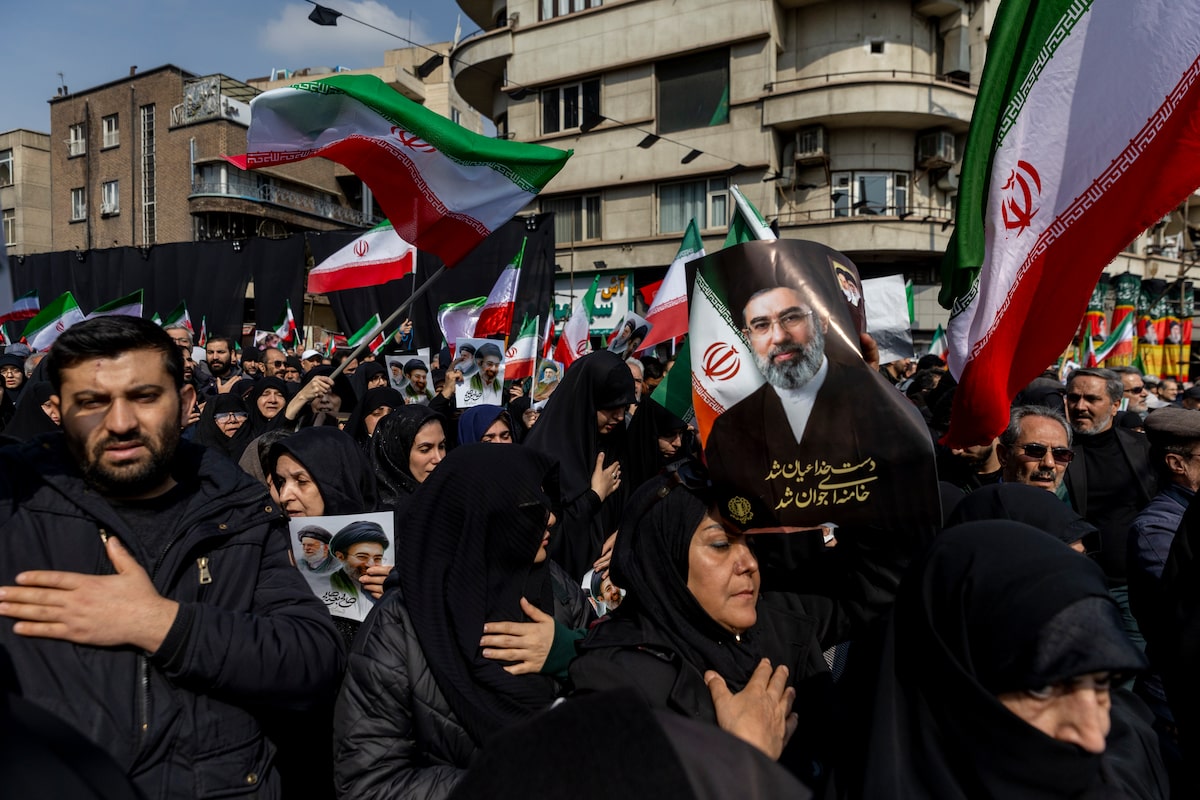
A woman holds a poster of the new Supreme Leader Mojtaba Khamenei as funerals are held for members of Iran’s Revolutionary Guards Corps and other military figures at Enghelab Square in Tehran on Wednesday.Majid Saeedi/Getty Images
Iran will avenge the blood of its martyrs, keep the Strait of Hormuz closed and attack U.S. bases, new Supreme Leader Mojtaba Khamenei said on Thursday in a statement read out on state television, his first remarks since succeeding his slain father.
In the defiant address, Khamenei said the United States must close all its bases in the region. The strait, which runs past Iran’s coast and supplies a fifth of the world’s oil, should remain shut to put pressure on the enemy, he said.
Two tankers were ablaze in an Iraqi port on Thursday after a hit by suspected Iranian explosive-laden boats, a step up in attacks that have cut off oil from the Middle East and defied Donald Trump’s claim to have won the war he launched two weeks ago.
World faces largest oil supply disruption in history, IEA says
Images verified by Reuters as having been filmed from the shore of the port of Basra showed ships engulfed in massive orange fireballs that lit up the night sky, after the attacks which Iraqi authorities blamed on Iranian boats. At least one crew member was killed.
Hours earlier, three other ships had been struck in the Gulf. Iran’s Revolutionary Guards claimed responsibility for at least one of those attacks, on a Thai bulk carrier that was set ablaze, which the Guards said had disobeyed their orders. Another container vessel reported being struck by an unknown projectile near the United Arab Emirates on Thursday.
The war that began with a U.S.-Israeli bombing campaign at the end of February has so far killed around 2,000 people and caused what the International Energy Agency describes as the biggest disruption to global energy supplies in history.
Two tankers were ablaze in an Iraqi port on Thursday after a hit by suspected Iranian explosive-laden boats.
Reuters
Global energy supplies disrupted
Undermining U.S. and Israeli claims to have knocked out much of Iran’s stock of long-range weapons, more drones were reported on Thursday flying into Kuwait, Iraq, the UAE, Bahrain and Oman. Lebanon’s Iran-backed militia Hezbollah fired its biggest volley of rockets into Israel of the war, prompting fresh Israeli strikes on Beirut.
Foreign ministers from the Group of Seven will meet in Paris on March 24 and 25 to discuss diplomatic efforts to end the Iran crisis, Canadian Foreign Minister Anita Anand told reporters on Thursday.
What to know about the challenges of reopening the Strait of Hormuz
Oil prices soared back above US$100 a barrel, having come down earlier in the week when Trump said the war would be over soon. Iran has said it will not let oil through the world’s most important energy trade route – the Strait of Hormuz that runs along its coast – until U.S. and Israeli attacks cease.
Citibank announced on Thursday it would temporarily shut its branches in the UAE, a day after Iran said it considered banks to be legitimate targets and warned Middle East residents to stay 1,000 metres from them. HSBC has shut branches in Qatar.
Oil prices soared back above US$100 a barrel, having come down earlier in the week.
Reuters
Trump says ‘we won’
U.S. President Trump, whose Republican Party is trying to hold on to Congress in an election later this year, has repeatedly tried to calm energy markets this week by saying the surge in oil prices will be short-lived.
But he has not explained how the war will end, or presented a plan to reopen the blockaded strait. U.S. and Israeli officials say the aim is to destroy Iran’s missile and nuclear programmes, but Trump has also demanded Iran’s “unconditional surrender” and the power to determine its leaders.
“You never like to say too early you won. We won,” Trump told a campaign-style rally in Hebron, Kentucky, on Wednesday. “In the first hour it was over.”
The United States had “virtually destroyed Iran,” he said. But he added: “We don’t want to leave early, do we? We got to finish the job.”
Trump sought to reassure voters on rising gasoline prices during stops in Kentucky and Ohio on Wednesday.
Reuters
Inside Iran, residents said security forces were increasing their presence on the streets, demonstrating their continued control.
“Security forces are everywhere, more than before. People are afraid to come out, but supermarkets are open,” teacher Majan, 35, said by phone from Tehran.
Three sources told Reuters that U.S. intelligence indicated that Iran’s leadership was still largely intact and not at risk of collapse any time soon.
Israel and the United States have called on Iranians to rise up and topple their clerical rulers. Many Iranians want change and some openly celebrated the death on the war’s first day of Supreme Leader Ayatollah Ali Khamenei, whose security forces had killed thousands of anti-government protesters in January. But there has been no sign of organized anti-government activity while the country is under attack.
A woman sits on rubble across from a residential building damaged last Monday during the U.S.-Israeli air campaign in Tehran on Thursday.Vahid Salemi/The Associated Press
Tehran seeks prolonged economic shock
Iranian Supreme Leader Ayatollah Mojtaba Khamenei hasn’t yet made a statement or been seen since being chosen to succeed his father Ayatollah Ali Khamenei, who was killed in the opening day of the conflict.
But Iranian President Masoud Pezeshkian suggested online Thursday that for the war to end, the world would need to recognize Iran’s “legitimate rights,” pay reparations and offer guarantees against future attacks.
Iran has made clear over the past two days that its strategy now is to impose a prolonged economic shock to force Trump to back off.
The spokesperson for Iran’s military command said on Wednesday that the world should prepare for oil prices of US$200 a barrel. The highest price in history was US$147.27 in July, 2008, weeks before the global financial crisis.
Thursday’s surge in oil prices came despite the announcement the previous day that developed countries would release 400 million barrels of oil from their strategic reserves, nearly half from the United States.
That is by far the biggest-ever co-ordinated intervention into the oil markets. Trump said it would “substantially reduce oil prices as we end this threat to America and the world.”
Opinion: War is good for absolutely nothing that’s good
But releasing the reserves will take months, and account for just three weeks of supply from the blockaded strait.
Futures contracts two and three months out suggest traders expect prices to ease in coming months, but far less quickly than they expected just days ago, despite the new promise of hundreds of millions of barrels from reserves.
“The only way to see oil prices trade lower on a sustained basis is by getting oil flowing through the Strait of Hormuz,” ING analysts said. “Failing to do so means that the market highs are still ahead of us.”
With a report from The Associated Press
A rescue worker and a sniffer dog search the rubble of a residential building.Vahid Salemi/The Associated Press