
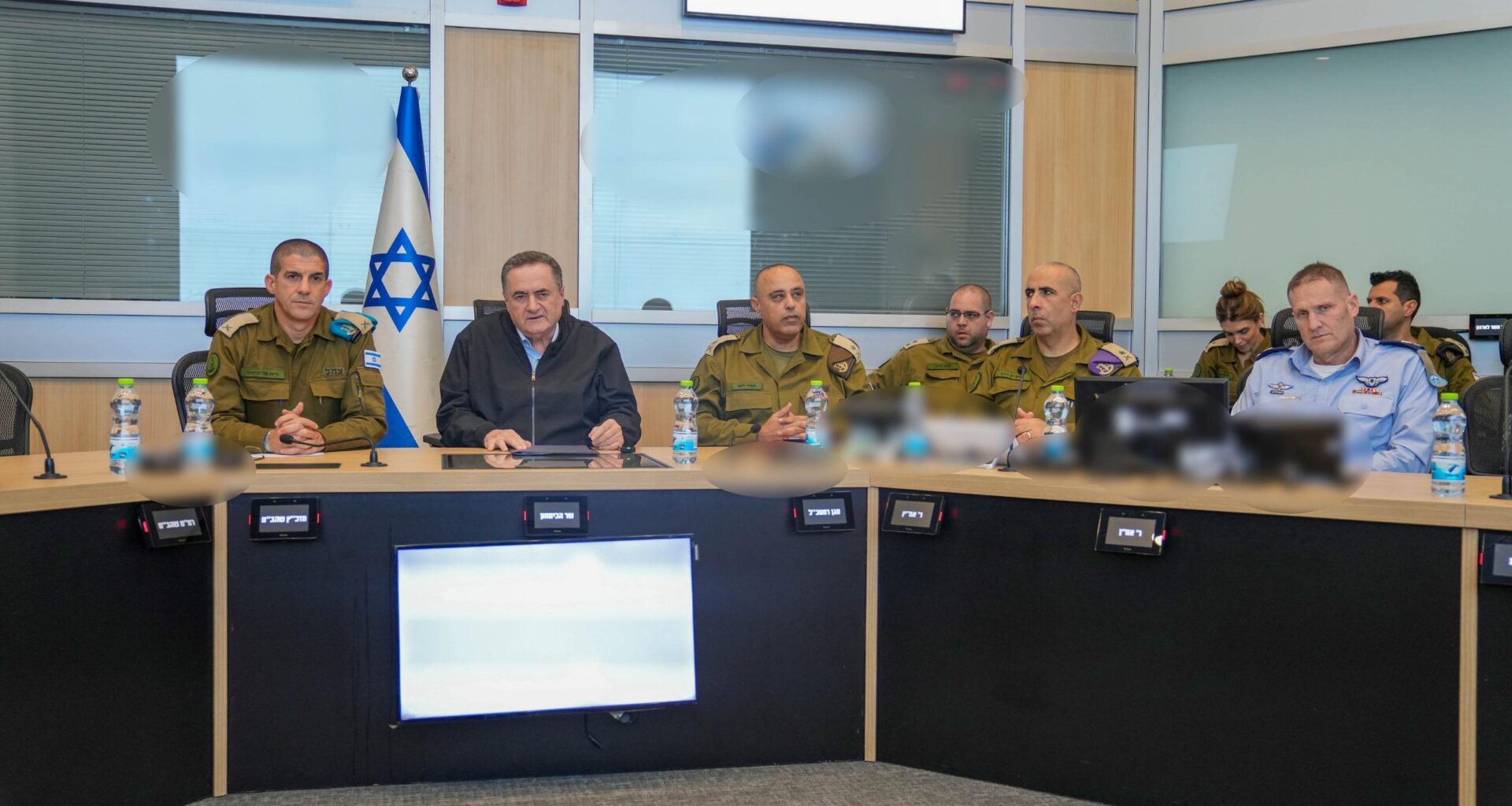
Defense Minister Israel Katz said Thursday he has warned Lebanon that if it does not stop the Hezbollah terror group’s continuing rocket and drone attacks, Israel will “take the territory and do it ourselves.”
Meanwhile, Israel expanded its evacuation warnings in south Lebanon, telling more communities further away from the border to leave or risk being targeted as the military escalates its operations against the terror group.
“Hezbollah launched heavy barrages toward the State of Israel yesterday. The IDF responded forcefully in the Dahiyeh and against Hezbollah targets across Lebanon,” Katz said during an assessment with senior Israel Defense Forces officers, referring to Beirut’s southern suburb, a Hezbollah stronghold.
“I warned the president of Lebanon that if the Lebanese government does not know how to control the territory and prevent Hezbollah from threatening the northern communities and firing at Israel, we will take the territory and do it ourselves,” he said.
Katz also said that he and Prime Minister Benjamin Netanyahu had “instructed the IDF to prepare for an expansion of IDF activity in Lebanon to restore calm and security to the northern communities.”
Get The Times of Israel’s Daily Edition
by email and never miss our top stories
By signing up, you agree to the terms
On Wednesday, Hezbollah launched some 200 rockets and around 20 drones at Israel over a period of several hours, marking its heaviest fire since it began its attacks on Israel in support of its sponsor Iran, amid the US-Israeli war against the regime in Tehran.
The vast majority of the rockets were intercepted or struck open areas. There were two impacts in residential areas, causing damage and lightly injuring two people. Nearly all of the drones were intercepted, aside from one that crashed near a border community without exploding, according to the military.
One rocket hit the yard of a home in Moshav Haniel in central Israel, causing a crater and destroying much of the home, with the exception of the reinforced room.
According to Channel 12, the woman who lives in the house and her carer managed to make it to the shelter during the 90-second warning period provided by the siren, and were likely saved as a result.
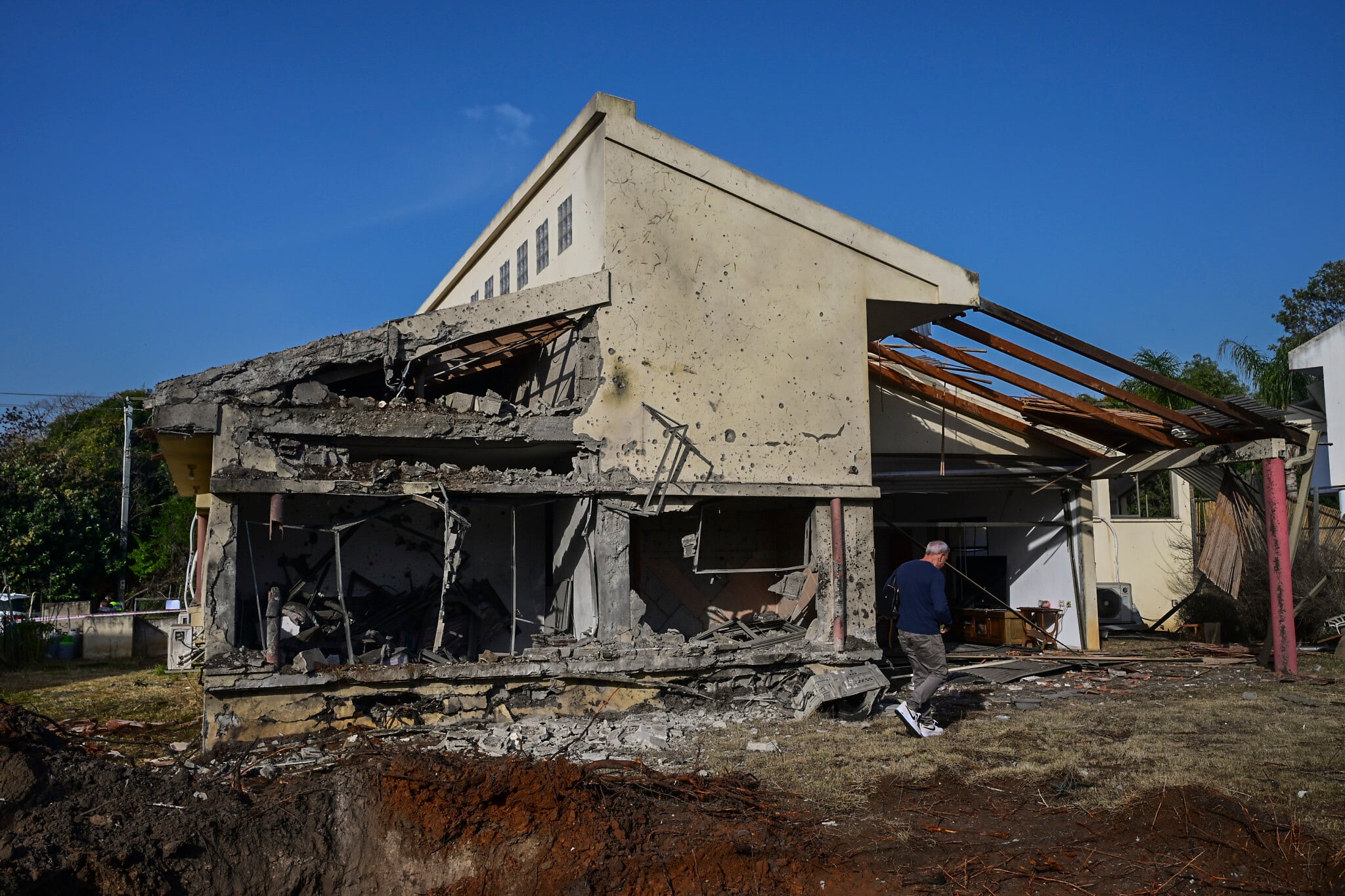
People stand at the scene where a house was hit by a missile fired toward Israel overnight in Moshav Haniel, March 12, 2026. (Michael Giladi/Flash90)
Another rocket struck a home in the northern town of Bi’ina, injuring a man. Four others were treated for acute anxiety at the scene.
Ongoing attacks
Since March 2, when Hezbollah began attacking Israel in response to the killing of Iran’s supreme leader Ali Khamenei, the terror group has launched around 100 rockets a day, according to the IDF.
The IDF says two-thirds of those rockets have been aimed at Israeli forces operating in southern Lebanon and along the border, and a third have been aimed at Israel.
In addition, Hezbollah has launched more than 100 drones at Israel during that time, the vast majority of which were shot down by the Israeli Air Force, according to the military.
The attacks continued Thursday, with sirens sounding in the Galilee during three separate attacks, one of which — around 3 p.m. — came as a barrage of ballistic missiles was launched from Iran toward central Israel.

Israelis take cover at bomb shelter in Jerusalem as a siren sounds warning of incoming ballistic missiles fired from Iran toward Israel, March 11, 2026. (Yonatan Sindel/Flash90)
Education Minister Yoav Kisch confirmed Thursday that the ministry’s plan for a partial reopening of schools starting as early as next week will not include northern Israel or the Tel Aviv area — the regions most targeted.
Israel has responded to the fire from Hezbollah with airstrikes targeting the group across Lebanon, including significant attacks in Dahiyeh, which the IDF ordered all residents to evacuate from, as well as occasional strikes inside central Beirut.
Israel has also sent ground troops further into southern Lebanon, going beyond the five strategic points it’s occupied since a ceasefire was reached with the terror group in late 2024.
Evacuation warnings expand
The IDF expanded its evacuation warning for southern Lebanon, telling all civilians south of the Zahrani River they should evacuate their homes immediately, amid the fighting against Hezbollah.
“The activity of the Hezbollah terror organization is forcing the IDF to act against it with force, especially in your areas. The IDF does not intend to harm you,” said army spokesman Col. Avichay Adraee.
“For your safety, we call on all residents located south of the Zahrani River: You must evacuate your homes immediately,” he said. “You must move immediately to the north of the Zahrani River.”
Last week, the IDF called on Lebanese civilians in southern Lebanon to evacuate to the north of the Litani River. The Zahrani River is located further north, and the new evacuation warning includes dozens more Lebanese towns.

An IDF evacuation warning issued for southern Lebanon on March 12, 2026. (Israel Defense Forces)
“Anyone who is near Hezbollah’s members, facilities, or [weapons] is putting their life at risk. Any building used by Hezbollah for military purposes may become a target,” Adraee said.
He warned that “any movement southward may put your life at risk.”
Key commanders killed
The IDF announced Thursday that a member of Iran’s Islamic Revolutionary Guard Corps who was operating as a commander in Hezbollah’s missile unit had been killed in an Israeli airstrike two days earlier.
Abu Dharr Mohammadi, who the military said was a “central figure in the military coordination” between Hezbollah and the Iranian regime, was targeted in Beirut on Tuesday. The army shared footage of the strike.
The IDF said Mohammadi coordinated between Hezbollah and senior Iranian officials, was “a key figure” in Hezbollah’s military force buildup in the field of missiles, and “served as an authority on the subject of Hezbollah’s strategic weapons.”
צה”ל חיסל מפקד מטעם משמרות המהפכה שפעל ביחידת הטילים של ארגון הטרור חיזבאללה בלבנון
צה”ל תקף מוקדם יותר השבוע, וחיסל את המחבל אבו ד’ר מחמדי, מפקד מטעם משמרות המהפכה שפעל ביחידת הטילים של ארגון הטרור חיזבאללה בביירות.
מחמדי היווה גורם מרכזי בתיאום הצבאי בין ארגון הטרור חיזבאללה… pic.twitter.com/tKwjQZ8XHH
— צבא ההגנה לישראל (@idfonline) March 12, 2026
Separately, the IDF said the commander of the south Lebanon sector in Hezbollah’s elite Radwan Force was killed in an airstrike last weekend. Abu Ali Riyan was targeted in an airstrike in the southern Lebanese town of Harouf on Saturday, according to the military.
The Radwan Force was previously tasked with invading Israel in a future war, and the IDF says the elite unit had advanced the terror group’s “Conquer the Galilee” plan for years, until the 2023-2024 war that saw most of Hezbollah’s leadership eliminated and the group badly weakened.
The military said Riyan managed the Radwan Force in southern Lebanon and was a “central figure responsible for coordinating operations, recruiting operatives, and managing the unit’s weapons supply chain.”
The IDF said it has killed over 350 terror operatives in Lebanon since hostilities escalated this month, mostly Hezbollah members, including over 100 fighters in the Radwan Force.
More than 60 command centers of the Radwan Force have also been struck, the army said.
Lebanon’s information minister said Thursday that Israeli strikes in the country had killed at least 687 people since March 2.
In a statement following a cabinet meeting, Paul Marcos said that “the number of killed reached 687, including 98 children and 52 women.” Beyond that, he did not distinguish between civilians and combatants.
IDF acknowledges failure in alerting public
The IDF acknowledged Thursday that it was a mistake not to update the public ahead of the Hezbollah attack the previous night, especially after Israel’s assessments of the planned barrage were leaked on social media and published by international media.
The military had had indications that the terror group planned a larger-than-usual attack, though it was not seen by the IDF as extraordinarily large considering that the Iranian proxy had already fired hundreds of rockets at Israel since the start of the conflict.
Rumors that Israel was bracing for a large attack swept through the country throughout the late afternoon. But at around 7 p.m. IDF Spokesman Brig. Gen. Effie Defrin downplayed the matter, saying in a post on X that there were no changes to the guidelines for civilians.
The military did begin to update local authorities in the north shortly before the Hezbollah attack began around an hour later. But IDF officials acknowledged that this was far too late, saying that the public should have been notified much earlier.
Some reporters said they were even blocked by the military censor from publishing the information ahead of the barrage, leaving Israelis to learn about the matter from leaks to foreign media.
The army said it would investigate and learn from the incident, and in the future will seek to update the public ahead of potential major attacks.
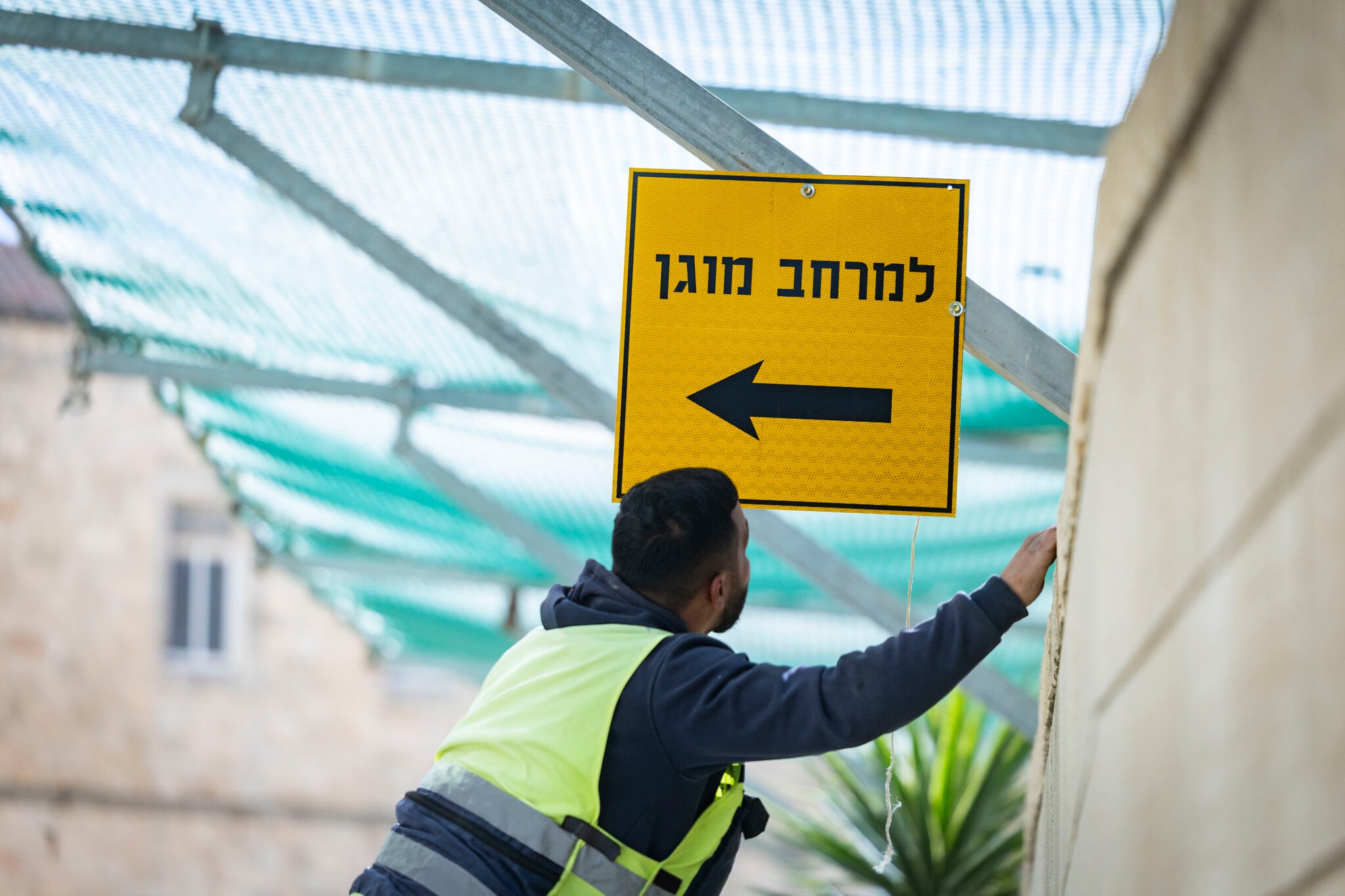
View of a sign pointing toward a protected space on Jaffa Street in Jerusalem amid the ongoing war with Iran and Hezbollah and missile fire toward Israel, March 10, 2026. (Chaim Goldberg/Flash90)
Rossella Tercatin and Times of Israel staff contributed to this report.