
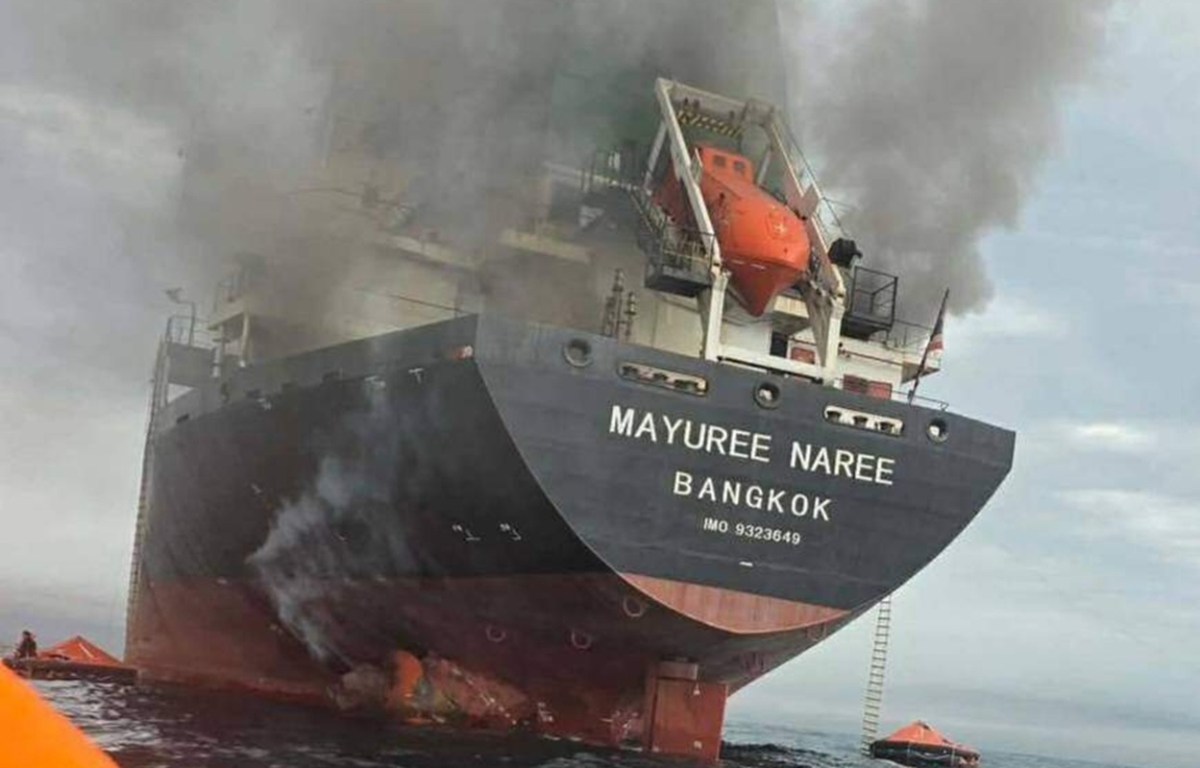
Russia has raked in nearly $7 billion in fossil fuel revenues since the U.S. and Israel’s strikes against Iran led to the near-closure of the Strait of Hormuz, according to a new report.
The strait is a critical chokepoint for global energy markets, with roughly a quarter of the world’s seaborne oil and one-fifth of liquefied natural gas passing through it each year.
Why It Matters
Moscow had been facing severe budget strains because of collapsing oil and gas revenues coupled with the high costs of the four-year war against Ukraine.
Russia’s oil industry is set to get a further boost as President Donald Trump mulls rolling back some sanctions levied following President Vladimir Putin’s full-scale invasion of Ukraine. The Trump administration argues this will help stabilize energy markets, but critics say the move would strengthen Russia’s hand in the four-year war.
Newsweek reached out to the U.S. Treasury and the Russian Foreign Ministry by email with requests for comment.
 Trump’s War is Feeding the Kremlin’s War Machine
Russia has profited to the tune of €510 million ($589 million) per day since the start of the Iran war, a 14 percent increase over the daily average in February, according to an analysis released Thursday by the Centre for Research on Energy and Clean Air.
As of time of writing, that’s approximately €6 billion ($6.9 billion) from gas and oil exports, or enough to buy 17,000 Shahed-136s every 24 hours. The Shahed-136 is the Iranian-designed attack drone that Russian forces have widely deployed in Ukraine.
“That is the reality of fossil fuel geopolitics. When markets panic, authoritarian exporters cash in. In less than two weeks, Russia has earned an estimated €6 billion from fossil fuel exports, money that ultimately feeds the Kremlin’s war machine,” said Alexander Kirk, a sanctions campaigner at Urgewald, a German environmental and human-rights-focused nonprofit.
Speaking to the prospect of the U.S. easing sanctions on Iran, Kirk said such a move would not stabilize markets but simply enable Russia to sell its oil at a much higher price.
“U.S. sanctions have forced Russian crude to trade at a steep discount. A rollback closes that gap overnight and hands the Kremlin a revenue boost worth billions, at the very moment that pressure is starting to bite,” he said.
Russia’s ‘Double Whammy’
The blockage of the Strait of Hormuz came at a good time for Russia, Chris Weafer, chief executive officer of the strategic consultancy Macro-Advisory, told Newsweek.
“In fact, it can be said the war is saving Russia from potential budget problems,” Weafer said.
“It is a double whammy positive, as A) the market price of oil and gas is a lot higher and B) Russia does not have to offer discounts to Asian buyers who have been nervous about sanctions and tariff risk,” he added.
The longer the Hormuz Strait is blocked, the more Russia also stands to benefit. Buyers in Asia, which sources 46 percent of its seaborne crude from the Middle East, have bought Russian oil at more than double the price of the previous three months, Weafer said.
While China is better insulated from such shocks thanks to diversified supply sources, decades of oil stockpiling and its push into renewables, a prolonged crisis could still see Beijing lean more heavily on Russian energy. It could also buoy Putin’s chances of persuading Chinese’s President Xi Jinping to sign off on a favorable deal to pipe 50 billion cubic meters of gas via the long‑delayed Power of Siberia 2 pipeline.
China and India account for approximately half Russia’s oil revenues.
In a controversial move last week, the Trump administration announced a 30-day waiver for Indian purchases of Russian oil.
In August, Trump hiked tariffs on the South Asian country’s goods over its continued purchases as part of U.S. efforts to bring Russia to the negotiating table. Treasury Secretary Scott Bessent called the waver a “stopgap measure” to alleviate pressure from the oil shock and argued Russia gets most of its oil revenue by drilling, not selling oil that’s been idling in tankers.
Kirk dismissed this argument.
“Sanctions work by restricting Russia’s pool of buyers, which forces it to sell at a discount. India, as one of the few remaining large buyers, has leverage to push that price down further,” he told Newsweek. “The waiver removes that pressure and allows Russia to narrow the discount without producing a single additional barrel.”
What People Are Saying
Scott Bessent, Secretary of the U.S. Treasury, wrote on X of the waiver: “This deliberately short-term measure will not provide significant financial benefit to the Russian government as it only authorizes transactions involving oil already stranded at sea.”
Congressmen Sam Liccardo (D-CA) and Ruben Gallego (D-AZ), wrote in an open letter to Bessent: “President Trump’s decision to throw the U.S. into an unauthorized war culminated in a predictable outcome: the blockade of the Strait of Hormuz, and decreased oil production throughout the Middle East.
“Rather than performing the necessary contingency planning that would keep India and other allies supplied with alternative sources, the administration’s hapless approach has allowed Russia and other adversaries to profit from oil reserves previously constrained by sanctions, supporting Russian efforts to harm U.S. troops and thwart U.S. intelligence.”

In a polarized era, the center is dismissed as bland. At Newsweek, ours is different: The Courageous Center—it’s not “both sides,” it’s sharp, challenging and alive with ideas. We follow facts, not factions. If that sounds like the kind of journalism you want to see thrive, we need you.
When you become a Newsweek Member, you support a mission to keep the center strong and vibrant. Members enjoy: Ad-free browsing, exclusive content and editor conversations. Help keep the center courageous. Join today.
