
Last Updated On 12 March 2026, 11:05 AM EDT (Toronto Time)
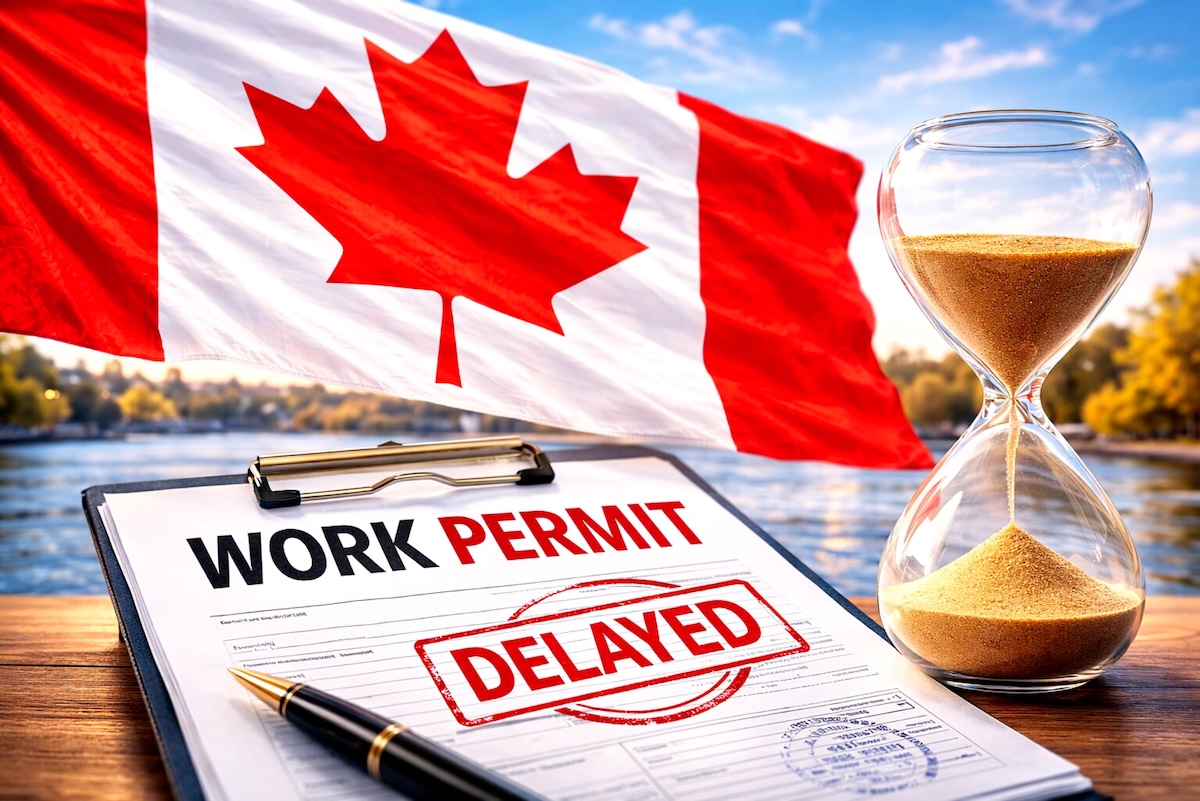
As of March 11, 2026, Immigration, Refugees and Citizenship Canada (IRCC) reports that the inland work permit processing average, including extensions, has reached 259 days.
If you applied for a work permit from inside Canada in 2026, the wait just got longer again.
That translates to roughly eight and a half months of waiting for a document that many applicants need simply to keep earning a living.
Some applications can take longer than 259 days, while others can be processed much sooner, as these are the average processing times for 80% of the applications processed by IRCC.
This is not a sudden spike. It is a persistent, week-after-week escalation that has now added 49 days to the timeline since the end of December 2025 and 18 days since January 28, 2026 alone.
No other IRCC processing time category has moved this consistently in one direction over such a compressed period.
For the hundreds of thousands of temporary foreign workers already in Canada, the consequences of this growing backlog extend well beyond simple inconvenience.
Extended processing times create uncertainty around employment continuity, travel eligibility, access to provincial health coverage, and the ability to plan for permanent residency pathways.
This article breaks down what is happening, why the numbers keep climbing, what applicants can do to protect themselves, and where this trend may be heading in the months ahead.
The Numbers at a Glance
Before diving into the analysis, here is a snapshot of the three inland extension categories that IRCC updated on March 11, 2026.
These figures reflect the time within which 80% of applicants received a decision.
By the numbers: The inland work permit timeline has expanded by an average of roughly five days per week over the past 10 weeks.
If that pace continues unchanged, processing could exceed 300 days before summer 2026.
Tracking the Upward Trajectory Since December 2025
To grasp the severity of the current situation, it helps to trace the progression over time.
At the end of December 2025, IRCC reported inland work permit processing at approximately 210 days.
By January 28, 2026, that figure had climbed to 241 days. The February 2026 update showed 246 days.
By the first weekly snapshot of March 2026, the number hit 258 days. Now, as of March 11, it stands at 259 days.
What makes this escalation particularly alarming is its consistency.
Unlike other IRCC categories that bounce between increases and decreases from one reporting period to the next, the inland work permit figure has moved in a single direction for every update since the start of the year.
There has been no week in 2026 where it declined, held flat, or even slowed meaningfully in its climb.
That kind of sustained upward momentum points to something more structural than a temporary surge.
It suggests that the volume of applications flowing into the inland work permit pipeline is systematically outpacing IRCC’s capacity to clear them on the other end.
Why Inland Work Permit Processing Keeps Climbing
IRCC has not issued a formal explanation for the sustained increase in inland work permit processing times. However, several factors are almost certainly contributing to the trend.
The first and most obvious is application volume. Canada admitted record numbers of temporary foreign workers in recent years, and many of those individuals are now filing renewals and extensions from inside the country at the same time.
Each wave of arrivals creates a corresponding wave of renewal applications roughly two to three years later. The system is likely absorbing the peak of one such wave right now.
Policy changes introduced in late 2024 and throughout 2025 also play a role.
The federal government tightened eligibility criteria for several work permit streams, introduced new compliance requirements for employers, and made adjustments to Labour Market Impact Assessment rules.
These changes added new layers of documentation and verification to each application, which means individual files take longer to adjudicate even when the officer handling them works at full speed.
The complexity of inland applications adds to the challenge. Unlike applications filed from abroad where an applicant’s admissibility can be assessed before they enter Canada, inland applications often involve people who have accumulated complicated immigration histories.
Employer changes, status transitions, dummy extensions, previous refusals, or flagged security profiles can all trigger additional review steps that extend processing timelines for the entire queue.
Finally, IRCC’s digital infrastructure may be under strain. The department has been migrating to new processing platforms over the past several years, and transitions of this scale inevitably create temporary inefficiencies as staff adapt to new workflows and systems.
Visitor Record Extensions Are Surging Even Faster
The inland work permit figure is concerning on its own, but it is not the only extension category experiencing severe delays.
Visitor record and visitor extension processing has reached 245 days as of March 11, 2026.
That represents a 19 day jump in just one week and a staggering 84 day increase since January 28, 2026.
To put the rate of acceleration in perspective, visitor extensions added more days in the past 10 weeks than inland work permits added over the same period.
The weekly rate of increase has been far more aggressive, suggesting that the visitor extension queue may be growing even faster relative to IRCC’s capacity to process it.
Critical alert: Visitor record extensions rose by 19 days in a single week, reaching 245 days.
Visitors seeking to extend their stay in Canada should file their applications as far in advance as possible to preserve their legal status while IRCC adjudicates the request.
This matters for work permit applicants because the same inland processing infrastructure handles multiple application types.
When one category surges, it can create ripple effects across others as IRCC shifts resources to manage competing priorities.
A sharp rise in visitor extension applications may be diverting officer attention from the work permit queue, or both categories may simply be overwhelmed by the same underlying capacity constraints.
Study Permit Extensions Offer a Rare Bright Spot
Not all extension categories are heading in the wrong direction. Study permit extensions dropped to 85 days as of March 11, 2026, shedding five days from the prior week and sitting 19 days below the January 28 level.
Positive trend: Study permit extension processing fell to 85 days, continuing a steady decline since late January.
This category is moving in the opposite direction of work permits and visitor extensions in comparatively longer run.
The divergence between study permit extensions and the other two categories is notable.
It indicates that IRCC capping on PAL/TAL conditions is working as part of its broader effort to meet commitments around international education.
Whatever the reason, the improving trajectory is welcome news for international students who need to renew their study authorization while remaining enrolled at Canadian institutions.
The contrast also reinforces a key insight about how IRCC operates. Processing times are not monolithic.
Understanding Implied Status During the Wait
For anyone staring down a 259 day wait for a work permit decision, understanding the concept of implied status is essential.
Under Canadian immigration regulations, a temporary resident who submits a renewal or extension application before their current permit expires is considered to have maintained lawful status in Canada until IRCC renders a decision on the new application.
This is commonly referred to as implied status.
In practical terms, implied status means you can continue working under the same conditions as your expiring or expired work permit while IRCC processes your renewal.
You do not need to stop working on the day your old permit expires, provided your renewal application was already in the IRCC system before that expiry date.
However, implied status has important limitations that every applicant should understand clearly. It only maintains the conditions of your most recent permit.
If your previous work permit authorized you to work for a specific employer, implied status allows you to keep working for that same employer under those same conditions.
It does not grant broader work authorization or allow you to take on a different role or employer without a separate application.
Implied status also does not produce a physical document. You will not receive a letter or card confirming your implied status.
The evidence consists of your expired work permit combined with proof that you submitted your renewal application before the expiry date.
Many applicants keep a copy of their application confirmation, payment receipt, and a screenshot of their IRCC portal showing the pending application as their proof.
One of the most common challenges with implied status arises around travel. Implied status applies within Canada only.
If you leave the country while on implied status, you may face complications at the border when attempting to return.
Without a valid physical work permit, re entry is not guaranteed, and a border officer will assess your situation based on the information available at that moment.
For this reason, many immigration professionals advise against international travel during the implied status period unless it is absolutely necessary.
What To Expect for the Rest of 2026
Predicting IRCC processing times with certainty is impossible, but the data trends and policy landscape offer some clues about where inland work permit processing may be headed.
On the concerning side, there is no public indication that IRCC has launched a targeted backlog reduction initiative for inland work permits.
Without a dedicated surge in officer allocation or a streamlining of the adjudication process, the upward trend is likely to continue for at least the next several weeks, given that record work permits are expiring in 2026.
Many are applying for dummy work permit extensions to continue their stay on implied status for at least around 259 days.
It may sound good for the short term but is a big negative in the Canadian immigration journey for the long term.
Furthermore, the federal government’s stated intention to reduce the number of temporary residents in Canada could, paradoxically, increase processing times in the short term.
As eligibility criteria tighten and more applications require additional scrutiny to determine whether they meet new standards, individual file processing times may lengthen even as the overall volume of new applications eventually declines.
Immigration policy announcements later in the year could also shift the picture.
If the government introduces legislative or administrative changes to expedite inland processing, such as expanding the use of automated decision tools or simplifying documentation requirements for straightforward renewal cases, the impact could materialize relatively quickly.
However, no such announcements have been made as of this writing.
In the absence of clear signals from IRCC, the safest assumption for applicants is that an average of 259 days represents a floor rather than a ceiling.
Planning around the possibility of a nine- to ten-month wait is prudent.
Hoping for a faster outcome is reasonable, but building your life plans around that hope is not.
For the latest developments on Canadian immigration news, evolving policy landscapes, and IRCC processing times, save this page and return regularly as new weekly and monthly data drops throughout 2026.
Frequently Asked Questions (FAQs)
What is implied status and how does it protect work permit holders in Canada?
Implied status is a provision under Canadian immigration law that allows temporary residents to continue working under the same conditions as their previous permit while IRCC processes a renewal or extension application. To qualify, you must submit your renewal before your current work permit expires. Once the application is in the system, you are legally entitled to keep working under the same employer and conditions until IRCC issues a decision, even if that takes months. Implied status does not produce a new physical document. It simply extends the legal authority of your existing permit while the new one is pending.
Can I change employers while my work permit renewal is processing inside Canada?
If you hold an employer specific work permit and have applied for a renewal, implied status only covers work under the same conditions as your previous permit. That means you generally cannot switch to a different employer while waiting for your renewal decision. If you need to change employers, you would typically need to submit a new work permit application naming the new employer, supported by a valid Labour Market Impact Assessment if required. Open work permit holders have more flexibility since their authorization is not tied to a single employer.
Does my LMIA remain valid if IRCC takes months to process my work permit inside Canada?
A Labour Market Impact Assessment is valid for six months from the date it is issued, during which a work permit application must be submitted. Once your application has been filed within that six month window, the LMIA has served its purpose and its expiry date no longer affects the processing of your file. However, if IRCC finds issues with the LMIA during review, they may request clarification or additional documentation from the employer, which could add further delays to an already lengthy timeline.
Can I apply for permanent residency while waiting for my work permit renewal decision?
Yes, you can submit a permanent residency application while your work permit renewal is pending. A pending work permit application does not disqualify you from applying through Express Entry, a Provincial Nominee Program, or any other PR pathway. However, you should ensure that you continue to meet all eligibility requirements for the PR stream you are applying under, including valid work experience and language test scores. If your PR application requires proof of valid work authorization, your implied status combined with your application confirmation receipt typically satisfies that requirement.
Will IRCC notify my employer if my work permit application is delayed or refused?
IRCC does not proactively communicate with employers about the status of an employee’s work permit application. All correspondence goes directly to the applicant or their authorized representative. If your application is delayed, it is your responsibility to keep your employer informed about your situation. If your application is refused, you must stop working immediately unless you have another valid basis to work in Canada. Employers can use the Employer Portal to verify whether a foreign worker holds a valid work permit, but the portal does not reveal pending application details.

Kamal Deep Singh, RCIC (Regulated Canadian Immigration Consultant) licensed by CICC (formerly known as ICCRC) with member number R708618. He brings extensive knowledge of immigration law and new changes to rapidly evolving IRCC.


by Satinder Bains
12 March 2026, 8:55 AM EDT12 March 2026, 11:39 AM EDT


by Satinder Bains
10 March 2026, 4:10 PM EDT11 March 2026, 11:03 AM EDT



Load More Post
Something went wrong. Please refresh the page and/or try again.
You may also like: New Minimum Wage In 5 Canadian Provinces Effective April 1
New Canada Minimum Wage Increase Coming in 2026