
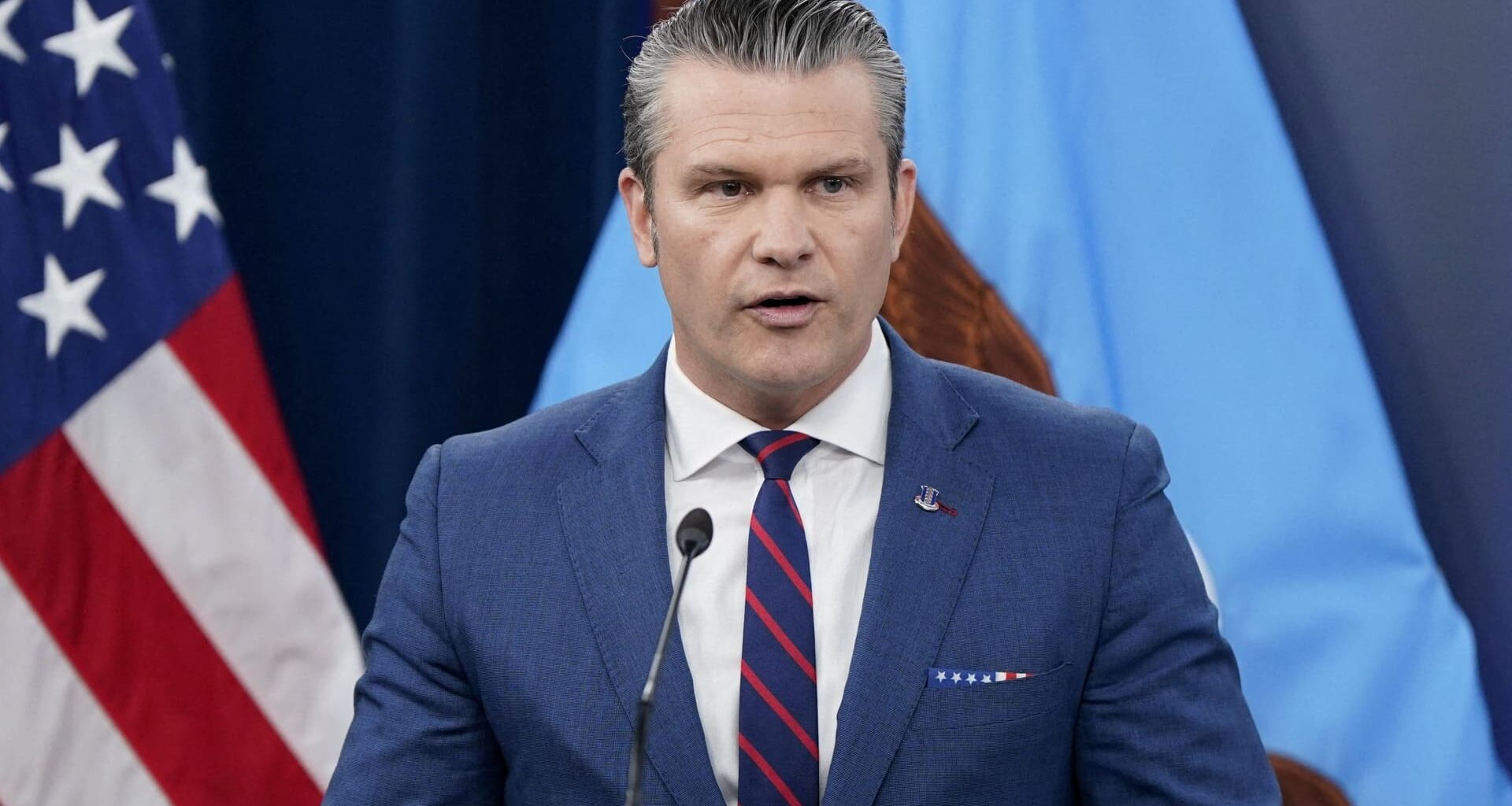
U.S. Secretary of Defense Pete Hegseth holds a briefing amid the U.S.-Israeli conflict with Iran, at the Pentagon in Washington, D.C., U.S., March 2, 2026.
Elizabeth Frantz | Reuters
Defense Secretary Pete Hegseth on Friday brushed aside concerns that the effective closure of the Strait of Hormuz because of the Iran war, which has spiked oil prices, would continue being a problem for the U.S. and the world for much longer.
Iran has been “exercising sheer desperation in the Straits of Hormuz,” Hegseth said at a Pentagon press briefing.
“We have been dealing with it, and don’t need to worry about it,” he said.
The trading price of West Texas Intermediate crude oil on Friday morning was around $93 per barrel. A day before the war began on Feb. 28, a barrel of WTI was selling for about $67.
Hegseth criticized media reports that claimed that before attacking Iran, the United States military lacked a plan to reopen the Strait of Hormuz, which is the world’s most critical oil shipping chokepoint.
“Of course, for decades, Iran has threatened shipping in the Strait of Hormuz. This is always what they do, hold the strait hostage,” he said.
“We planned for it. We recognize it,” Hegseth told a reporter who asked him why the Pentagon had not planned for the strait being choked off to traffic.
“Ultimately, we want to do it sequentially in the way that makes the most sense for what we want to achieve.”
Read more U.S.-Iran war news
Neither Hegseth nor Joint Chiefs of Staff Chairman Dan Caine said how the U.S. would open up the strait to the traffic of oil tankers and other ships.
On Thursday morning, Energy Secretary Chris Wright told CNBC that the U.S. Navy is not ready to escort oil tankers through the strait. Treasury Secretary Scott Bessent, hours later, told Sky News that the U.S. Navy, and possibly an international coalition, would begin escorting ships through the strait as soon as “militarily possible.”
Asked how soon the Strait of Hormuz would be open to traffic, Hegseth said Friday, “The only thing prohibiting transit in the straits right now is Iran shooting at shipping.”
“We have a plan for every option here,” he said. “We’re working with our interagency partners. That’s not a strait we’re going to allow to remain contested or a lack of flow of international goods.”
Caine, when asked about removing mines from the Strait of Hormuz laid by Iran, said, “We retain a range of options to solve a whole variety of problems.”
Hegseth predicted, again, that “soon and very soon, all of Iran’s defense companies will be destroyed.” He said that as of two days ago, every company that builds components of Iran’s ballistic missiles “has been functionally defeated.”
The Defense secretary speculated that Iran’s “new so-called, not-so-supreme leader,” Mojtaba Khamenei, “is wounded and likely disfigured.”
“He put out a statement yesterday, a weak one, actually, but there was no voice and there was no video,” Hegseth said.
Hegseth and Caine’s vagueness in offering either details of a possible solution to the strait’s closure, or a timeline for such a solution came as RBC Capital Markets, in a note on Friday, said, “There is significant skepticism that a robust US Navy tanker escort service will be operational soon due to capacity constraints as well as the fact that Iran’s enhanced military capabilities will pose a bigger challenge than the US faced during the Tanker Wars of the 1980s.”
The note also said that a $20 billion insurance promoted by the U.S. International Development Finance Corp., to encourage oil tankers and other commercial vessels to begin ffic to begin transiting the straight “similarly … is not generating much enthusiasm as it only covers the roughly 22 miles of sea lanes in the Strait, not the surrounding waterways, and offers neither casualty nor environmental coverage.”
“Above all, we are struck by the fact that a number of Washington-based security analysts seem to be working with longer-duration timelines than market participants residing outside the Beltway,” RBS’s Helima Croft, head of global commodity strategy and MENA research, wrote.