
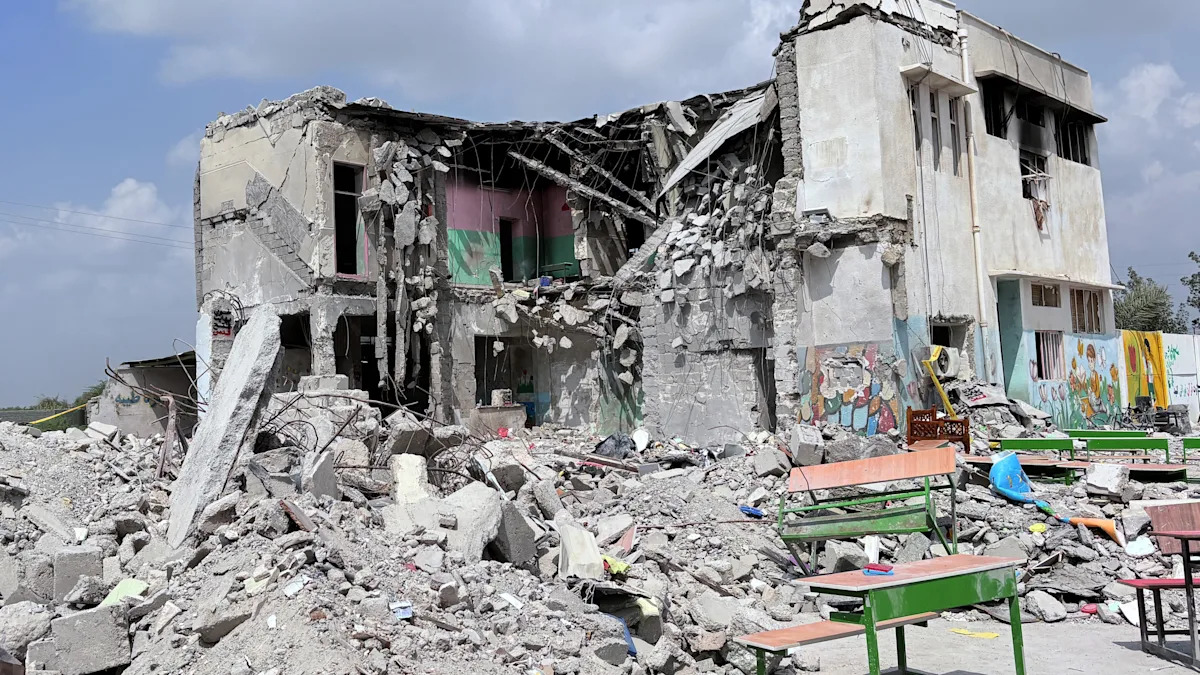
On Feb. 28 — the day the United States launched its first wave of attacks on Iran — a missile struck the Shajarah Tayyebeh elementary school for girls in Minab, near the Strait of Hormuz. At least 175 people were killed, according to Iranian officials. Most of them were children.
And now it looks like the U.S. was responsible for the deadly attack.
An ongoing U.S. military investigation has determined that the school was destroyed by an American Tomahawk cruise missile as the “result of a targeting mistake,” according to U.S. officials and others familiar with the preliminary findings who spoke to the New York Times. (Reuters first reported on March 5 that “military investigators believe it is likely that U.S. forces were responsible.”)
The Times went on to characterize the strike on a school full of young girls as “one of the most devastating single military errors in recent decades.” It has been condemned by the Iranian government, UNESCO and other human rights organizations and activists as a violation of international humanitarian law.
As of Thursday afternoon, the U.S. has not officially accepted responsibility. At first, President Trump blamed the Iranians; in recent days, he has pivoted to saying he is unaware of his administration’s preliminary findings. Other members of the Trump administration have declined to comment, saying only that the incident is under investigation.
On Friday, Defense Secretary Pete Hegseth said that U.S. Central Command had designated a general officer “from outside CENTCOM” to further investigate the attack.
“The command investigation will take as long as necessary to address all the matters surrounding this incident,” Hegseth added.
Here’s everything we know so far about the Shajarah Tayyebeh strike.
What happened
A missile struck Shajarah Tayyebeh mid-morning on Saturday, Feb. 28. (Saturday is a workday in Iran.) The U.S.-Israeli onslaught began around 10 a.m., just as students were arriving at school. In response, Shajarah Tayyebeh decided to close for the rest of the day, according to an Iranian teachers’ representative, but parents were unable to retrieve their children in time.
By 10:45, Shajarah Tayyebeh had been hit.
The impact destroyed at least half of the two-story school building. Videos and images verified by U.S. media outlets showed dozens of Iranians gathered around the partially collapsed structure as black smoke billowed from its windows. According to the Times, “emergency workers with the Red Crescent” — the equivalent of the Red Cross in Muslim-majority countries — “could be seen alongside families desperately combing through the rubble, which was littered with schoolbooks and book bags covered in blood and ashes.”
What remained of the school’s blue, muraled walls — crayons, flowers, leaves, an apple, a child reading — could be seen in the background.
Rescue workers retrieved a severed arm from the rubble. Victims were laid out in body bags at the scene.
According to the Iranian Ministry of Education, 264 students were present at the time of the attack. Most of them were girls between the ages of 7 and 12. In addition to the dead, Iranian officials have said the strike injured nearly 100 people — making it the worst mass civilian casualty event of the war so far and one of the worst in recent U.S. military history.
“The Minab school incident has no comparison with any other incident,” the head of Iran’s Red Crescent said, in a March 1 video posted on social media.
“Even in Gaza” so many students had never been killed simultaneously, he added, calling the attack “a unique and bitter incident.”
What U.S. investigators have found
Initial speculation focused on Israel, but subsequent reporting linked the strike to the United States.
The evidence has been mounting for more than a week.
Shajarah Tayyebeh is located right next to a naval base that belongs to Iran’s Revolutionary Guard, or IRGC — the country’s most powerful military force. In fact, the school building used to be part of the base.
Satellite images show that by September 2016, the building had been walled off and separated from the adjacent military compound. According to the Times, “watchtowers that once stood near the building had been removed, three public entrances were opened to the school, ground was cleared and play areas including a sports field were painted on asphalt, and walls were painted blue and pink.”
Yet after U.S. officials confirmed that U.S. forces were attacking naval targets near the Strait of Hormuz on the day in question, the Times and other outlets were able to determine by March 5 that the school strike occurred “at the same time” as attacks on the IRGC’s adjacent naval base. The timing suggested that U.S. forces, not Israeli forces, were “most likely to have carried out the strike.”
A few days later, on March 8, Iran’s government-sponsored Mehr News Agency uploaded a video — subsequently verified by the Times and others — showing a Tomahawk cruise missile striking the IRGC naval base next to Shajarah Tayyebeh.
The U.S. military is the only force involved in the conflict that uses Tomahawks.
On March 9, Iran’s state broadcaster posted photos of mangled missile fragments on Telegram and claimed they were “the remains of the American missile that landed on the children of Minab school.” The Times verified that the fragments bore “the markings” of “a U.S.-made Tomahawk cruise missile manufactured in 2014 or later” (while also noting that “it is not clear where or how the fragments were recovered — or whether they pertain specifically to the school strike”).
When asked on March 4 if the United States had struck the school, White House press secretary Karoline Leavitt said, “Not that we know of.” She added that “the Department of War is investigating this matter.”
Now, according to the Times, a preliminary U.S. military investigation has confirmed what many had come to fear: that “the Feb. 28 strike on the Shajarah Tayyebeh elementary school building was the result of a targeting mistake by the U.S. military, which was conducting strikes on an adjacent Iranian base of which the school building was formerly a part.”
How could U.S. forces make such a disastrous targeting mistake? People briefed on the investigation told the Times that “officers at U.S. Central Command created the target coordinates for the strike using outdated data provided by the Defense Intelligence Agency.” In effect, they said, the DIA should have updated its “target coding” — perhaps with new imagery or data from the National Geospatial-Intelligence Agency — to differentiate the school building from the IRGC base. Instead, they “labeled the school building as a military target” and then passed that erroneous information to Central Command.
What Trump has said
March 7: “No, in my opinion, based on what I’ve seen, that was done by Iran,” Trump said when a reporter aboard Air Force One asked if the U.S. had bombed Shajareh Tayyebeh. “We think it was done by Iran — because they are very inaccurate, as you know, with their munitions. They have no accuracy whatsoever. It was done by Iran.”
A reporter then asked Defense Secretary Pete Hegseth, who was standing nearby, whether he agreed with the president. “We’re certainly investigating,” Hegseth said. He then added that “the only side that targets civilians is Iran.”
March 9: At a press conference in Miami, a reporter confronted Trump about “footage that shows that an American missile strike and a Tomahawk missile likely destroyed that Iranian girls’ school.”
“Will the U.S. accept any responsibility for that strike?” the reporter asked.
“Well, I haven’t seen it, and I will say that the Tomahawk, which is one of the most powerful weapons around is … sold and used by other countries,” Trump responded. “And whether it’s Iran, [which] also has some Tomahawks. They wish they had more. But whether it’s Iran or somebody else, the fact that a Tomahawk — a Tomahawk is very generic. It’s sold to other countries. But that’s being investigated right now.”
The only other countries that use Tomahawks are Japan, the United Kingdom, Australia and the Netherlands, according to the Center for Strategic and International Studies. Iran doesn’t have any Tomahawks. Pressed to explain why he believed that “Iran somehow got its hands on a Tomahawk and bombed its own elementary school on the first day of the war,” Trump backtracked a little.
“I just don’t know enough about it. I think it’s something that I was told is under investigation,” he said. “Whatever the report shows, I’m willing to live with that report.”
March 10: Citing a “new report” about military investigators’ preliminary finding of U.S. culpability, a reporter asked Trump outside the White House if he would take responsibility for the school strike as commander in chief.
“I don’t know about that,” he said.
“The investigation is still ongoing,” Leavitt, the White House press secretary, said in a statement. She has also said that Trump will accept the results of the U.S. military investigation.
Will anyone be held accountable?
The day after the strike, UNESCO — the United Nations’ cultural and education agency — said in a statement that “the killing of pupils in a place dedicated to learning constitutes a grave violation of the protection afforded to schools under international humanitarian law.”
Intentionally attacking a school, hospital or other civilian structure is a war crime; indiscriminate strikes also violate the law. Mistakes are more complicated, as a legal matter.
On Thursday, 46 Democratic senators sent a letter to Hegseth demanding a “swift investigation into the strikes on this school and any other potential U.S. military actions causing civilian harm.”
“To be clear, the war against Iran is a war of choice without Congressional authorization,” the senators wrote. “Nonetheless, as these military actions continue, the United States and Israel must abide by U.S. and international law, including the law of armed conflict.”
Citing Hegseth’s recent vow that Operation Epic Fury would have “no stupid rules of engagement” — just “death and destruction from the sky all day long” — the senators accused him of “abandoning the Defense Department’s commitment to minimizing civilian harm in U.S. military operations.”
Last year, Hegseth slashed the Pentagon oversight offices that would have investigated the school strike, including the Civilian Protection Center of Excellence, a group that assists in limiting risk to civilians. According to Politico, about 90% of the 200 employees who previously worked on civilian casualties have been eliminated.
Is AI to blame?
Some have speculated that artificial intelligence may have misidentified Shajarah Tayyebeh as a military target. Claude, the large language model created by Anthropic, works with U.S. government systems and software to identify points of interest for military intelligence officers. But it doesn’t directly create targets.
U.S. officials told the New York Times that investigators have been looking into AI — and other technical intelligence-gathering methods — as a possible problem. But the same officials said “the error was unlikely to have been the result of new technology,” according to the paper. “Instead, they said, it likely reflected a common — but sometimes devastating — human error in wartime.”
Intelligence officers are supposed to verify that targeting data is correct, and CENTCOM is responsible for checking any information received from other agencies. But sometimes this doesn’t happen in fast-moving situations — like the opening days of a war. The consequences can be tragic.