
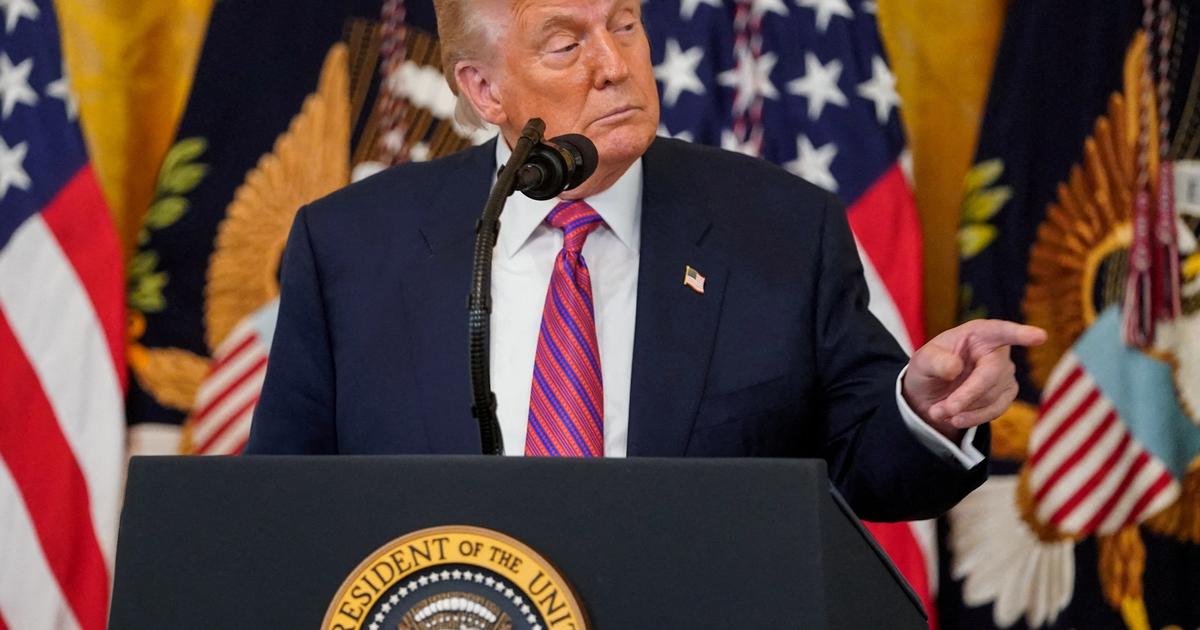
Trump issued the warning in a post on Truth Social, saying any attempt by Iran to mine the narrow maritime passage would trigger a severe response.
“If Iran has put out any mines in the Hormuz Strait, and we have no reports of them doing so, we want them removed, IMMEDIATELY! If for any reason mines were placed, and they are not removed forthwith, the Military consequences to Iran will be at a level never seen before,” he wrote.
“If, on the other hand, they remove what may have been placed, it will be a giant step in the right direction!”
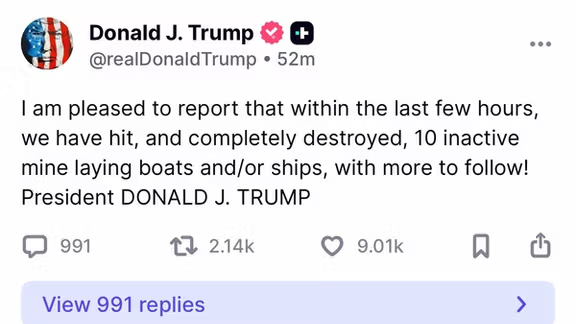
He later said American forces have destroyed 10 inactive Iranian mine-laying boats and ships in recent hours, warning that additional strikes could follow.
CBS News earlier quoted US officials as saying that Iran may be preparing to deploy naval mines in the strategic waterway in an attempt to further disrupt shipping through the Persian Gulf. According to the officials, Tehran could use small boats capable of carrying two or three mines each to place them in the strait.
The warning comes as the United States continues to review options to protect maritime traffic in the region.
The chairman of the Joint Chiefs of Staff said Tuesday the Pentagon is examining possible measures, including escorting commercial vessels through the Strait of Hormuz, a route through which roughly a fifth of global oil supplies pass.
“We are looking at a range of options to set the military conditions to be able to do that,” Gen. Dan Caine said during a briefing when asked about escorting ships.
He said officials are evaluating the risks and resources required for such an operation.
The White House also signaled that the administration is preparing additional steps to ensure the strait remains open.
Press Secretary Karoline Leavitt said the Trump administration has already offered political risk insurance to tankers operating in the Persian Gulf and temporarily waived certain oil-related sanctions.
She added that Trump has also offered the US Navy to escort tankers if necessary, but confirmed that no ship has been escorted yet, days after the idea was first raised to reassure maritime trade companies.
“The President and his energy team are closely watching the markets, speaking with industry leaders, and the US military is drawing up additional options, following the President’s directive to continue keeping the Strait of Hormuz open,” Leavitt said.
Iran’s Guards threaten commercial ships
Iranian officials have meanwhile doubled down on their own warnings over access to the strait.
Alireza Tangsiri, commander of the naval forces of Iran’s Revolutionary Guard, said ships linked to what he called “aggressors” would not be allowed to pass through the Strait of Hormuz.
“If you have doubts, come closer and test it,” Tangsiri wrote on X.
Earlier, the Revolutionary Guards said Arab or European countries that expel Israeli and US ambassadors from their territories would be granted full freedom of transit through the strait starting Tuesday.
US officials say the military campaign against Iran has already reduced Tehran’s ability to carry out attacks.
Gen. Caine said ballistic missile launches have dropped sharply since the start of Operation Epic Fury.
“Ballistic missile attacks continue to trend downwards, 90% from where they started, and one-way attack drones have decreased 83% since the beginning of the operation,” he said.
Defense Secretary Pete Hegseth said the United States and Israel were “winning decisively” in the conflict and vowed the campaign would continue until its objectives are achieved.
The goals of Operation Epic Fury, he said, remain destroying Iran’s missile stockpiles, launchers and defense industrial base, degrading its naval capabilities and ensuring Tehran cannot obtain nuclear weapons.
“Our will is endless, but ultimately the president gets to determine the end state of those objectives,” Hegseth said.