
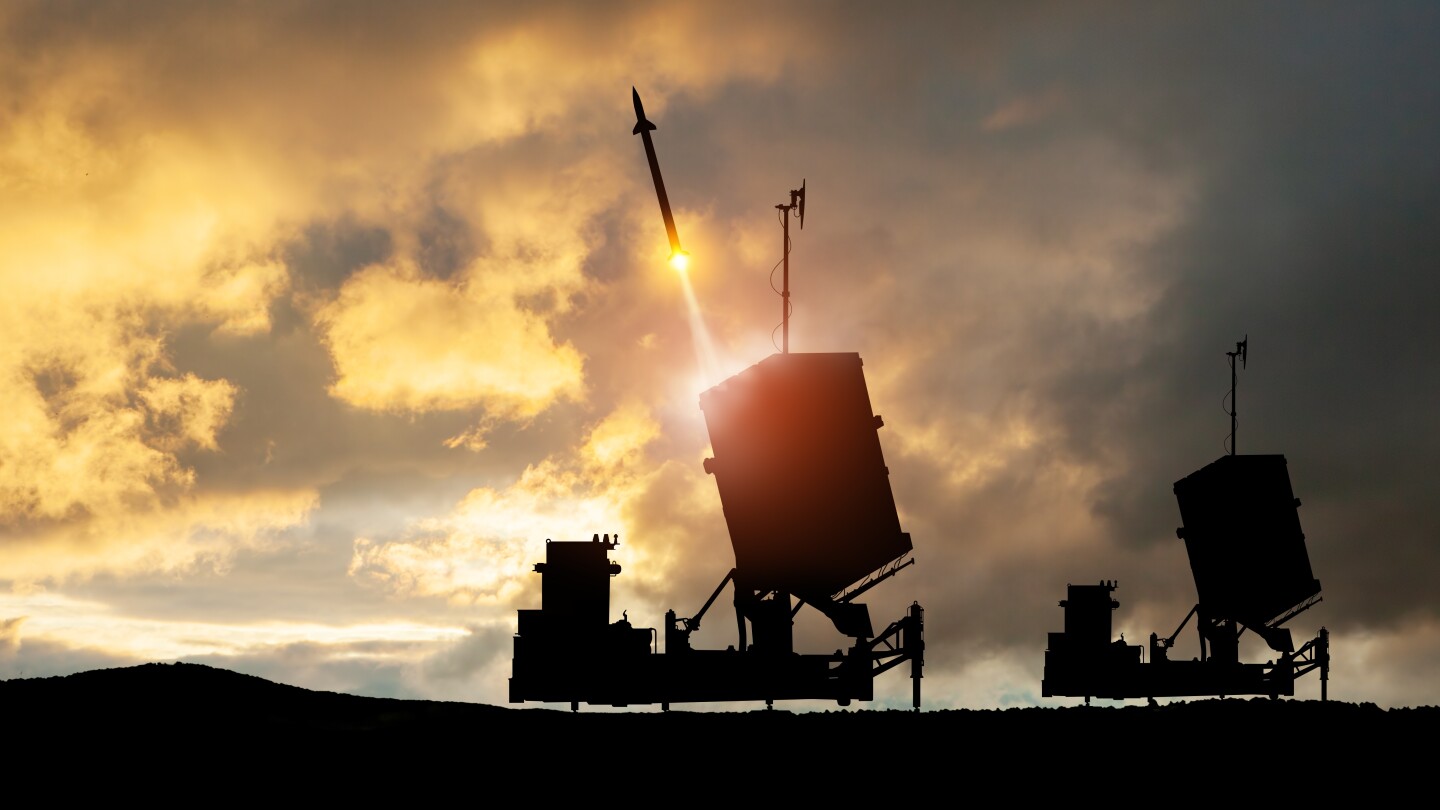
The home front. I was on the platform at Tel Aviv’s Savidor Mercaz train station on Monday afternoon as two air-raid warnings followed one another in close succession.
The first came by way of the mobile phones of everyone on the platform that began to vibrate with the oddly urgent high-pitched whistling sound the Home Front Command has decided is the most appropriate way to inform Israelis that heavy Iranian ordnance is heading their way. The written warning that accompanies the whistling instructs the recipient to make their way to a shelter as soon as possible.
The platform emptied and within minutes was deserted, except for a small collection of bold or troubled souls who had decided for whatever reason not to take shelter.
The platform emptied and within minutes was deserted, except for a small collection of bold or troubled souls who had decided for whatever reason not to take shelter. After a couple of minutes, air-raid sirens signalled that the attack was imminent. There followed the sound of loud crumps and a series of explosions, interceptions or landings of missiles. Then silence. And then, after a minute or so, a relaxing of tension and a rapid, quiet return to routine.
This scene, or something resembling it, plays out several times a day in central Israel at present.
The second warning, which came about 10 minutes later, wasn’t preceded by the whistling phones. We proceeded directly to the sirens. That was because the missiles in question were coming not from Iran but from the proximity of Lebanon, fired by Hezbollah, Tehran’s proxy in the Levant. The drill was much the same.
Israel’s air defences are holding, even as Israeli and US air power operates freely over Iranian skies, laying waste to Iranian missile capacities and, increasingly, to targets related to governance. So far, 12 Israelis have died as a result of the Iranian and Hezbollah missile and drone attacks.
Israeli domestic support for the war is holding, too, with all polls showing an overwhelming majority in favour of the campaign continuing.
The outbreak of the war found me in London. With Israeli airspace closed, I made my way back via Cairo airport and overland through Sinai to the Taba border crossing. My arrival at the border coincided with the arrival of the first of the “rescue flights” bringing stranded Israelis home via Athens to Egypt’s Taba airport and then Eilat. I watched with a certain wonder as hundreds of Israelis filed through the Egyptian and then the Israeli border procedures.
It has become a cliche of Israel’s information campaigns to note that rescue flights usually are engaged in taking people out of war zones, not bringing them back into one. It remains true, nevertheless, and notable.
A day after my arrival, as I made my way to buy provisions through the near empty streets of Jerusalem, a woman asked me where I’d come in from. “London,” I replied. She made an expression of sympathy. “Yes, it’s difficult there, isn’t it?” This might sound counterintuitive. We were in a few quiet hours between air-raid warnings. But it isn’t.
The conflict of the past two years and the widespread response to it in some Western countries have indicated to many Israelis that we are back in Jewish historical time. That is, isolated and without much hope of fair assessment or judgment from considerable parts of the world.
It has become a cliche of Israel’s information campaigns to note that rescue flights usually are engaged in taking people out of war zones, not bringing them back into one.
From this point of view, being under the threat of Iranian missiles comes at least with the knowledge that you know where the enemy is located, where your friends are to be found and the clear dividing line between the two.
That this is now the mainstream or a mainstream Israeli response to the current situation is a remarkable and not especially heartwarming indication of the nature of the times we are living in.
Episode in a long war
So how is the war proceeding? It is probably a mistake to see the current round of hostilities between Israel, the US and the Islamic Republic of Iran as meriting the status of a separate conflict that began on February 28, 2026, and presumably will end at some stage in coming days or weeks.
Rather, this is the latest episode in an ongoing contest that effectively has been under way since the Islamic Revolution in Iran in 1979. In this contest, the Iranian regime is seeking to emerge as the dominant strategic force in the region.
This ambition is to be realised through a long war strategy intended to result in the destruction of Israel, dominance of key Arab countries by Iranian proxies, the transformation of Gulf countries into Iranian clients and the expulsion or severe diminishing of the US in the region.
This strategy has been in implementation in recent decades. The Iranian nuclear program, its ballistic missile program and its support for armed proxies throughout the region constitute its three key components.
While simplistic and overly linear connections should be avoided, it is a fact that this ambition cannot be separated from the broader, global geostrategic picture.
Iran was able to ride out the first Trump administration’s strategy of “maximum pressure” because of Chinese willingness to continue purchasing Iranian oil. Now negotiation of a deal for Iranian purchase of Chinese CM-302 anti-ship missiles is in its final stages. Reports in recent days have noted that two Iranian state-owned cargo ships have set out from China’s Gaolan port. Western governments suspect the ships are carrying sodium perchlorate, a vital ingredient in the production of propellant for ballistic missiles.
Similarly, Iran has sold $US4bn worth of weaponry to Russia in the course of the past half decade, most significantly the Shahed 136 drones that have reaped a steady toll in strikes against Ukraine. In turn, Tehran has bought helicopters, armoured vehicles and aircraft from Moscow.
The current Middle East war is a component in a larger global power contest. It is also the case that the larger contest is not yet being fought kinetically on all its fronts.
In neither case, of course, have these powers offered large-scale, open, kinetic assistance to Iran’s war effort. This should not be allowed to obscure the lines of co-operation and links between these powers. The current Middle East war is a component in a larger global power contest. It is also the case that the larger contest is not yet being fought kinetically on all its fronts. These two facts are not in contradiction.
With a touch of hubris, Israeli and American commentators after the 12-day war last year, the fall of the Assad regime in December 2024 and Hezbollah’s signing of a ceasefire deal with Israel in November that year concluded that the Iran-led Mehwar al-Muqawama (axis of resistance) was a busted flush. This was not so. Nevertheless, the Iranian regime suffered serious and indeed unprecedented setbacks. Defeated in Gaza, Lebanon and Syria, the regime appeared for a moment in January to be on the ropes, facing the fury of its own people in the most determined internal unrest since 1979.
This moment appears to have passed for now. The Iranian regional alliance is much diminished. It is not, however, conclusively defeated and the regime does not appear to be in immediate danger.
Contrasting US and Israeli strategies
For Israel, this war offers an opportunity to degrade Iranian capacities further, even in the absence of regime change. With Israel’s own skies well defended, Jerusalem has no particular incentive to seek an off-ramp and every reason to want to continue to reduce the capabilities of its most significant enemy.
The chance has been enthusiastically embraced. Roughly two-thirds of Iran’s missile arsenal capable of reaching Israel are no more. Half of Tehran’s ballistic missile launchers have been destroyed. Iran’s air defences have almost been removed in their entirety.
Israel estimates that about 3000 members of Iran’s security forces have been killed. A significant part of the Israeli effort consists of targeting regime personnel and key sites. The Israeli strategy in this round of fighting is neither mysterious nor especially complex.
Israel of course would like to see the Iranian regime fall. It is cognisant, however, of the fact that air power, while awesome in its capabilities, cannot of itself change regimes. History offers no examples of this.
To destroy the Iranian regime, one of two things must happen: an army must advance and conquer the Iranian capital; or a popular revolution/insurgency must take on the regime and win.
Israel is bombing Basij and Islamic Revolutionary Guard Corps sites across Iran, including in the restive border provinces, the better to enable popular action.
There is no prospect of the former happening, for obvious reasons. For the latter to succeed, probably some element of the regime itself would need to cease to obey its orders – such a thing cannot be induced from outside.
History is full of examples, modern and less recent, of states helping to facilitate, finance, train and support local revolutionary and insurgent movements. But ultimately, popular revolutions follow their own dynamic. So Israel is bombing Basij and Islamic Revolutionary Guard Corps sites across Iran, including in the restive border provinces, the better to enable popular action.
But in the end the action itself will come because of the Iranian people’s will. As of now, following the brutal repression that took place in January, there are no serious signs of renewed mass unrest.
From Jerusalem’s point of view this is regrettable, but it doesn’t remove all options.
If the Iranian regime won’t fall soon and won’t end its regional ambitions, including the destruction of Israel, then what remains is to weaken it as much as possible. This goal is being achieved.
The US has a different strategic calculus. It is possible that at a certain point in coming weeks the Trump administration will choose to conclude its campaign somewhere short of the destruction of the regime. The impact of events on gas and oil prices, the blocking of the Strait of Hormuz, along with the probably unachievable stated goal of “unconditional surrender”, mean that at a certain point the administration may declare itself satisfied and cease further action.
A “Venezuela type” solution, which may have been what the administration was hoping for, is extremely unlikely to emerge. The Islamic regime in Iran will survive or it will be destroyed. But the prospect of it producing a pliant, Delcy Rodriguez-type leader is close to non-existent. New Supreme Leader Mojtaba Khamenei is no less and maybe more of a rigid ideologue than was his father.
Should the US choose to walk away rather than up the ante by forcing open the strait, the regime is likely to paint its defiance as victory. All sides will assume another round will come.
Should the US choose to walk away rather than up the ante by forcing open the strait, the regime is likely to paint its defiance as victory.
From Israel’s point of view, a situation where the Iranian regime suffers massive damage but survives, while Israel avoids serious harm to its civilians or its armed forces, is, though not optimal, within the range of acceptable possible outcomes.
Tehran’s decision to strike at the Gulf countries and even at Azerbaijan in this round of the conflict is likely to prove an additional net positive for Israel. It will once more draw the lines separating Iran and its allies from other regional states in the most stark ways. Israel gains from regional perceptions that Iran is a dangerous, threatening and out-of-control regime. This raises the value of closeness to Israel as an enemy state to Iran with high military capacities.
Israel after October 7
The entry of Hezbollah into the war adds tactical complexity without until now fundamentally changing the shape of events. Israel appears to have been surprised by the extent of the Lebanese Shia Islamist organisation’s recovery of rocket and missile capacities following its decimation in the last months of 2024.
Statements by the Lebanese government declaring Hezbollah’s weapons “illegal” are undoubtedly welcome and indeed overdue. But there is little possibility of serious efforts by the Beirut authorities to disarm Hezbollah. Rather, if the organisation continues or intensifies its missile barrage, the prospect of an Israeli ground manoeuvre resulting in the capture of additional Lebanese territory will come, alongside heavy Israeli retribution from the air.
If the US chooses to end the war in the next couple of weeks, this prospect will be averted. But the latest round of clashes more or less ensures that the five positions held by Israel north of the border will stay in Israeli hands.
This latter point is an indication of the extent to which Israeli tactics and strategy have altered since the October 7, 2023, massacres. The events of October 7 were the result of a strategic blunder by Israel in the field of strategic assessment. Jerusalem assumed the Hamas rulers of Gaza were deterred and consequently neglected intelligence coverage and border security in relation to Gaza. As a result of this error, Israel now seeks to rely on physical facts and conventional military superiority alone.
This is an episode in the war for the future of the Middle East, as Israelis are well aware. It is also very probably not the final chapter.
In the case of Lebanon, Syria and Gaza, this means deploying troops as a physical barrier between civilian communities and potential threats, preferably on the enemy’s side of the border, until such time as normal relations can be established and non-state military factors removed.
In the case of Iran, it means physically weakening and degrading the regime, both in terms of its capacities in the nuclear and missile fields and in terms of its ability to govern, with the clear end goal being the downfall of the regime.
In the meantime, the missile alerts are still coming in every few hours. The Galilee was heavily targeted by Hezbollah on Wednesday night. Two hundred missiles were fired. No fatalities, though, and no signs of civilian morale fraying or cracking. Lebanon and Iran are receiving much worse punishment.
This is an episode in the war for the future of the Middle East, as Israelis are well aware. It is also very probably not the final chapter.