
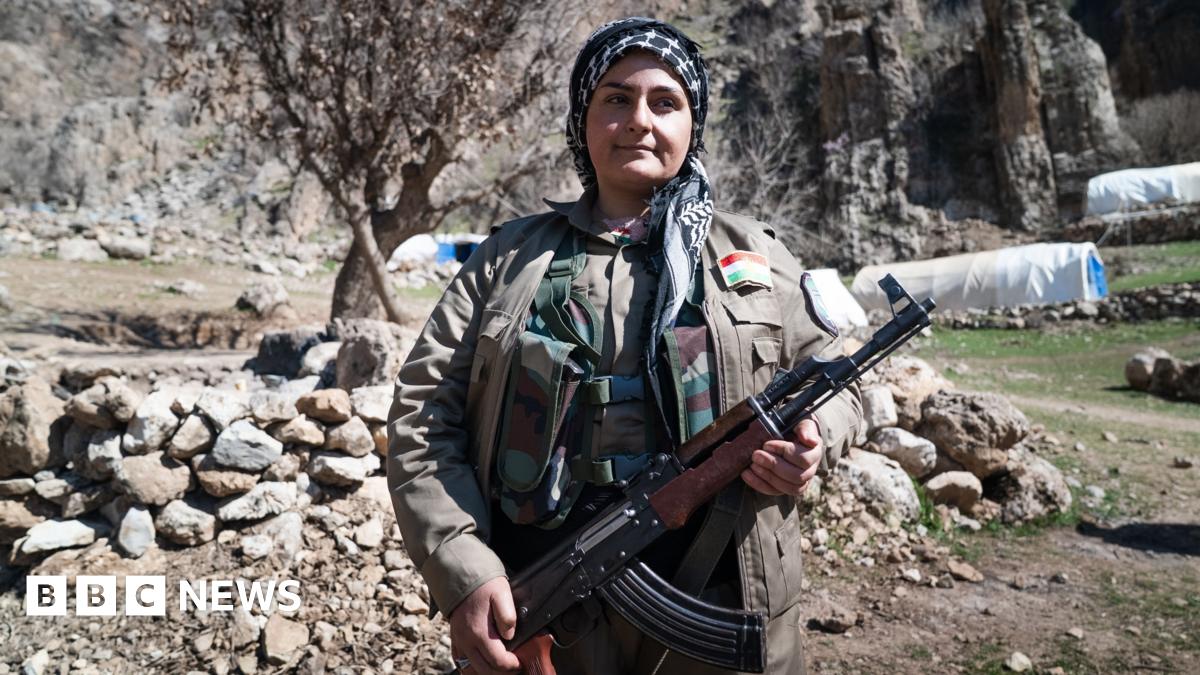
A senior Komala party official, Amjad Hossein Panahi, is visiting the fighters. He’s also a Peshmerga, along with his wife.
He tells us he’s been waiting to see the fall of the regime since its birth 47 years ago, but air strikes alone won’t bring it down.
“Bombing is weakening the regime, but it’s a big country and this is not enough,” he says. “Ground forces must intervene, and the Kurds can play an important role in this.” First, he wants to see a no-fly zone imposed by the US.
But with rising oil prices, hurting Americans (and many others) at the petrol pumps, how long will the US remain in the fight?
“I don’t trust Trump,” he replies bluntly. “I feel he may decide to stop the war. This is my personal view. But whether or not Trump stops the war, the Islamic Republic is in its final days. It will be brought down, by him or by [Israeli Prime Minister Benjamin] Netanyahu, or by the people.”
Then we are interrupted when he gets a call with news of an attack of a Komala camp in the city of Sulaymaniyah, near the border with Iran.
“We have to leave this place now,” he warns. “The Iranians are attacking with drones. They could attack here.”
He shouts to the Peshmerga who are gathered around.
“Spread out, spread out. Drones and ballistic missiles are coming. Hurry!”
The fighters scatter and so do we.
We wait for a while, but the skies remain clear. We leave the Peshmerga in position in the mountains, just as they have been for decades.
If they do enter the war – at some point – it could be very costly for them, and threaten the fragile stability of Iraq.
Additional reporting by Wietske Burema, Matthew Goddard and Bishar Shareef