
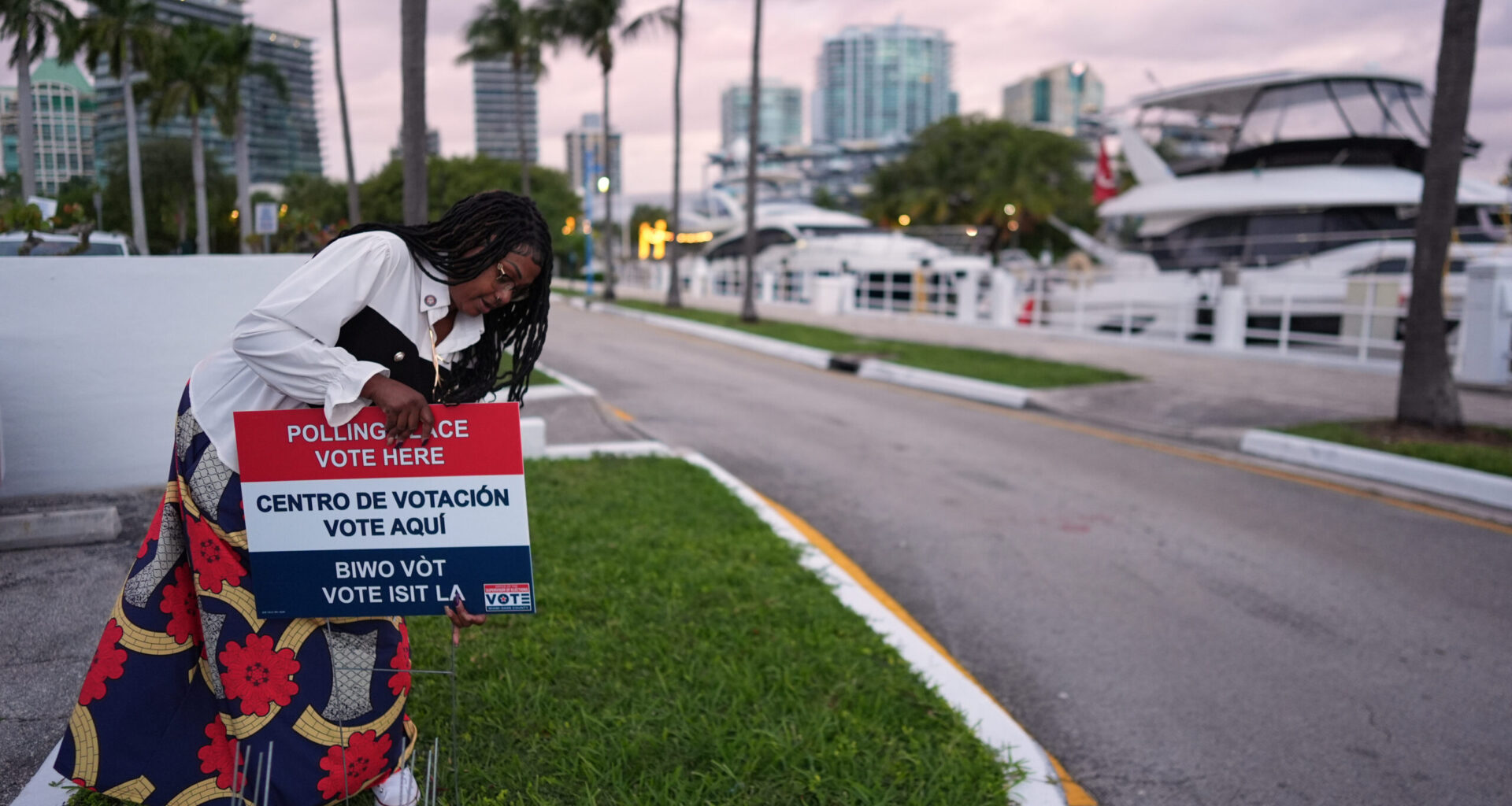
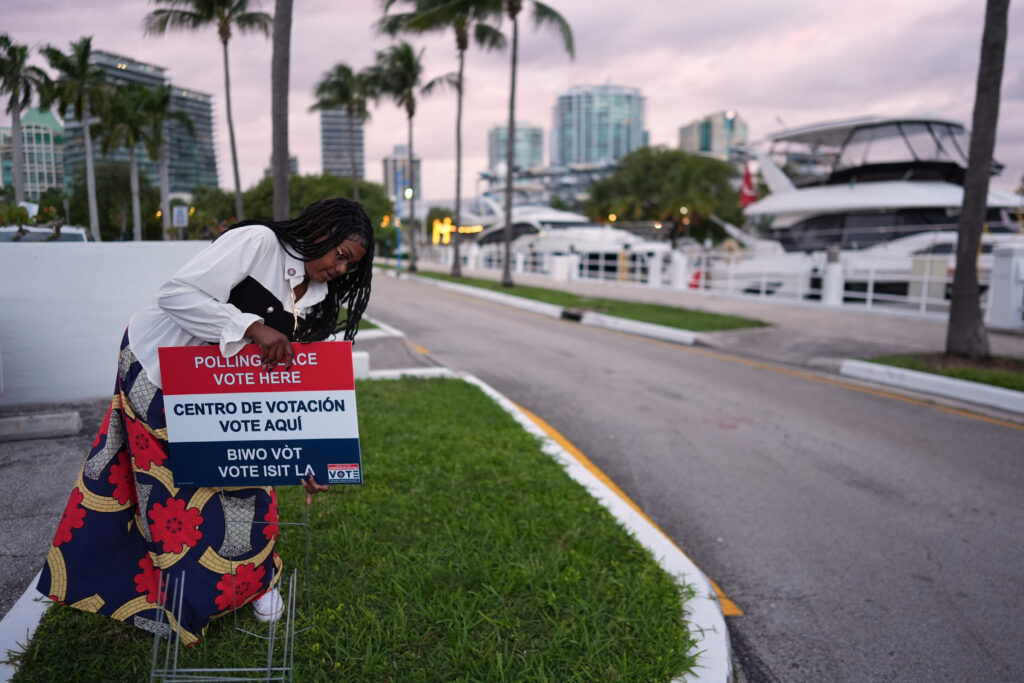
 Polling place supervisor Bridget Knighton installs a sign directing voters to a voting site at Miami City Hall, on Election Day, Tuesday, Nov. 4, 2025, in Miami. (AP Photo/Rebecca Blackwell)
Florida lawmakers passed the final version of the state’s SAVE America Act, an anti-voting law pushed by President Donald Trump nationally, after House and Senate leaders Thursday reconciled differences between their versions of the bill.
With the battle over the national SAVE America Act reaching a fever pitch, Florida Republicans this week raced to enact their own version of the restrictions, which could disenfranchise millions of voters by enacting significant new hurdles to casting a ballot.
The severe new voting rules would require voters to prove their citizenship status, as well as remove student ID as an acceptable form of voter identification.
Gov. Ron DeSantis (R) is expected to sign the measure into law.
Under the new law, a voter registration applicant’s citizenship status must be verified by the Florida Department of Highway Safety and Motor Vehicles. Until that happens, an applicant will be registered as an unverified voter and must vote with a provisional ballot that will not be counted if his or her legal status as a citizen cannot be verified through the department’s records.
The law doesn’t just impact new registrations. It also requires the Florida Department of State to verify the citizenship status of all registered voters who have not already been verified as U.S. citizens. If the citizenship status of a registered voter cannot be established or the voter record does not indicate that the registered voter’s citizenship is verified, the department must notify local election officials, who then notify the registered voter.
Florida Democratic lawmakers blasted their Republican counterparts for making voting more difficult when the state already has secure elections, as well as sufficient procedures for preventing and prosecuting illegal voting.
“If the system is working, why are we making it harder for eligible Florida citizens to vote?” state Sen. Kristen Arrington (D) asked.
Last year, Florida found 198 “likely noncitizens who illegally registered and/or voted in Florida” out of the more than 13 million people on its voter rolls, according to a report from the state’s Office of Election Crimes and Security. The office referred 170 of them to law enforcement.
Bacardi Jackson, executive director of the ACLU of Florida, said in a statement that SAVE America’s burden will fall hardest on students, seniors, naturalized citizens and working families without easy access to the required records.
“The freedom to vote should never hinge on someone’s ability to navigate a maze of bureaucracy,” Jackson said. “Democracy depends on participation. And when barriers stand between the people and the ballot box, democracy itself is at risk.”
And Genesis Robinson, executive director of the Florida advocacy group Equal Ground, said that, ultimately, the new law is about narrowing that participation, not protecting elections.
“Let this be a warning to Floridians and all Americans,” Robinson said. “We must pay attention to what is happening here in Florida, and stand up, demonstrate, protest, and raise the alarm so this suppression doesn’t continue in our state and spread across the nation.”