
Israel yesterday said the war against Iran was entering its “decisive phase,” as explosions rocked cities across the Middle East, with strikes on the US embassy in Baghdad and a major Emirati energy facility.
Black smoke rose above the embassy in Iraq, the second time it has been targeted since Feb. 28, when the US and Israel attacked Iran and plunged the Gulf into a conflict that has sent shockwaves through the global economy. Millions have been displaced by waves of drone, missile and aerial bombing, while more than 1,200 people have reportedly been killed in Iran, with little sign of the conflict slowing down as it entered its third week.
Clouds of dark black smoke were also rising yesterday from Fujairah, United Arab Emirates, home to a major Emirati oil storage and export terminal.
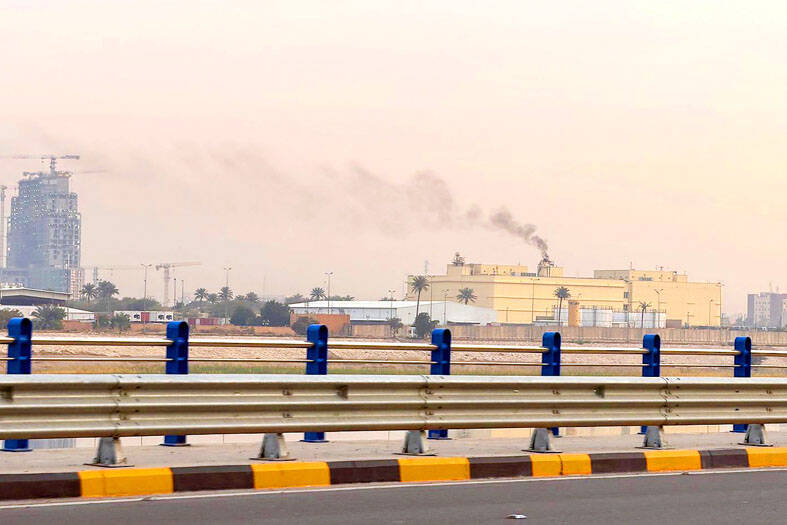
Photo: AP
Israeli Minister of Defense Israel Katz said the war was entering a “decisive phase,” even if he cautioned that it would “continue as long as necessary.”
Yet, despite facing superior US and Israeli firepower, Iran appears determined to fight on. It has launched missile and drone attacks against at least 10 of its neighbors and has choked off traffic through the vital Strait of Hormuz.
Israel’s army warned people in an industrial zone of Tabriz in northern Iran to evacuate, signaling an imminent attack.
The hit on the US embassy in Baghdad followed strikes against the powerful Iran-backed group Kataeb Hezbollah, killing two members including a “key figure,” security sources said.
US President Donald Trump said on Friday that US forces had struck Iran’s Kharg Island, its biggest oil export hub, and “obliterated every MILITARY target” while sparing its energy facilities.
Iranian media confirmed the island’s oil facilities were unaffected.
Iran had threatened US-linked energy firms would be “turned into a pile of ashes” if they were hit.
Iran’s threats to shipping in the Strait of Hormuz have brought traffic to a virtual halt on a route that normally carries one-fifth of global oil supplies.
Trump said the US Navy would start escorting tankers through the Strait of Hormuz “very soon,” but governments around the world fear a prolonged blow to their economies with crude oil prices up more than 40 percent since the war began.
The Palestinian militant group Hamas yesterday called for Iran to refrain from targeting neighboring countries, in a rare breach between the allies, although it affirmed Tehran’s right to defend itself.
Qatar said it yesterday intercepted two missiles over the capital’s downtown area and evacuated key areas.
The Saudi Arabian Ministry of Defense said its forces had intercepted dozens of drones on Friday.
Strikes have continued in Iran, with heavy blasts shaking Tehran late on Friday.
The Iranian Ministry of Health and Medical Education said more than 1,200 people have been killed by US and Israeli attacks, numbers that could not be independently verified.
The UN Refugee Agency has estimated that up to 3.2 million people have been displaced in Iran since the war started.
Trump described Iran as “totally defeated” and in search of a deal he was unwilling to consider.
US media raised the possibility of a ground invasion, with the New York Times and the Wall Street Journal reporting that the Pentagon had dispatched the Japan-based amphibious assault ship USS Tripoli to the region with about 2,500 US Marines.
Iran’s rulers appear intent on showing they would survive the war and maintain control, despite their supreme leader Ali Khamenei being killed on day one.
Khamenei’s son, Mojtaba, was named the new supreme leader, but has been absent from public view and is reportedly wounded.
Beyond the Gulf, Turkey said NATO forces shot down a ballistic missile launched from Iran — the third such interception in the war.