
Your support helps us to tell the story
From reproductive rights to climate change to Big Tech, The Independent is on the ground when the story is developing. Whether it’s investigating the financials of Elon Musk’s pro-Trump PAC or producing our latest documentary, ‘The A Word’, which shines a light on the American women fighting for reproductive rights, we know how important it is to parse out the facts from the messaging.
At such a critical moment in US history, we need reporters on the ground. Your donation allows us to keep sending journalists to speak to both sides of the story.
The Independent is trusted by Americans across the entire political spectrum. And unlike many other quality news outlets, we choose not to lock Americans out of our reporting and analysis with paywalls. We believe quality journalism should be available to everyone, paid for by those who can afford it.
Your support makes all the difference.Read more
Rachel Reeves has vowed to support households grappling with spiralling energy bills as a result of the deepening crisis in the Middle East.
The chancellor’s announcement comes as a package of support for those reliant on heating oil, a fuel not covered by the energy price cap, is expected to be set out next week.
Approximately 1.5 million households currently using heating oil are facing severe cost increases, with the price per litre having doubled since the onset of the crisis.
It comes amid concerns that instability in the Middle East could hit the cost of living around the world, after Brent crude, the global benchmark for oil prices, jumped to more than $100 (£74) a barrel earlier this week for the first time since 2022, contributing to higher fuel bills and the risk of increased household energy costs across the UK.
Meanwhile, official figures revealed economic growth flatlined in January, heightening fears that soaring fuel and energy prices could tip the struggling UK economy into recession, piling pressure on the chancellor to ensure that households are protected.
Speaking to The Times over the weekend, Ms Reeves confirmed that she has set aside funding to support households reliant on heating oil, as well as “working through” a longer-term strategy to support other households once the energy price cap lifts in June.
open image in gallery
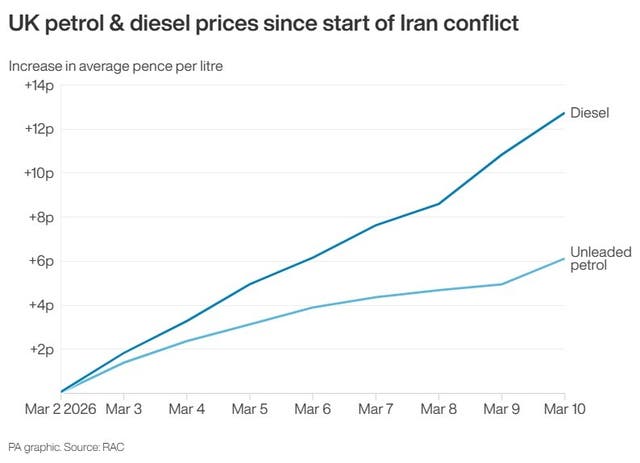
Petrol and diesel prices have increased significantly since the start of the Iran-US conflict (PA)
“I have found the money and we’ve worked through with MPs and others a response for people who are not protected by the energy price cap,” she said. “We’re giving greater support to those who really need it.”
While gas and electricity bills are shielded by Ofgem’s price cap until June, analysts warn of potential “dramatic hikes” thereafter if the conflict persists and Iran maintains its grip on shipping through the Strait of Hormuz.
Cornwall Insight forecasts a 10 per cent rise in household energy bills from July, pushing the typical dual fuel household’s annual cost to £1,801 – an increase of £160 on April’s cap.
The chancellor indicated more time is available to formulate a plan for gas and electricity, thanks to the existing price cap.
“We’ve got some time, and we are working through in the Iran response board (a group of Treasury ministers and officials) different approaches that we could take, including looking at more targeted options,” she said.
Ms Reeves also expressed concern over the nation’s “high debt” and played down the likelihood of a broad energy bailout, similar to the £35bn package following Russia’s invasion of Ukraine.
open image in gallery
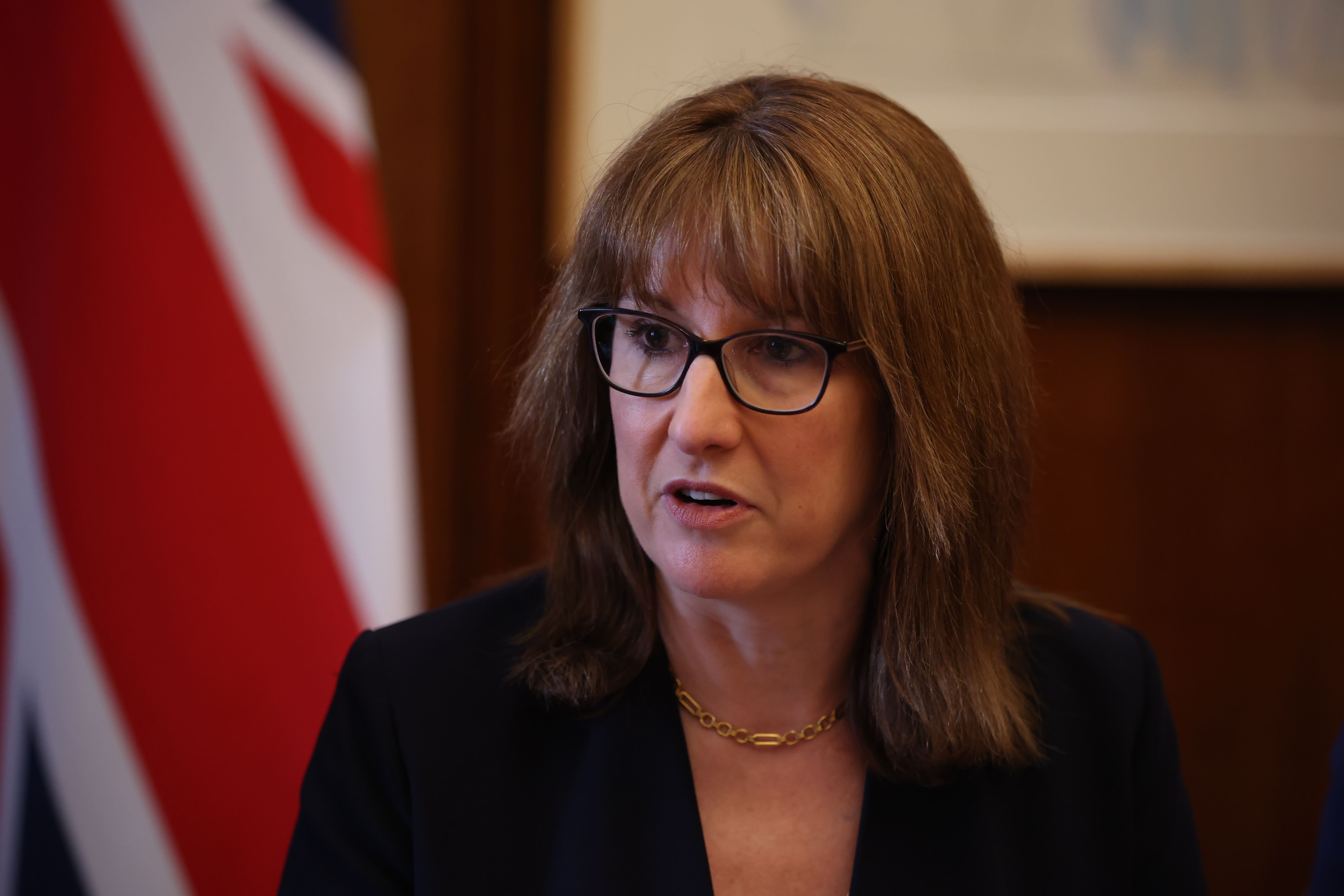
Chancellor of the Exchequer Rachel Reeves during a roundtable with petrol retailers and energy suppliers at 11 Downing Street (PA)
“It is important even when there is an economic shock – or perhaps particularly when there’s an economic shock – that you continue to be disciplined about your use of public money,” she added.
It came after the chancellor and energy secretary met with oil firm bosses and forecourt operators in Downing Street on Friday, warning that ministers won’t tolerate unfair pricing practices.
But a petrol retailers’ trade group accused ministers of provoking abuse against forecourt workers with their use of “incorrect and inflammatory language”, just hours before the crunch meeting with Ms Reeves.
The Petrol Retailers Association, which represents large and small independent petrol retailers across the UK, hit out at ministers’ suggestions that there had been “rip-off” pricing and “profiteering” by fuel providers.
It comes as the wider Middle East crisis continues to escalate, with significant implications for global energy markets and international relations.
On Friday, Sir Keir Starmer risked a fresh rift with Donald Trump by confirming that Britain won’t be following the US in lifting sanctions on Russian oil, saying that the move risks helping Vladimir Putin’s “war machine”.
No 10 instead urged its international allies to maintain pressure on Moscow, and to avoid inadvertently funding Putin’s war in Ukraine by purchasing Russian oil.
Mr Trump’s decision to issue exemptions for Russian oil already at sea has sparked fears that Putin could use the Iran conflict to boost Russia’s own war chest, with foreign secretary Yvette Cooper accusing Russia and Iran of attempting to “hijack the global economy”.
The Joint Maritime Information Centre has reported at least 20 incidents involving shipping and offshore infrastructure in the Arabian Gulf, Strait of Hormuz, and Gulf of Oman since 1 March.
The Strait, a vital artery for oil and gas, has seen traffic plummet from 138 to approximately five ships daily due to attack threats.
But as the conflict continued to escalate, US defence secretary Pete Hegseth played down concerns over disruption in the Strait of Hormuz, claiming that the US was “decimating” the Iranian regime.
open image in gallery
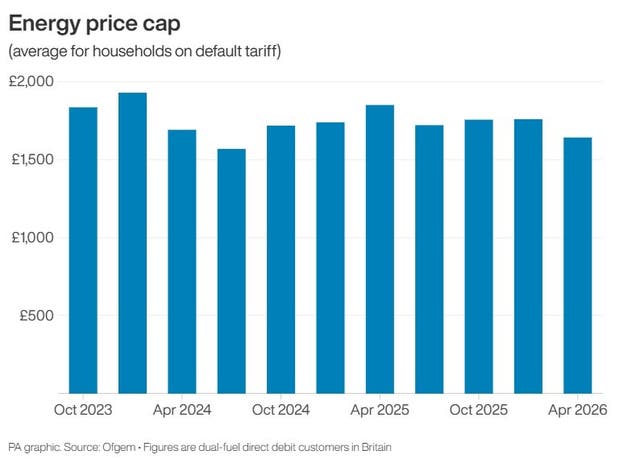
The energy price cap for households since October 2023 (PA)
The US has deployed 2,500 marines and an amphibious assault ship to the region, while an airstrike in Baghdad killed at least one person, and a missile struck the US embassy helipad.
A government spokesman acknowledged public concern over the impact of global conflicts on the cost of living, stating: “While it is too soon to know the full impact of this crisis, as the chancellor said, she will take the necessary decisions to help families with the cost of living and protect the public finances.”
The spokesperson highlighted existing measures, including the extended 5p fuel duty cut, the expanded warm homes discount, and the energy price cap, which is set to reduce bills by £117.