
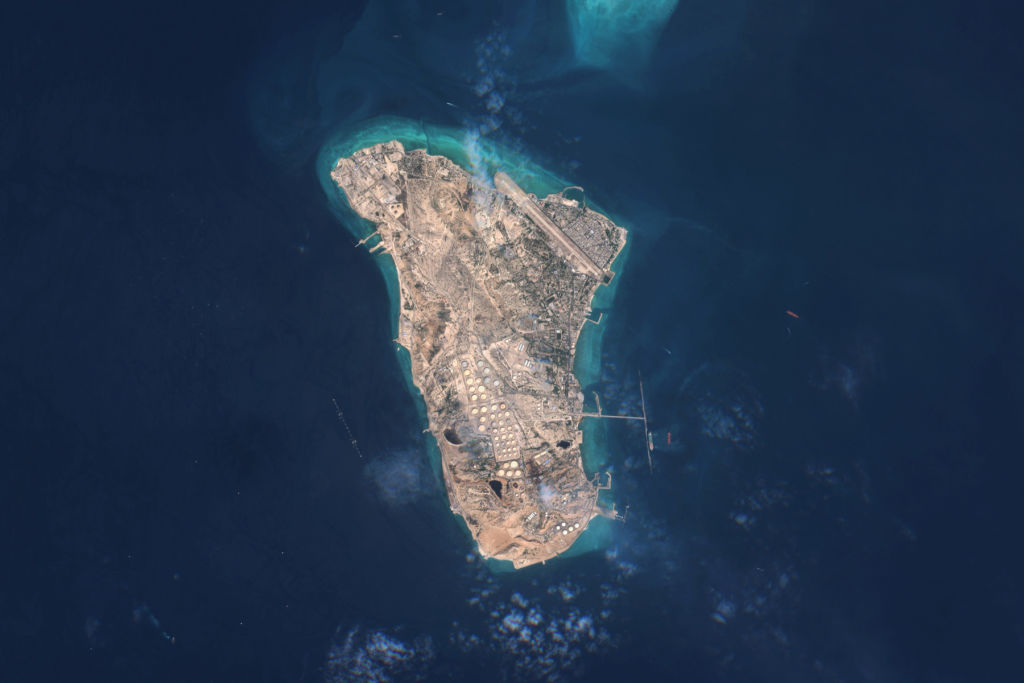
The United States bombed dozens of targets overnight Friday on Kharg Island, Iran’s main oil hub, in what President Donald Trump characterized as an effort to pressure Iranian leaders to end their blockade of the Strait of Hormuz.
The president said he had chosen not to strike oil infrastructure on the island, but threatened to do so if Iran continued to attack ships in the maritime passage.
“Our Weapons are the most powerful and sophisticated that the World has ever known but, for reasons of decency, I have chosen NOT to wipe out the Oil Infrastructure on the Island,” Trump wrote on Truth Social on Friday evening.
“However, should Iran, or anyone else, do anything to interfere with the Free and Safe Passage of Ships through the Strait of Hormuz, I will immediately reconsider this decision,” he added.
U.S. Central Command said Saturday that American forces struck about 90 military targets on Kharg Island, which serves as Iran’s primary oil export terminal and sits 300 miles north of the Strait of Hormuz, a narrow waterway in the Persian Gulf through which roughly one-fifth of the world’s oil supply passes.
Speculation that Trump may attempt to seize the island has increased in recent days following reports that some 2,500 U.S. Marines and an amphibious assault ship are on their way to the Middle East, according to multiple news outlets, which cited U.S. officials.
On Saturday, Lindsey Graham, a Republican who has been influential in guiding Trump’s policy on Iran and his decision to attack, argued that controlling the island could shorten the war.
“Seldom in warfare does an enemy provide you a single target like Kharg Island that could dramatically alter the outcome of the conflict,” he wrote on X.
“If Iran loses control or the ability to operate its oil infrastructure from Kharg Island, its economy is annihilated. He who controls Kharg Island, controls the destiny of this war,” he added.
He ended the message with “Semper Fi,” which is the official motto of the Marine Corps.
It appears that Trump has had his sights set on Kharg for quite some time now. In a 1988 interview with The Guardian, Trump specifically mentioned it in a broad outline of his foreign policy views.
“I’d be harsh on Iran. They’ve been beating us psychologically, making us look a bunch of fools,” he said.
“One bullet shot at one of our men or ships and I’d do a number on Kharg Island. I’d go in and take it,” he said at the time.
Here’s what you need to know about Kharg Island.
Why is Kharg Island so important?
Roughly one-third the size of Manhattan, Kharg Island is a critical hub for the country’s energy industry. The island handles the vast majority of Iran’s crude oil exports and serves as a key link between the country’s oil fields and global markets.
Located about 15 miles off Iran’s coast in the Persian Gulf, the island has deep-water ports that allow large oil tankers to dock and load crude for export — something that much of Iran’s coastline cannot easily accommodate.
“Kharg Island [generates] $78 billion a year in energy revenue, with irreplaceable deep water berths no other Iranian port can replicate,” Miad Maleki, a former U.S. Treasury sanctions official and senior advisor at the Washington-based Foundation for Defense of Democracies, told TIME.
According to Maleki, Iran allocates a large share of its oil export revenue to the armed forces, with the military physically taking possession of the barrels and selling much of the oil independently, mostly to China. Maleki said this makes Kharg not just the backbone of Iran’s economy, but also the military’s primary revenue source.
Before the current conflict, the terminal handled about 90% of Iran’s crude oil exports. Oil shipments from the island are a major source of revenue for Iran’s government. Iran earned $53 billion in net oil export revenues in 2025, roughly 11 percent of its annual GDP, according to an analyst cited by NBC.
“If Kharg were attacked and its energy infrastructure destroyed, that would take 90% of Iran’s crude exports offline,” Amir Handjani, Resident Fellow at the Quincy Institute, told TIME. “It will also invite massive Iranian retaliation on the energy infrastructure of the Arab States of the Persian Gulf, beyond what we have seen so far.”
Because of its central role in Iran’s oil exports, any disruption to operations on Kharg Island could ripple beyond the region, potentially affecting global oil markets and shipping through the Strait of Hormuz, which connects the Persian Gulf and the Gulf of Oman.
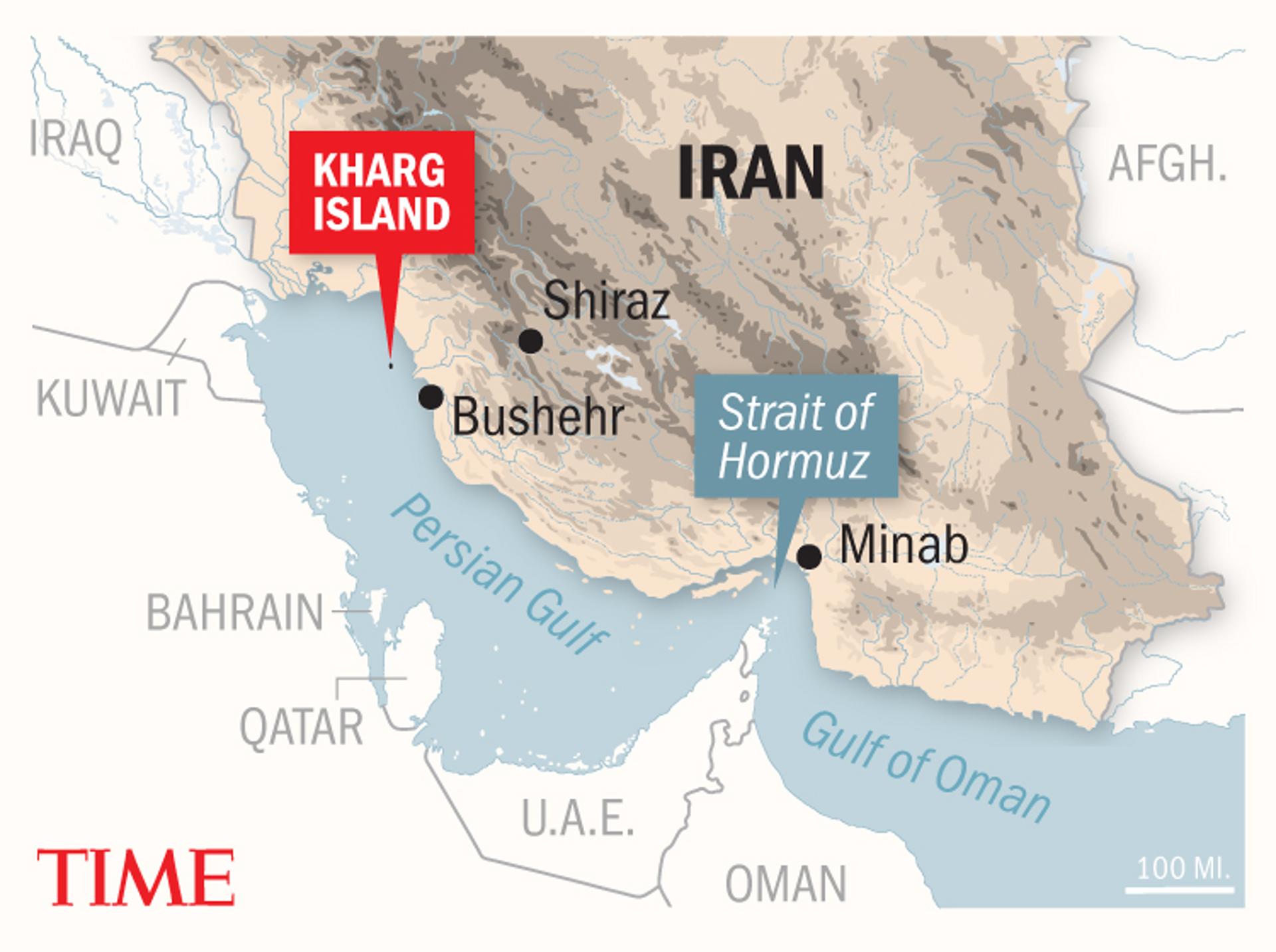
A map showing the location of Kharg Island.
Tankers regularly load oil at the island’s terminals before shipping it to buyers overseas, including China. Satellite imagery in recent days has shown multiple tankers loading crude at Khrag, according to maritime intelligence firm TankerTrackers.com.
Much of the oil exported from Kharg Island ultimately goes to China, which has remained one of the main buyers of Iranian crude despite Western sanctions. Energy shipments to China account for a significant portion of Iran’s oil revenue and play an important role in funding the country’s government.
How will Iran respond?
Iran has long threatened to respond to attacks against its oil infrastructure by attacking oil facilities across the Gulf—a development that could shake global markets even further and cause oil prices to spike.
Should Kharg Island come under serious threat, Tehran could retaliate by increasing its attacks with missile or drone strikes on the oil infrastructure of Gulf countries, which have already been battered by missile and drone attacks.
Iranian forces could also continue to target shipping in the Strait of Hormuz using small, fast boats, naval mines, and suicide drones.
Iran’s Foreign Minister Abbas Araghchi said on Saturday that his country would attack the facilities of U.S. companies in the Middle East if its energy infrastructure is targeted.
“If Iranian facilities are targeted our forces will target facilities of American companies in the region or companies in which the United States has shares,” he said, according to the Tasnim News Agency, which is affiliated with the Islamic Revolutionary Guard Corps (IRGC).
He added that Iran would “act with caution so that densely populated areas are not targeted” in retaliatory strikes.
Also on Saturday, Iran’s military threatened to strike multiple cities in the United Arab Emirates, claiming the U.S. used facilities there to launch its attack on Kharg Island.
The IRGC said the U.S. attack came from “ports, docks, and hideouts within” UAE cities, though it did not specify which ones could be targeted.
“[The IRGC] considers it its legitimate right to defend its national sovereignty and territory by hitting and targeting the origin of the American enemy missiles in shipping ports, docks, and hideouts of American soldiers sheltered in some cities in the UAE,” the statement said, according to Iranian state media, as reported by Al Jazeera.
Smoke reportedly rose over the UAE’s Fujairah port Saturday after debris from an intercepted drone fell on the major oil hub, the Fujairah Media Office said.
Handjani added that the subsequent attack on storage tankers in Fujairah was “more than symbolic” because the port was built to bypass the Strait of Hormuz.
“This is Iran saying — I can even hit you on the other side of the straits as well,” Handjani told TIME. “It’s also a warning to the Trump administration. If you take out our energy infrastructure, we will respond in kind in the Gulf states.”
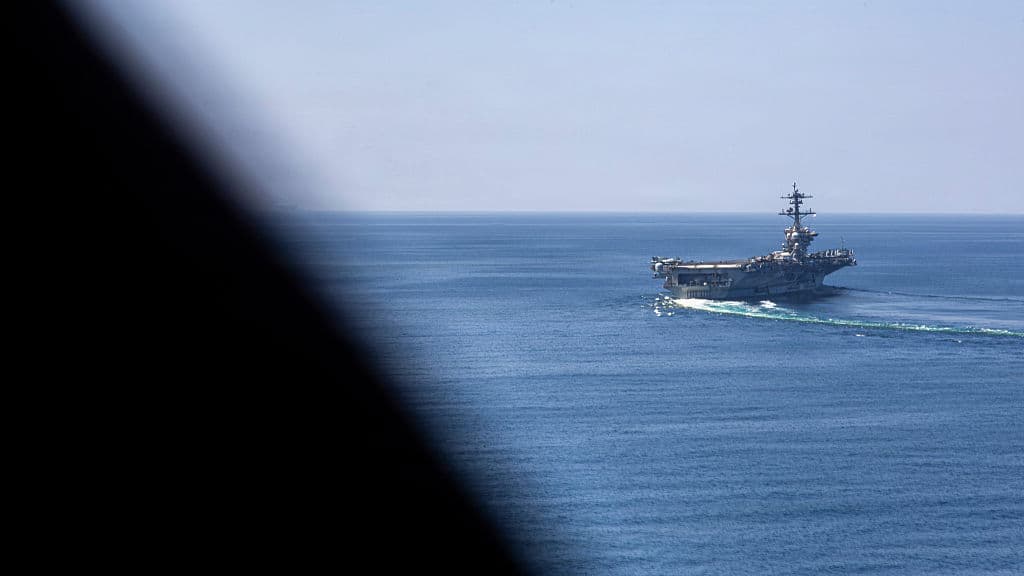
In this handout photo provided by the U.S. Navy, Nimitz-class aircraft carrier USS Abraham Lincoln (CVN 72) sails in support of Operation Epic Fury on March 3, 2026 in the Mediterranean Sea. Photo by U.S. Navy via Getty Images
Does this mean the U.S. will capture the island?
The question is whether the U.S. military’s strikes are a precursor to the capture of the island.
According to Handjani, it is certainly a possibility, but “an invasion of Kharg would precipitate Iranian retaliation on Kharg. It’s close to the Iranian mainland and much easier for Iranian drones and missiles to strike than American bases in the [Gulf Cooperation Council].”
Maleki suggests the targets of the overnight strikes on Friday give a clue.
“The March 13 strikes destroyed the runway, naval base, air defenses, and mine storage: exactly the targets you neutralize before an amphibious or airborne assault,” Maleki told TIME.
Maleki said there had been reports that the U.S. special operations forces, including units from Delta Force, are preparing operations in the region, alongside additional Marine and naval deployments to the Persian Gulf.
One crucial factor that might determine Trump’s next move is the enormous strategic advantage that control of the island would grant the United States, he added. Because of Kharg’s central role in Iran’s oil system, control of the island would effectively determine how much oil Iran can move into global markets.
“So, a U.S. military presence on Kharg would simultaneously guarantee freedom of navigation by dominating the northern Persian Gulf, give President Trump direct control over Iran’s oil sector, [and] create the physical precondition for redirecting Iranian oil from China to Western markets.”
How will the strikes impact global oil prices?
The biggest impact on oil prices would likely come from Iran’s retaliation rather than from damage to Kharg Island’s oil infrastructure.
Handjani points out that Trump’s decision not to strike oil infrastructure on Kharg Island has less to do with decency and more with it being “wise to do so.” If Kharg is attacked and most of Iran’s oil exports are no longer available, it would “give Iran more of a pretext to launch an all-out assault on the energy infrastructure of the other Gulf States. We would be in a nightmare scenario for oil prices.”
Iran’s attacks on the Gulf and its closure of the Strait of Hormuz have already caused global oil prices to spike to prices not seen in years, above $100 per barrel. The International Energy Agency has called the current crisis the “largest supply disruption in the history of the global oil market.”
Key oil facilities across the Gulf have been hit by Iranian drones, stalling production—including a terminal for oil exports in Oman on Friday.
Ship traffic through the Strait, which normally carries over 20 percent of the world’s daily oil supply, has slowed to a trickle. Several oil tankers were attacked in the Strait of Hormuz on Thursday.
Producers in Qatar, Iraq, and the UAE have partially halted operations, and analysts warn that even a coordinated release from strategic reserves, including 400 million barrels pledged by IEA countries, will only provide temporary relief unless shipping resumes safely, NBC reported.
The disruption has also driven U.S. gasoline prices higher, with crude shortages rippling through global energy markets and fueling concerns over a prolonged supply crisis.
The national average for a gallon of regular gasoline in the United States rose to $3.68 on Saturday, up five cents from Friday, according to AAA. U.S. benchmark West Texas Intermediate crude is trading just above $98 per barrel, while the international benchmark Brent crude closed the week near $104 per barrel.
Has the island been attacked before?
Kharg Island has previously been targeted during periods of conflict in the region, most notably during the Iran-Iraq War in the 1980s, when Iraqi forces carried out repeated bombing raids on the island’s oil facilities.
Those attacks caused significant damage to export infrastructure.
Despite the attacks, Iran continued to repair the facilities and keep its oil shipments flowing. In the decades since, Tehran has heavily fortified Kharg with air defenses, hardened structures, and underground storage tanks, designed to ensure crude exports can continue even under sustained military assault.