
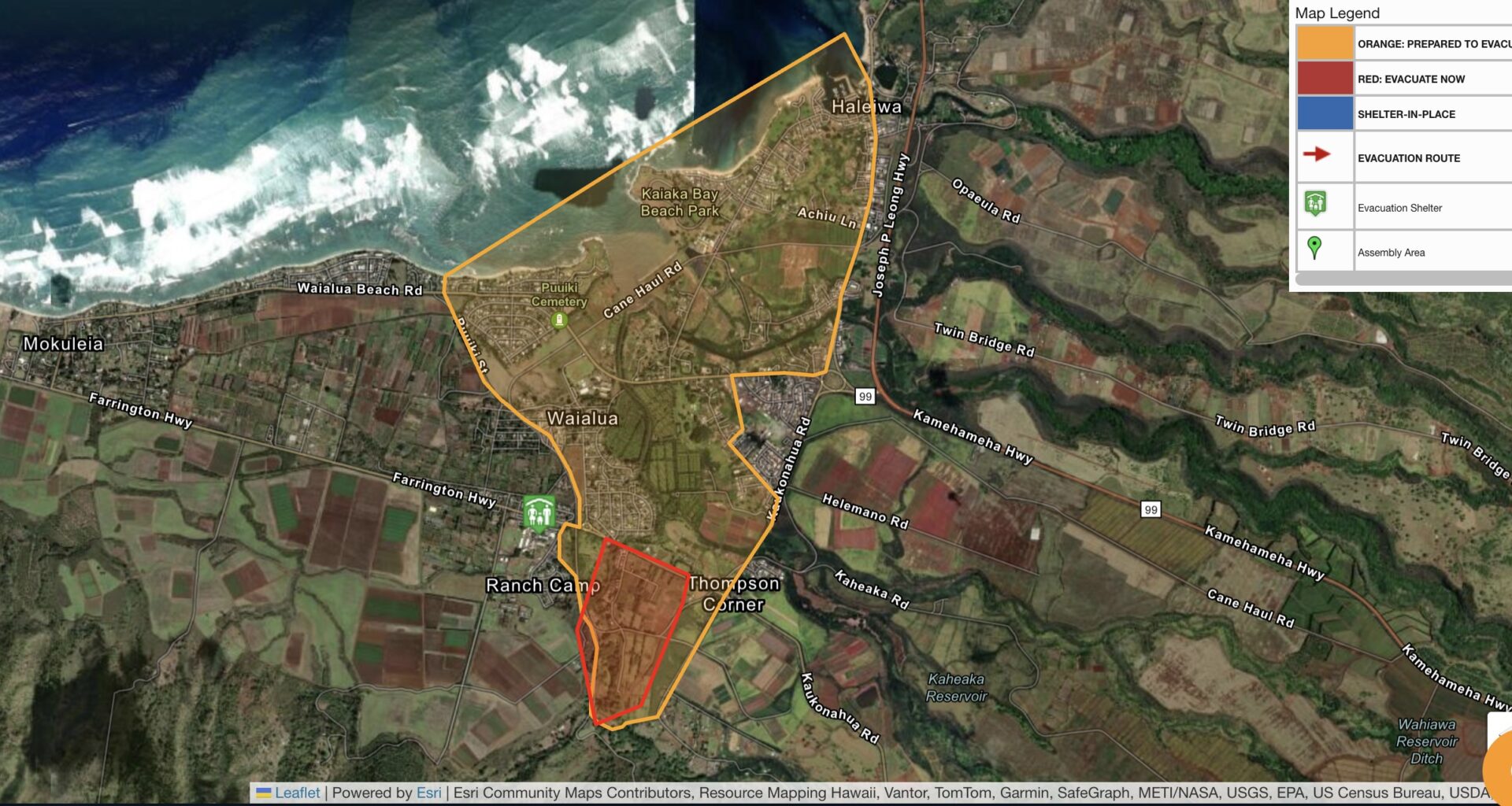
UPDATE: At 4:40 a.m. Saturday the city sent out an alert ending the evacuation notice, stating that water levels were consistent at the Wahiawā Dam. As of 7:15 a.m., water at the reservoir spillway was at 81.9 feet, down almost a foot from the previous night. The Otake Camp evacuation also has ended.
The dam of the Wahiawā Reservoir is at risk of failing, threatening to unleash “catastrophic flooding” on thousands of people living in Waialua and Haleʻiwa, Honolulu’s emergency department said on Friday night.
As rain poured down on Friday, Otake Camp, a low-lying area that historically housed plantation workers, was ordered to evacuate, and residents in the surrounding areas were warned to be prepared to leave on short notice.
SEARCH THE MAP: Look up your address on the evacuation map here.
As of 5:15 p.m., the reservoir had filled up to 82.8 feet, just shy of an 84-foot threshold that officials have said in the past would trigger evacuation orders. Just after 10 p.m., the city said water levels were trending down but being closely monitored. The water usually sits around 65 to 75 feet, according to federal government data.
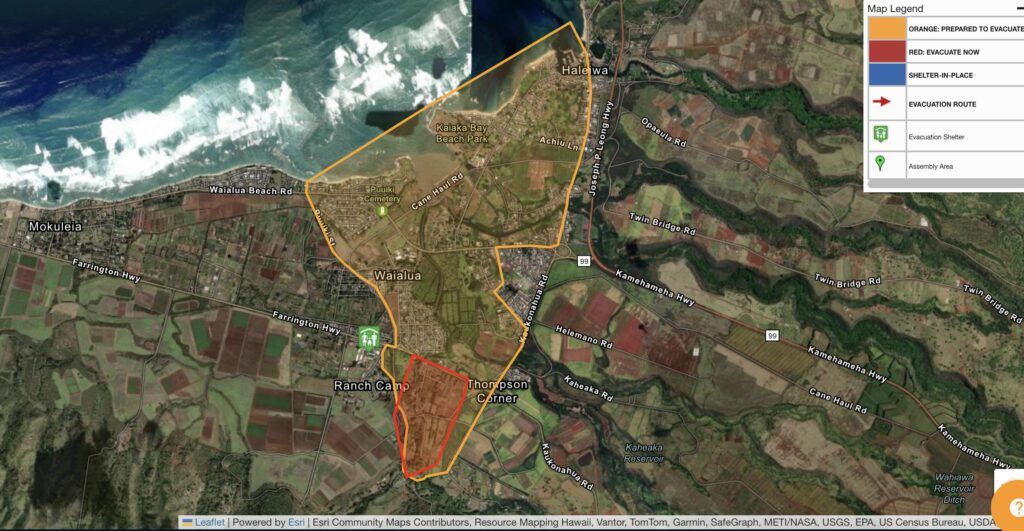 Residents of Waialua and Haleʻiwa were advised on Friday to prepare to leave their homes. (Honolulu/2026)
The U.S. Army Corps of Engineers has labeled the Wahiawā Dam as a “high hazard dam.” Its catastrophic failure would put 2,500 lives in danger, the agency found. The state of Hawaiʻi also classifies the Wahiawā Reservoir as a high hazard dam because its failure “will result in probable loss of human life,” according to a Department of Land and Natural Resources memo.
Gov. Josh Green called the dam his “biggest concern” at a press conference earlier Friday evening. The dam, Green said, is about 90-feet high. “At 88 feet, you’ve got a big problem,” Green said. “Water can’t be allowed to spill over the dam. It would cause structural concerns and could really cause significant tragedy.”
Racquel Achiu, a farmer and community leader, lives on Waialua farmland that sits in a zone labeled orange on the city’s map — labeled “prepare to evacuate.” She was anxious to leave but her family wanted to stay put.
It’s been raining all day, she said, “and there’s no end in sight.”
“This place is a mess,” she said.
 Racquel Achiu recorded flooding outside her car window on the North Shore of Oʻahu on Friday. (Provided video screenshot/2026)
Anyone evacuating was being directed to Waialua High and Intermediate School, which sits just outside the evacuation zone.
As of 8:30 p.m., the shelter only had 11 people, according to Molly Pierce from the Honolulu Department of Emergency Management. She said that’s about on par with other shelters around the island, each of which had no more than about 20 people. Evacuees should be aware that shelters don’t have any food or amenities.
“It’s limited services,” she said. “It’s there to protect life. It’s not necessarily the most comfortable or well resourced facility.”
Rep. Sean Quinlan, whose district includes Haleʻiwa and North Shore, said late Friday that residents were hunkering down, waiting on updates from city officials on the water levels of the dam. He said his wife and kids had evacuated to his parents’ house in Sunset Beach.
Communication has been better compared to four years ago, when residents had just minutes to evacuate as storm waters shut off the three bridges into Haleʻiwa, Quinlan said. This time around, evacuation notices have gone out much sooner.
But he noted that weather events appear to be getting more serious.
“I think unfortunately that this is the new normal,” he said. “We’ve had two of these rain events in less than a month … and I think these are going to occur more and more often, so we just have to be prepared.”
Dam’s Transfer To State Long Delayed
Earlier on Friday, the Board of Land and Natural Resources had been scheduled to vote on a measure allowing the state to buy the Wahiawā Reservoir. The plan had been in the works for years and was intended to allow for repairs and safety upgrades.
But the meeting was canceled as the state government shut down due to the storm.
“Isn’t that ironic?” said Kathleen Elliott-Pahinui, a member of the North Shore Neighborhood Board.
The area was historically dominated by sugar plantations that had drainage ditches, according to Achiu, also a member of the neighborhood board. But modern developments have filled those trenches in, leaving water nowhere to go.
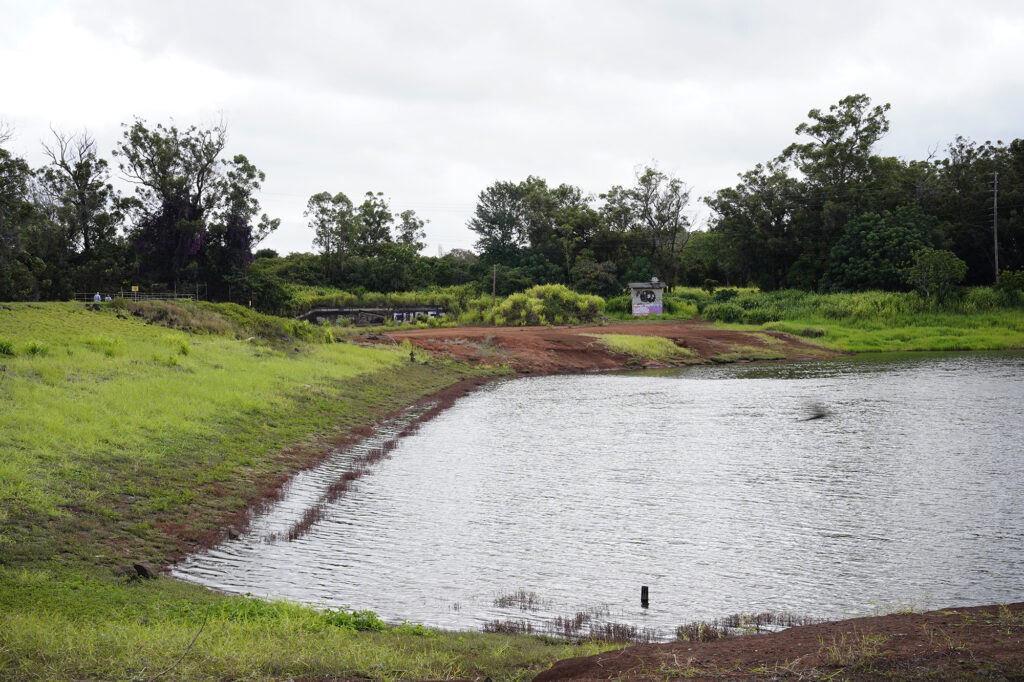 The Wahiawā Dam and spillway, here pictured in 2024, play a crucial role in relieving pressure on the Wahiawā Reservoir, also known as Lake Wilson, during heavy rains. When the reservoir was first built, it had an initial capacity of 3 billion gallons. (Kevin Fujii/Civil Beat/2024)
“So all the way down to Kaʻena, the rivers are just breaching the roads and the farmlands,” she said. “Here we are with, like, a ridiculous amount of water that can’t go anywhere.”
Achiu was involved in talks to transfer the reservoir to the state, but she hasn’t heard any updates since she attended a meeting last summer. From her point of view, the process has been slowed by bureaucracy, with state departments having to do their due diligence.
“The sense of urgency is not there,” she said. “I don’t feel that, and it’s frustrating because we’ve said it a million times to our representatives, millions of times to anyone who would listen, and be like: Listen, we’re down here. Are you guys worried? Because we are.”
The dam was built in 1906 to supply irrigation water to the Waialua Sugar Co. The reservoir and the dam are now owned by Dole Food Co. and Sustainable Hawaiʻi Inc.
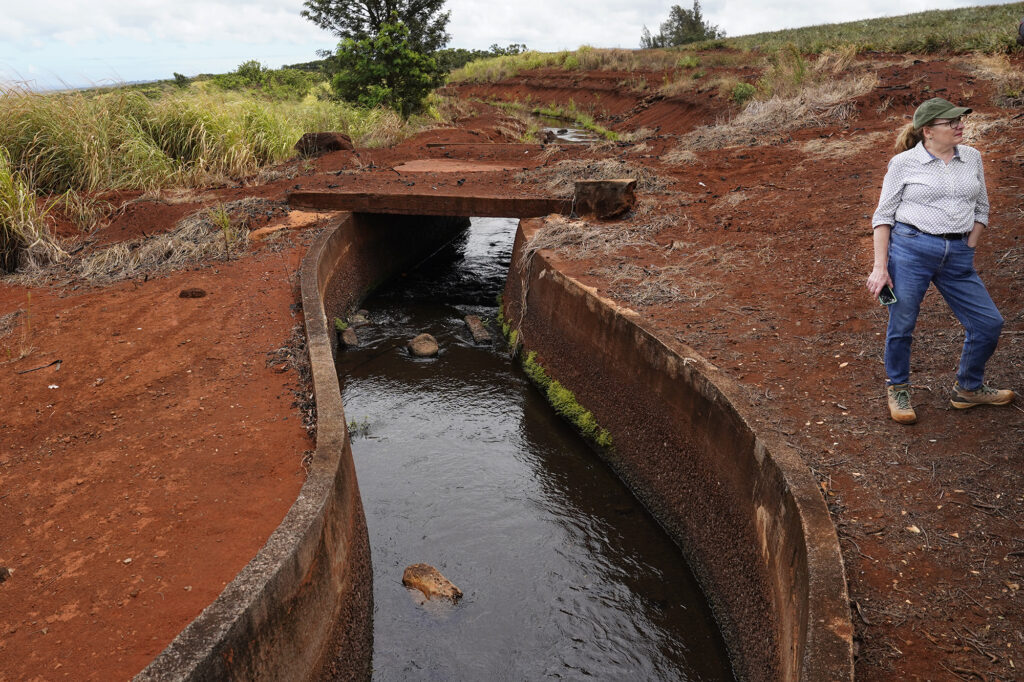 ADC Executive Director Wendy Gady, pictured in 2024, stands near a portion of the 30 miles of Dole-owned irrigation ditches fed by the Wahiawā Reservoir, also known as Lake Wilson. (Kevin Fujii/Civil Beat/2024)
The state Department of Land and Natural Resources issued four deficiency notices to Dole between 2009 and 2020 for failing to adhere to dam safety regulations. Then in 2021, the state land board issued a $20,000 fine to Dole for failing to address safety concerns with the dam and its spillway.
A recent safety report notes that the spillway is “undersized and deteriorated” and notes that there are stability issues with the reservoir’s embankment.
The deficiency notices and fines were also issued for failing to keep the water level below a 65-foot restriction set by the state.
Dole General Manager Dan Nellis said the spillway was built to accommodate milder storms, not today’s stronger varieties.
“It’s a good, strong dam,” Nellis said. “It’s very functional.”
The state moved to acquire the reservoir and accompanying irrigation system in 2023. That year, Dole also asked the land board to suspend its fines and remediation plan while it worked out a deal to transfer the reservoir to the state. The land board rejected that proposal and kept the fines in place. But the state has yet to close on the acquisition of the dam.
It’s still unclear what stage of the acquisition the state is in, though the purchase of Sustainable Hawaiʻi’s 143-acre portion of the dam and spillway was in escrow in January this year. The remainder of the system, owned by Dole, was not complete at that time.
The price tag for the system and safety improvements is now over $50 million.
The state planned for the Department of Land and Natural Resources to take over Lake Wilson, with the remaining infrastructure to be owned by the Agribusiness Development Corp. once refurbished.
The state-owned corporation anticipated the transaction would be complete by June this year but was “ahead of schedule,” executive director Wendy Gady told Civil Beat in January.
Reporters Caitlin Thompson and Thomas Heaton contributed to this report.

Sign up for our FREE morning newsletter and face each day more informed.
Sign Up
Sorry. That’s an invalid e-mail.
Thanks! We’ll send you a confirmation e-mail shortly.