
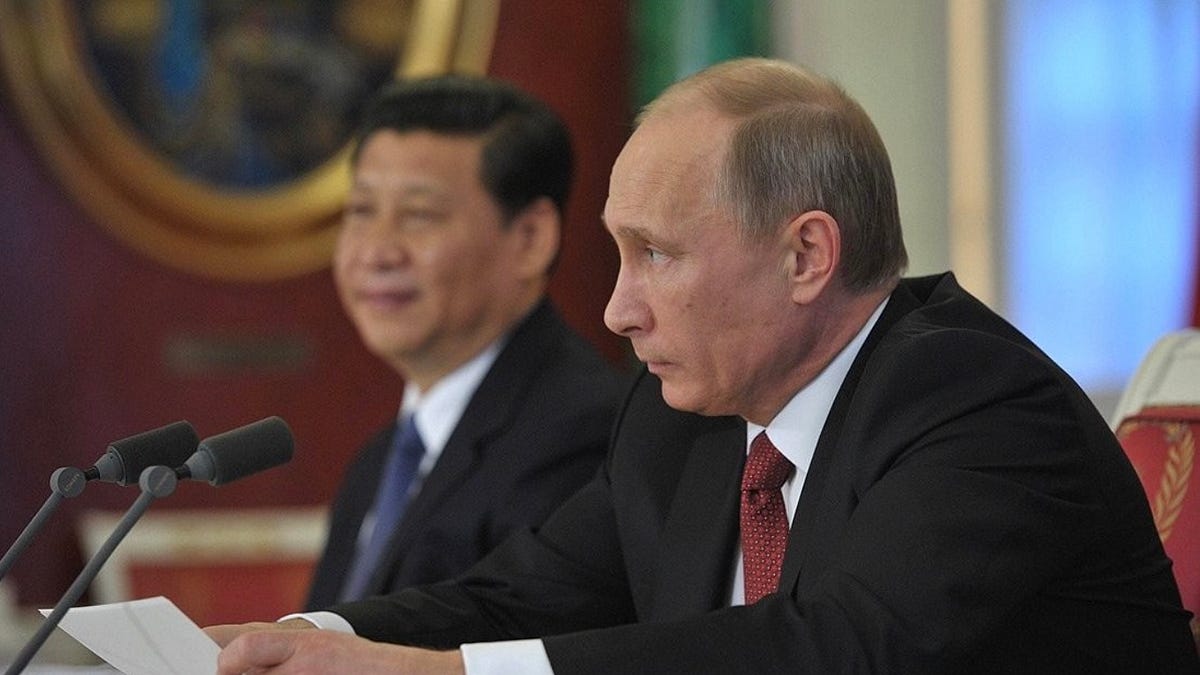
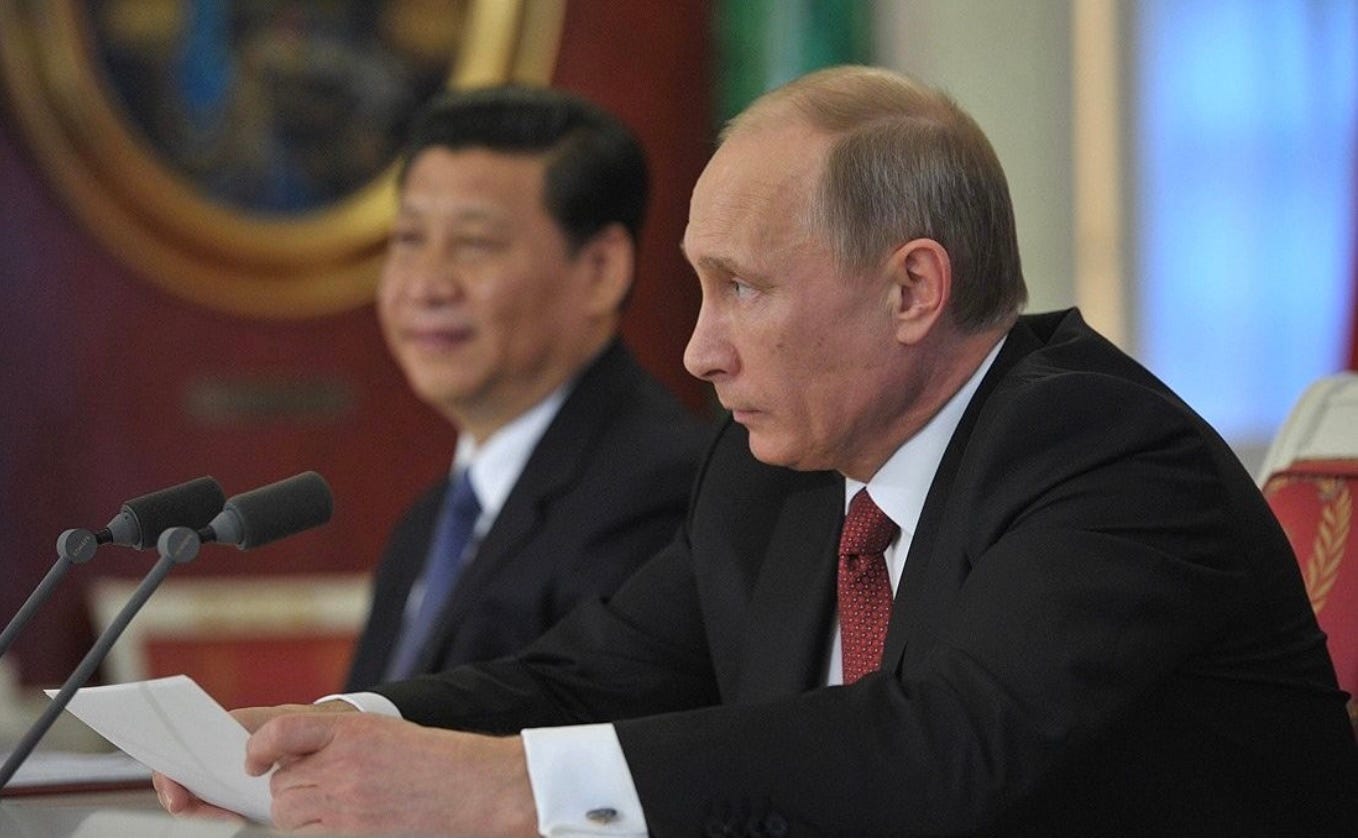
 Credit: Kremlin.ru
It is, of course, too early to make final assessments of which countries won and lost because of Trump’s decision to attack Iran. In the first two weeks, however, the obvious beneficiary of Trump’s war in the Middle East is Vladimir Putin’s Russia. Xi Jinping’s China is the runner-up.
Most obviously, Trump’s war has pushed global oil prices to over $100 a barrel. Analysts estimate that the last two weeks alone have generated an extra $150 million per day in revenue for Moscow. That’s more money for Putin to build more weapons to kill more Ukrainians. This money will also relieve pressure on Russia’s domestic economy, which, before the Iran war, was showing real signs of strain. Trump has thrown Putin a lifeline. And it’s not as if oil prices will snap back quickly when Trump decides his war is over, either. Energy facilities in the region have been damaged, maritime insurance costs for tankers have increased, and markets may price in a lasting risk premium for oil shipments passing through the Strait of Hormuz. These are all factors that could keep the oil price elevated.
Second, as if the oil-price boon wasn’t enough for Moscow, Trump has sweetened the pot further by lifting sanctions on Russian oil companies. “To increase the global reach of existing supply, Treasury is providing a temporary authorization to permit countries to purchase Russian oil currently stranded at sea,” Secretary Scott Bessent said on 12 March. “Temporarily” lifting sanctions against Russia does not look like a well thought out strategy for pressing Putin to end his war in Ukraine, especially when other countries—Canada, Norway, and Germany—have criticized the decision. While most of the world’s consumers, including Americans, will now have to cope with increased inflation as a result of Trump’s war, Putin is accumulating unexpected windfall profits.
Third, America’s armed forces are burning through billions of dollars in munitions, dramatically reducing stockpiles of Tomahawk missiles and PAC-3 interceptors for Patriot missile defense systems in particular. Although Trump had already vetoed the idea of sending long-range Tomahawks to Ukraine, Ukrainian efforts to acquire PAC-3 interceptors seemed more plausible. After all, these are weapons that would be used to defend Ukrainian civilians, not attack targets inside Russia. After two weeks of war in the Middle East, however, the United States has already used over 1000 of these interceptors, according to a Bloomberg Intelligence report. That’s more than Washington has supplied to Kyiv during the entire four years of the Russian war against Ukraine. The likelihood that Ukraine will receive more PAC-3s in the near future has dramatically decreased. That’s another victory for Putin.
Fourth, after credible reporting revealed that Russia was providing intelligence to Iran to help target American soldiers and assets in the Middle East, Trump and his team could—and should—have criticized Putin and punished Moscow for helping our enemy. Instead, Trump decided to do the opposite and pretend that Putin was not helping the Iranian regime, or not helping much. Most shockingly, his special envoy for both Russia and Iran, Steve Witkoff, announced on television that Putin had assured Trump that Russia was not helping Iran. It reminded me of the 2018 Helsinki Summit when Trump sided with Putin against his own intelligence community in claiming that Russia had not interfered in the 2016 U.S. presidential election.
Fifth, Trump’s war against Iran has hijacked public, media and official attention away from Putin’s war against Ukraine. Peace negotiations have been suspended as the world focuses instead on the Middle East. Moreover, Trump’s abandonment of Ukraine—reducing to zero U.S. military and economic assistance to Ukraine in 2025—was poised to be a campaign issue in the November 2026 mid-term elections. Now his war in Iran will eclipse all attention on Ukraine. Chalk that up as another win for Putin.
Sixth, by deciding to attack Iran preemptively without support from or even debate within the United Nations Security Council, NATO, or the U.S. Congress, Trump’s war looks to many around the world like Putin’s illegal invasion of Ukraine. I personally disagree with this comparison. I did not support Trump’s decision to launch this war because a threat to the United States was not imminent. But the theocratic regime in Iran is a brutal dictatorship at home and a supporter of terrorism abroad. By contrast, Ukraine is a democracy that has never threatened anyone. Nevertheless, I’m not sure I’d win that argument of difference in Johannesburg, Delhi, or Jakarta, as many citizens in the post-colonial, developing world see these two instances of great power military might against a weaker foe as similar. Trump’s new war against Iran is also further fueling America’s image around the world as a rogue state that ignores the rules-based international order, just like Putin’s Russia. That’s another win for Putin. Instead of looking like an imperial autocrat, Putin now looks like just another general leader of a great power … just like Trump.
Why China Also Benefits from Trump’s War
The global reputational damage of Trump’s war in Iran benefits not only Putin, but especially Xi Jinping and the People’s Republic of China. That’s why they get runner-up status regarding short-term winners from this war.
Unlike both Russia and the United States, China has not attacked or (yet) invaded other countries in the post-Cold War era. At a time when Washington and Moscow appear willing to disregard the rules of the international system, the People’s Republic of China looks like the more reliable and predictable partner. Soaring global oil prices are adversely affecting many countries that did not vote for the decision to start the war. Even American partners in the Middle East are being attacked right now; they also were not consulted ahead of time about the consequences of this war for their economic and security interests. In this environment, China can easily cast itself as the more respectable stakeholder in the rules-based order right now. And Xi is Putin’s closest ally. What benefits autocratic China also benefits autocratic Russia.
Second, Xi benefits from the American pivot back to the Middle East and away from Asia. All those missiles being fired at Iran are weapons that will never be used against Chinese forces. America’s posture of deterrence in Asia, especially our ability to help defend Taiwan, is radically weaker today than it was just two weeks ago. The United States will recover, rebuild stockpiles, and redeploy our ships to Asia. But getting back to the readiness of two weeks ago will take time. And the war in Iran still is not over.
Negative Consequences for Putin and Xi of Trump’s War
Trump’s war against Iran is not all upside for Putin and Xi. Like the incredibly successful U.S. military and intelligence operation to seize Nicolas Maduro in Venezuela, this war is displaying America’s incredible military might. Our soldiers did not make the decision to attack Iran. But once given the order, they have executed the mission in a way that Russian and Chinese forces cannot. (For details on the balance of power between the United States. China, and Russia, see my latest book, Autocrats vs. Democrats.) That show of tremendous American military power can enhance deterrence in Asia and Europe.
In addition, President Zelenskyy has offered assistance to the United States to help shoot down Iranian Shahed drones. Tragically, Ukrainian warriors and drone companies have developed real expertise in this domain over the last four years. This new arena of military cooperation could help solidify US-Ukraine military efforts in Europe. More generally, Ukrainian drone successes in the Middle East might attract greater American and European investment in Ukrainian drone companies. That’s a bad outcome for Putin.
Finally, as was the case with Bashar al-Assad in Syria and Maduro in Venezuela, Putin has again been exposed for his inability to protect his ally, Supreme Leader Ali Khamenei, in Iran. This does not make Russia look like a useful ally. More generally, Russia’s position in the Middle East has taken another hit, adding to setbacks initially suffered after the bombing of Iran by the United States and Israel last June. (For the details, see the Foreign Affairs article written by Abbas Milani and I.)
But to date, the benefits to Putin of Trump’s war in Iran greatly outweigh the costs. To a lesser extent, the same is true for Xi so far.
However, the war is not over. Final assessments must wait until then.