
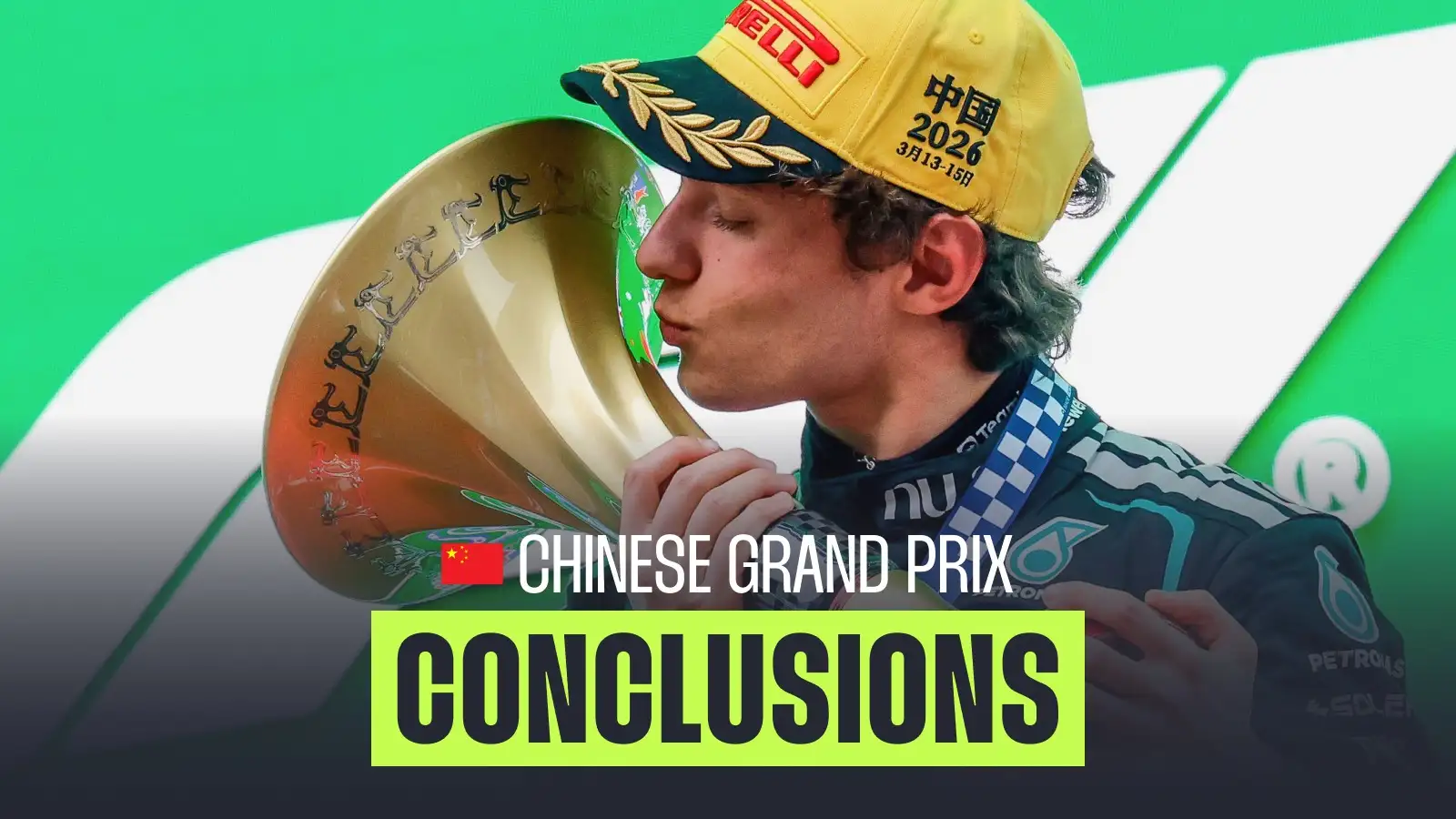
Mercedes driver Kimi Antonelli claimed his maiden Formula 1 victory at the Chinese Grand Prix, the second race of the F1 2026 season in Shanghai.
Antonelli converted pole position into a first career win with Mercedes teammate George Russell in second and Lewis Hamilton claiming his first podium finish for Ferrari with third. Here are our conclusions from China…
Kimi Antonelli has everything he needs to become the youngest F1 world champion
Want more PlanetF1.com coverage? Add us as a preferred source on Google to your favourites list for news you can trust
If you were to ask Helmut Marko to name the biggest regret of his career, almost certainly it would concern Max Verstappen.
Red Bull scaled heights with Verstappen that few in F1 have ever touched before, but one thing it never quite managed to do was break its own record for producing F1’s youngest-ever world champion.
In an era in which Formula 1 drivers seem to keep getting younger and younger, Sebastian Vettel’s record of 23 years and 134 days from 2010 has been waiting to fall for a decade or more.
In truth, Max never stood a chance.
He entered F1 in an era of domination by Lewis Hamilton and Mercedes, limited to occasional victories for the first five years of his career in a bunch of underpowered, unreliable, almost-there-but-not-quite Red Bulls.
Even the great Max Verstappen – his talent obvious from the moment he first stepped into an F1 car – had to wait until halfway through 2019, his fifth full season, to finally nab a pole position (another stat that’s never sat quite right), eventually becoming world champion for the first time aged 24 in 2021.
Where does the true balance lie in F1’s everlasting car-versus-driver debate? There’s your answer.
Even the most gifted drivers can be rendered powerless without the machinery to convert all that potential into prizes.
It is not merely a question of talent in this sport, but opportunity too.
Here is where we find the difference between a young Verstappen and today’s boy wonder Kimi Antonelli.
How to follow an act like Lewis Hamilton? That’s the question Mercedes was confronted with at the start of 2024.
The easy – safe – thing to do would have been to bring in an established race winner like Carlos Sainz and to accept what would have been, to all intents and purposes, a downgrade.
It is one thing for Red Bull, with its emphasis on youth and all things extreme, to gamble on a teenager; quite another for Mercedes, as corporate as corporate can be, to take the plunge.
With the promotion of Antonelli for 2025, Mercedes willingly signed itself up for short-term pain while clinging to the hope of long-term gain.
There would be days, of course, when he would make rookie mistakes, knock off the front wing and raise serious doubts over the team’s wisdom of piling such pressure on the shoulders of someone so young.
But the upside?
The upside, if he could just navigate the early hazards, had the potential to alter the course of F1 history.
The really impressive thing about Antonelli, as noted in PlanetF1.com’s conclusions from the Australian Grand Prix, is the rate of his development and how quickly he has moved from one phase to the next.
It was only late last summer, after all, that he had the look of a little boy lost in the big wide world of F1 having been moved to tears at the nadir of his mid-season struggles.
The progress in the months since has been breathtaking and the tears that arrived with his maiden F1 victory on Sunday came from a different place, in some ways a different driver, entirely.
Recap: How the F1 2026 season has unfolded so far
Australian GP conclusions: Formula Net Zero, Russell’s main threat, Aston Martin-Honda mistake
F1 testing conclusions: Bring back V10s, fresh Aston Martin hope, secret Ferrari weapon
This win is total validation for the risk Mercedes took with the signing of Antonelli two years ago when the watching world was saying no.
And doubtless now, with the feel of a winner’s trophy in the palms of his hands – with the confidence of knowing that, yes, he really can do it – he will grow even stronger, and at an even quicker rate, from here.
Like last year’s world champion, Lando Norris, part of the battle for Antonelli has always been to see for himself what everyone else sees in him.
Maybe now Andrea Kimi Antonelli – to use the name given to him at birth and not the one bestowed on him to make him sound cool and the rest of us feel warm and fuzzy inside – will realise just how good he is.
Toto Wolff was quick after Sunday’s race to dismiss talk of Antonelli competing for the world championship this season.
Yet with Mercedes so dominant it is undeniable that, like the battle between Norris and Oscar Piastri last year, the 2026 title race could come down to moments of unreliability and/or a patchy string of results at the wrong time.
It might well prove that 2026 has come slightly soon for Antonelli and that the greater experience of George Russell, himself a victim of one such moment in qualifying in China, will tell over the course of this season.
But 2027? 2028? If Antonelli continues on this trajectory, Russell won’t be able to contain him forever.
And Vettel’s record?
Still just 19, that little place in history is his for the taking.
Lewis Hamilton must have mixed feelings over the Mercedes vs Ferrari battle
Is Lewis Hamilton ready to be wonderful?
That was the question posed by this website in the days after his move to Ferrari was announced in early 2024.
Being wonderful required Hamilton to let go, accepting that time was ticking, he was no longer the driver he used to be and that his only shot at an eighth world championship came and went in the controversy of Abu Dhabi 2021.
It asked him to embrace a different, slightly reduced role at Ferrari, conceding that he would be behind Charles Leclerc more often than not in return for becoming more cherished, more appreciated, as retirement slowly honed into view.
More than anything, it offered Hamilton the chance to change the tone of the final years of his career, ending his time in F1 on a happier, more fulfilling note than his final years at Mercedes had threatened to provide.
Think back to Fernando Alonso being wonderful in his first season with Aston Martin in 2023, basking in the Indian summer of his career, and you get the idea.
Yet try as he might, Lewis couldn’t be wonderful last year.
How could he be when the main problem he found at Ferrari – a badly born, fundamentally flawed car with its big weakness baked in for the season – was the same he encountered in his latter Mercedes days?
When, far from the fresh start he had been looking for, 2025 was merely a continuation of the same old problems of the previous three years?
Little wonder that Hamilton often looked so haunted, so cursed, as his latest nightmare unfolded last season.
This year?
Already, even after just two races, this year – let’s call it Being Wonderful: Take Two – feels different.
For the first time since 2021, Hamilton has a car he can work with – really work with – again.
He should win races in 2026. Probably not as many as Leclerc. Probably not enough to become a factor in the title battle.
But enough to rediscover his self-worth and repair whatever damage the last few years have done to his reputation.
Enough to end his career, presumably at the end of this season or next, in a fashion more befitting of his achievements.
Was his first podium for Ferrari on Sunday a sign, as some have already claimed, that Hamilton is back to his best in 2026?
Or was it simply the first real glimpse of Lewis being wonderful?
This is, and always was, most likely to be the limit of his ambitions as a Ferrari driver. This, the thought may have crossed his mind in China, would be a better way to bow out.
Go deeper: Could Lewis Hamilton end up leaving Mercedes for Ferrari?
Think Lewis Hamilton regrets his move to Ferrari? Just wait until 2026
How Lewis Hamilton overcame thrilling Leclerc battle for first Ferrari podium
Yet Hamilton would not be human if he did not glance to his right on the podium in Shanghai, see the Mercedes drivers celebrating a second consecutive one-two finish in 2026 and ask if it was all worth it.
There was a suspicion back in 2024 that his move to Ferrari was, at least in part, an emotional spasm, a decision rooted in the raw frustration of his consecutive winless seasons at Mercedes in 2022/23.
With whispers of a significant Mercedes advantage for 2026 even back then, though, would he not have been better to keep calm, stick it out and wait patiently for the rules to swing back his way?
It is not a question he would take kindly to – see how he would flatly dismiss any suggestion that he might regret his decision to join Ferrari in 2024/25 – but surely there would be some pain if the team he walked away from ended up dominating this season.
It made for one of the great F1 moments in Shanghai when Hamilton joined his successor at Mercedes on the podium on the day he achieved a landmark result with Ferrari.
There was something almost paternal about the pride he took from Antonelli’s pole and victory, as though Kimi’s success had elevated his own sense of achievement.
Yet, deep down, Lewis must wonder if it should have been him in that Mercedes – him just starting to dream of the 2026 title – instead.
Max Verstappen is being driven away from F1
Why were so many people urging Max Verstappen to make the move to Mercedes last year? Precisely for weekends like this.
It was obvious three years ago that Max would be no fan of the 2026 rules, but a competitive car would have at least made them easier for him to stomach.
He doesn’t even have that right now as the optimism surrounding Red Bull in pre-season testing has drained away over the first two weekends of the new season.
Of the world champions of the modern era, only Jenson Button in 2009 had the good sense to see his team’s dip coming and get out of there before it arrived.
An act of disloyalty it might have been, yet jumping from one stone to the next at the opportune moment is often necessary – sometimes to be encouraged – in a sport in which the sands shift every few years.
There was hope last summer that Verstappen might have learned from the tragedy of Sebastian Vettel, who stuck with Red Bull for a set of new engine regulations and promptly went off the edge of the cliff with the team in 2014.
Max’s performance clause, you say?
Wouldn’t have mattered. Contracts are made to broken and, at that level, the driver invariably gets what the driver wants.
And if Max wanted to drive a Mercedes in 2026, what was Red Bull going to do about it?
But, no, Verstappen ended up staying…
… And look where he is now: a second off the pace in qualifying; 47 behind the leader when he was called in to retire; staring down the barrel of the wasted year Jos should have been telling him to avoid at all costs.
He hates the rules. Found the car undriveable here. Setup changes didn’t help. Every lap is survival. Can’t push because the car won’t let him.
Oh, and did he mention that he hates the rules?
With Aston Martin’s current woes taking that team out of serious contention for his signature for now, there remains a widespread assumption that there will be a Mercedes seat waiting for him whenever Max says the word.
Indeed, his upcoming Nurburgring 24 hours appearance behind the wheel of a Red Bull-branded Mercedes, announced a day after the Australian Grand Prix, has been regarded as the latest evidence of the burgeoning relationship between the two parties.
Yet what need would Mercedes have for Verstappen on the back of a successful 2026 if George Russell and Kimi Antonelli prove themselves capable of identical results in a dominant car?
What reason would there be to throw all that away – all the time and resource spent nurturing Russell and Antonelli to this point – just for Max, his eye-watering salary and the indisputable political edge brought to a team by the Verstappen camp?
This is why the perfect time for Max to make the move was last year when those lingering doubts about Russell and his world championship credentials were still alive.
And if he’s disillusioned by the new rules, takes zero joy from the act of driving the car and has no chance of winning anyway, what exactly is left to keep him around?
For the first time, now you can see how a sabbatical – taking a couple of years out to fulfil his dreams in endurance racing, leaving the door open to an F1 return when the regulations revert to something more palatable – could become the most appealing option available to him.
The next set of rules might not be designed to enhance the racing spectacle or tempt more manufacturers in, but simply to bring Max back.
A word of advice before F1 returns to Suzuka, the scene of one of Verstappen’s greatest feats of 2025, next weekend: cherish him while he’s still here.
It might not be for as long as you think.
McLaren Powertrains? Going it alone might be necessary for sustained success
McLaren is unlikely to be the only team to suffer this sort of indignity in 2026.
At the start of a new era, and with these fragile new engines, we are currently at the height of DNS season, when the risk of little gremlins emerging within touching distance of the race start is as high as it has been for years.
In the rush to brand McLaren’s Sunday a disaster in Shanghai, it was widely overlooked that Audi has only seen one car take the start at the first two races of this season.
It could happen to any of them at any time. It just so happened to be McLaren, amazingly with both cars at once, in Shanghai.
The double DNS for Lando Norris and Oscar Piastri has come at a particularly fascinating time in the team’s relationship with Mercedes.
As noted in PlanetF1.com’s conclusions from the Australian Grand Prix, McLaren is back to feeling like second-class citizens at the start of 2026, convinced that the works Mercedes team is doing something its customers can’t, or simply haven’t worked out how to do yet.
It was Ron Dennis, the former McLaren team principal, who remarked more than a decade ago that teams with customer engines cannot win a world championship in the modern era.
McLaren’s success since 2024 – back-to-back constructors’ titles and a drivers’ championship with Norris – has been held up as evidence that Dennis’s theory was wide of the mark.
Yet in terms of setting a team up for long-term, sustained success through different rules cycles?
Maybe Ron was on to something after all.
No doubt it helped McLaren during the ground-effect era that Mercedes got itself so muddled on the chassis side that it could not benefit from the inherent advantages – packaging, integration, optimisation – provided by its own engine.
McLaren is with Mercedes for at least the medium-term future having announced an extension of the partnership until 2030 almost three years ago.
That, however, only came after a period of extremely heavy petting (inviting the chairman as a guest at Suzuka, hiring one of the WEC drivers as an official reserve) with Toyota.
Haas has since become Toyota’s most likely option for an F1 return with some expecting a full takeover of the team over the coming years.
Yet in light of McLaren’s glitchy start to 2026, and the apparent discontent with Mercedes, might this be an avenue Zak Brown and Andrea Stella revisit in their post-2030 planning?
Or, alternatively, and given that the team is already producing an in-house powertrain for its 2027 WEC hypercar, might now be the time for McLaren to finally consider taking a Red Bull-style plunge by establishing its own specialist engine division?
If a company like Red Bull, with far wider interests than motorsport, can do it, why can’t McLaren?
McLaren Powertrains, anyone? It does have a ring to it…
The F1 2026 rules were made for a highlights reel – what if that was the plan?
Last week it was Formula Net Zero. This week it’s the “battery world championship.”
Credit for that one goes to a Mr F Alonso, who has a career in journalism to fall back on if the whole racing thing doesn’t go to plan.
There was talk of a better representation of the 2026 rules as the calendar moved from Australia to China and to a circuit with fewer energy demands.
Yet, ultimately, all of the holes in the regulations that appeared in Melbourne were still present and incorrect in Shanghai.
Super clipping, which as many have pointed out over the last seven days is anything but super, is here to stay, permanently stripping the world’s great corners of their challenge.
And the racing, entertaining though it is at times, is riddled with the sort of gimmicky shallowness you would typically find in Formula E, recently described in these pages as the form of motorsport for people who do not like motorsport.
Exhibit A: the battle between George Russell and Lewis Hamilton in the opening laps of Saturday’s sprint race.
It looked great on the YouTube highlights videos and the Instagram reels.
Yet strip away the superficiality and, like Russell’s duel with Charles Leclerc in Australia, once again there was nothing more to it than the ebb and flow of energy management.
For lap after lap George would deploy his battery to nip past on the back straight… and Lewis would use his to get him back into Turn 1.
And that’s fine if you get your kicks out of the simple sight of one car going in front of another.
But for those who like a little driver skill to go with their motor racing? There’s not much left here. It’s the very definition of style over substance.
Before F1 went big time a few years ago, Drive to Survive would take its content from whatever the on-track action produced and make the best of it.
Since 2021, though, there has been a creeping sense that the tail is wagging the dog, that the racing now exists primarily to advance the Drive to Survive narrative.
This is the sort of warped thinking that results in Insta-friendly highlights, an increased number of sprint races and shorter grand prix distances tailor-made for short attention spans, an idea floated by Stefano Domenicali, the Formula 1 chief executive, last year.
And so the thought occurred when the highlights reel ended on Saturday morning: what if the 2026 rules aren’t some great misstep after all, but instead part of the plan?
What if this is exactly what they – the powers that ought not to be – actually want? And what they think F1 in the mid-2020s should look like?
Now that would be the real worry.
Want to be the first to know exclusive information from the F1 paddock? Join our broadcast channel on WhatsApp to get the scoop on the latest developments from our team of accredited journalists.
You can also subscribe to the PlanetF1 YouTube channel for exclusive features, hear from our paddock journalists with stories from the heart of Formula 1 and much more!
Read next: Chinese GP driver ratings: Antonelli shines, Hamilton impresses and Ocon falters