
Keir Starmer says Britain ‘will not be drawn into the wider war’ in Gulf.
The Associated Press
British Prime Minister Keir Starmer said Britain is working with allies on a viable plan to open the Strait of Hormuz, but he offered few specifics and no timetable for when any collective action might take place.
Mr. Starmer was responding to warnings from U.S. President Donald Trump who said on Sunday that if NATO allies didn’t help open the strait, “it will be very bad for the future of NATO.”
In a press conference on Monday, Mr. Starmer said no decision had been made about whether Britain would join an effort to patrol the strait, and he made it clear that it would not be a NATO mission.
“It’s a discussion. We’re not at the point of decisions yet. It’s obviously a difficult question, that goes without saying, in relation to how you safeguard maritime traffic,” he told reporters.
He added that any collective action must be credible, viable and involve as many countries as possible. “Let me be clear, that won’t be, and it’s never been envisioned to be, a NATO mission. That will have to be an alliance of partners which is why we’re working with partners both in Europe, in the Gulf, and with the U.S.”
Trump calls on countries to help secure Strait of Hormuz as energy crisis fears escalate
He added that Britain has autonomous mine hunting systems in the Gulf region and it could deploy anti-drone systems. But he insisted that the U.K. “will not be drawn into the wider war.”
Repeated air strikes by U.S. and Israeli jets have crippled the Iranian military, but Iran has managed to effectively close the Strait of Hormuz by attacking oil tankers. Roughly 20 per cent of the world’s oil passes through the narrow waterway. Since the war started, the price of oil has soared 45 per cent to more than US$100 a barrel.
Mr. Trump has expressed frustration that NATO allies and others have not offered to help the U.S. reopen the strait by sending warships, minesweepers and troops. He has demanded that seven countries take part in a coalition, without naming them. He has previously called on China, France, Japan, South Korea, and the U.K. to join.
“It’s only appropriate that people who are the beneficiaries of the strait will help to make sure that nothing bad happens there. If there’s no response or if it’s a negative response, I think it will be very bad for the future of NATO,” Mr. Trump told the Financial Times.
His call has been met with little action so far.
Trump said on Sunday his administration is talking to seven countries about helping to secure the Strait of Hormuz.
Reuters
France’s foreign ministry said on Sunday that its naval mission remains in the Eastern Mediterranean, and any deployment will only be for defensive purposes. The European Union’s foreign policy representative, Kaja Kallas, said on Monday that member states will discuss what actions they can take. “It is in our interest to keep the Strait of Hormuz open,” she told reporters in Brussels.
Germany’s Defence Minister Boris Pistorius rejected Mr. Trump’s demands. “What does Trump expect a handful of European frigates to do that the powerful U.S. navy cannot? This is not our war, and we did not start it,” Mr. Pistorius wrote on X.
Italy’s Foreign Minister Antonio Tajani said his country supports reinforcing EU naval missions in the Red Sea. “However, I don’t think these missions can be expanded to include the Strait of Hormuz, especially since they are anti-piracy and defensive missions,” he told reporters in Brussels.
Mr. Trump has singled out Britain for particular scorn. “The U.K. might be considered the number one ally, the longest serving et cetera and when I asked for them to come, they didn’t want to come,” he said on Sunday.
Trump tells U.K. he doesn’t need its help to win war with Iran
Earlier this month, he said the U.S. didn’t need British warships and he criticized Mr. Starmer for initially refusing to permit U.S. warplanes from using the Diego Garcia military base to launch air strikes in the early days of the war. Britain has since allowed U.S. jets to launch missions from the base, which is jointly managed by both countries, but only for defensive purposes. “This is not Winston Churchill that we’re dealing with,” Mr. Trump said at the time.
On Monday, Mr. Starmer played down the growing tension with Mr. Trump. He described their relationship as “good” and said they had a productive conversation on Sunday about Iran.
“We’re strong allies, have been for decades. But it is for me to act in what I consider to be the best interests of Britain, and I have to keep that uppermost in my mind,” he said.
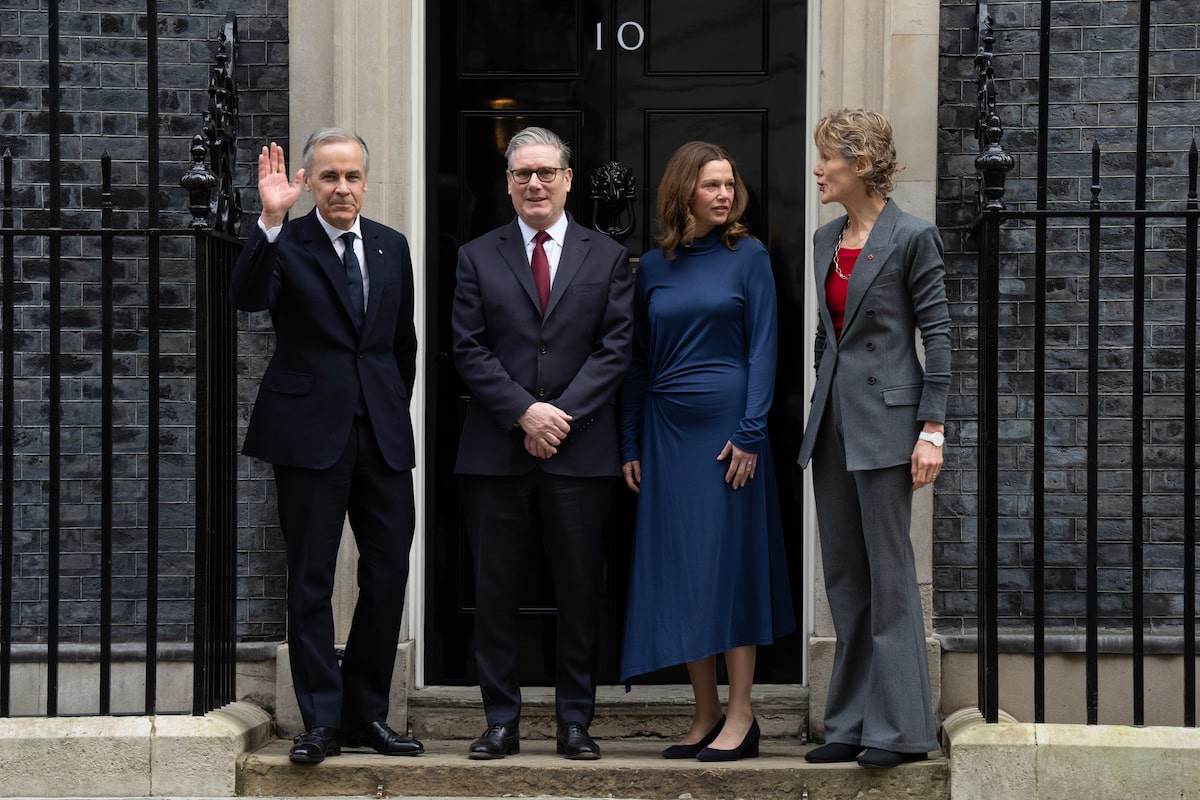
Prime Minister Mark Carney, left, and Diana Fox Carney, right, are greeted by British Prime Minister Keir Starmer and Victoria Starmer at 10 Downing Street in London on Monday.Adrian Wyld/The Canadian Press
Earlier on Monday, Mr. Starmer met Prime Minister Mark Carney at Downing Street. The two leaders “condemned the Iranian regime’s missile and drone attacks, including on civilian and energy infrastructure, and expressed deep concern over the toll on civilians, the risk of further regional escalation, and the broader global economic consequences of the conflict, including rising energy prices,” according to a summary of the meeting provided by Canadian officials.
Mr. Carney arrived in London Sunday evening after a three-day visit to Norway where the emphasis was on Arctic security. During the visit he attended a NATO exercise called Cold Response, which involved 32,000 troops from 14 nations including Canada. Mr. Carney also held a summit with leaders from five Nordic countries – Norway, Finland, Sweden, Denmark and Iceland –in an effort to form a bloc of middle power nations.
The group is hoping to have an influence within NATO, the European Union, and other multinational organizations. But during a press conference on Sunday, they had little to offer in the way of solutions for the war in Iran.
“We will use any channel we have, any opportunity we have, to urge the parties to find a way that will de-escalate this war,” Norwegian Prime Minister Jonas Gahr Store said on behalf of the group. “I think that’s what we can say. It is not our war.”
Prime Minister Mark Carney and British Prime Minister Keir Starmer discussed the war in Iran, its effect on global energy markets and concerns about the broader regional conflict, according to a readout from the Prime Minister’s Office.
The Canadian Press