
The Athletic has live coverage of the latest news for the 2026 World Cup.
In March 2024, Canada’s men’s national team had reason to be on edge.
It had bottled a 2-1 lead in the first leg of the Concacaf Nations League quarterfinals the previous November, allowing three goals at home to Jamaica in an embarrassing second-leg loss. As a result, the Canadians were forced to travel to Frisco, Texas, for a one-game playoff against Trinidad and Tobago, where the winner would qualify for Copa America.
A loss would have derailed the program’s progress, having already suffered multiple embarrassing moments through the past few years. Copa America qualification was a must for the World Cup cohost.
And so it would be easy to assume that when Canadian players gathered with representatives from Nike in Texas that March to begin discussions over their 2026 World Cup kit, they would be tentative about making a bold statement.
They were not.
“The players said they want to feel deadly,” Stuart McArthur, Nike senior design director, recalled at a kit launch event in March.
There was no tentativeness from players when sharing their thoughts in collaborative meetings with Nike. Players were eager to move on from an embarrassing World Cup performance less than two years earlier – exacerbated by the fact that Canada was the only team at the 2022 World Cup to not have new kits, owing to failures both on Canada Soccer and Nike’s end. Instead, Canada wore generic teamwear to its first men’s World Cup since 1986.
Even before the hiring of Jesse Marsch, Canadian players wanted to reveal their identity: hungry, aggressive and ready to make the world take note on home turf.
“‘We’re going to show up, and impose ourselves on the pitch at the World Cup,’” McArthur remembers hearing from players.
Nike’s mandate was clear, and while Canada had lacked a visual element to illuminate its ascent, over the next two years, that would change.
When a camera panned to Alphonso Davies leaping into the air to celebrate Canada’s first goal ever at a men’s World Cup, viewers could see the good and bad of the team’s kits.
The good? Canadian players loved playing in the black kits they wore in their second game, against Croatia. Black made them feel powerful and different from their peers in Qatar.
“That black kit speaks volumes,” national team defender Sam Adekugbe told The Athletic in 2022. “It kind of has a sense of the dirty work behind it, where we’ve come from.”
The bad? The black kits were from Nike’s Strike II template line. One of the world’s better stories heading into the World Cup stepped onto the field in the kind of generic kits any recreational team around the world could have worn. Players were disappointed. Nike didn’t help them meet the moment.
Canada Soccer insists Canada’s new kits are not a reaction to 2022. While that may be true, what is clear is that from the beginning of the design process, both Nike and the players did not want to take the field at a home World Cup with shame hanging on their shoulders.
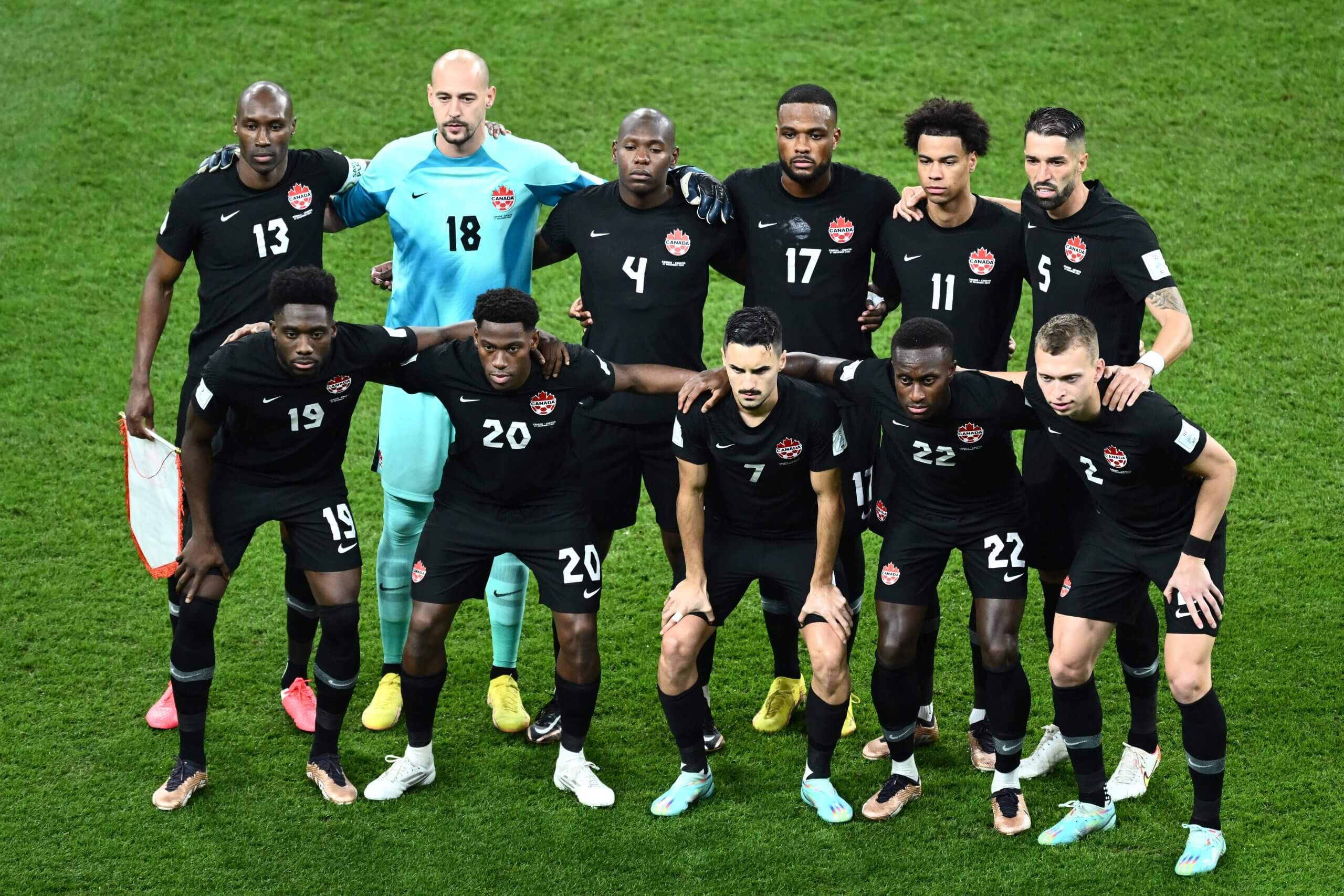
Canada players donning their black kits at the 2022 World Cup in Qatar. (Jewel Samad / AFP / Getty Images)
Ahead of the March 2024 international window, Canada Soccer presented Nike with an insights document regarding World Cup kits. The organization outlined details it felt spoke to its national teams, the sport in Canada and the country itself.
Nike responded, telling Canada Soccer it was ready to create the boldest kits in the program’s history.
“Early in the process Nike asked Canada Soccer if we were comfortable for them pushing the envelope as it relates to the design of our kits,” Dominic Martin, Director of Marketing for Canada Soccer, said. “We gave them the green light to push forward with dynamic and innovative design.”
National teams often develop identities revealed within the kits. For generations with Adidas, German kits are the height of classic simplicity. With Nike, France always displays suave sophistication with their looks.
Nike wanted Canada’s identity to be more daring.
“Our approach definitely had to consider the gravity of where this tournament was taking place,” McArthur said. “And this is a home tournament for Canada, a country that prides itself on being from the north. And in this moment in time, they are making progress and they have real ambition. And I think that is typified in the positivity and the true nature of what we’ve put into these garments.”
Before Canada’s win over Trinidad and Tobago, Nike held two pivotal sessions to shape the kits’ vision. The first was with the players themselves.
As opposed to years past, Nike valued the player’s voices above any other. Nike representatives implored players to share their thoughts, positive and negative, and also showed players a generation’s worth of past Canada kits to gauge what they liked and disliked.
There was very little from past kits that resonated.
“There’s not a lot of variability across that, and here’s an opportunity to make a statement with the kits,” Martin said.
Nike got the message. Jonathan David requested long-sleeve kits, which Canada did not have in 2022. Canada’s goalkeepers – Maxime Crépeau and Dayne St. Clair – asked for green goalkeeper kits.
“The thing that we felt is just that immediate identification of ‘This is us.’ I think similar to Canada, similar to the USA, the players really see themselves in this uniform,” McArthur said. “It’s a heavily collaborative process. So on one side, you’ve got this huge pride they talk about, they put on volunteers and we’re just like, this is us. And then they’ve got this alter-ego, which is a full badass.”
Nike also met with members of The Voyageurs, Canada’s official supporters group, over breakfast. Dozens of members had made the trip, and Canada Soccer told Nike the supporters’ vision was important, too.
Many Voyageurs said kits that were less conservative than past editions, or those that had indigenous themes, would resonate most.
“There was a lot of talk about emphasizing the maple leaf as opposed to Canadian landmarks in the background of the shirt,” Alex Ho, a member of The Voyageurs, said.
Over the next 18 months, Nike shared updates on the design process with Canada Soccer. Meanwhile, Canada’s Copa America kits were a step in the right direction, with some innovative touches.
Yet nothing could have prepared players for what they saw in November 2025. Half of that international window was spent in Fort Lauderdale, Fla., before a friendly against Venezuela.
In airy hotel meeting rooms, the kits were unveiled for the first time to players, who were said to be floored by the originality.
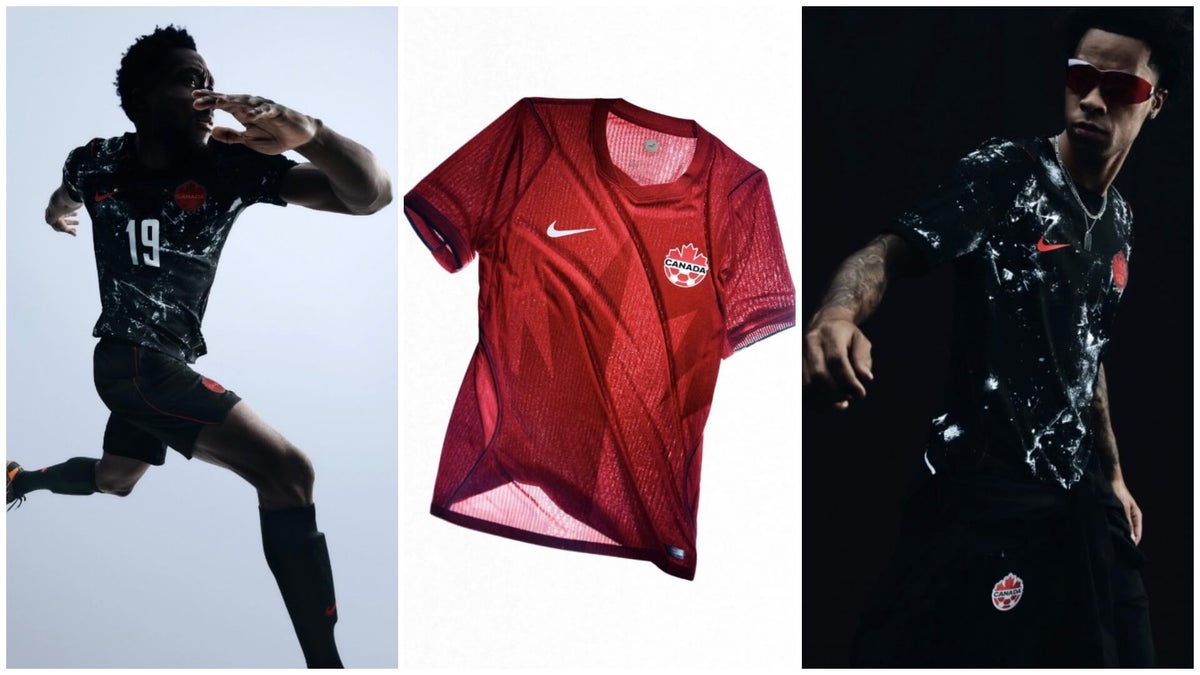
The imagery of the home red kit is powerful and iconic. The maple leaf, which is central to Canada’s flag, is just as central to the kit.
“When you look at the home jersey, we really wanted to think about that idea of True North. When you talk to the team, and we have had a huge process of getting to know them, you really want to create that feeling of identity. And we really love the maple leaf representing that ambition, that forward-thinking, that positivity, which really is something they related to,” McArthur said.
A white-and-grey third kit also features the maple leaf prominently.

Yet it is Canada’s black away kit that truly stands out. Internally, Canada Soccer believes it could set men’s jersey sales records.
“Looking at the jersey itself, it’s made up of the idea of ice and breaking of ice and that mastery of, if you’re from the north you have to master the environment. You have to be able to deal with it. Toughness and resilience is what makes Canadians Canadian,” McArthur said.
Players indeed came away from the original unveiling feeling emboldened. Their goal is to top their World Cup group. It’s ambitious, considering Canada has never earned a single point at a men’s World Cup.
But internally, Canada believes this team is different. There’s a level of talent that didn’t exist in 2022. There’s a sense of resilience after being humbled in Qatar.
There is also a readiness to be different. And look different.
“It’s pride that they take in (the kits), the pride in this moment for Canada to welcome the world into their neighborhoods and into their country,” McArthur said of what stuck out from conversations with players about their kit. It is really a moment for them to represent who they are and put themselves on the map.”