
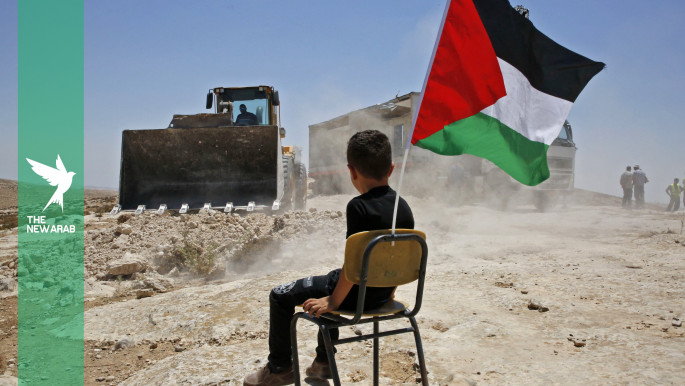
New restrictions on movement and a deadly surge in settler violence in the occupied West Bank have raised fears that Israel is exploiting the war on Iran to accelerate its long-term goal of annexing the Palestinian territory.
At least 11 Palestinians have been killed by the Israeli army and settlers in the occupied West Bank since the US-Israeli assault on Iran began in late February.
In the latest incident on Sunday, a Palestinian couple and their two children were killed near the village of Tammun in the northern West Bank by Israeli forces. The victims each reportedly suffered gunshot wounds to the head.
In a recent statement, the Palestinian Ministry of Foreign Affairs said that Israel is “exploiting the atmosphere of war, regional tensions, and the preoccupation of the international community to impose a new reality on occupied Palestinian land”.
Last year, the UN’s OCHA documented 849 movement obstacles within the West Bank, including gates, checkpoints, and roadblocks restricting movement in the occupied territory.
Most of the gates and barriers that were closed in the days following the 7 October attacks in 2023 have not been reopened since. After the US and Israel launched the war on Iran on 28 February, the West Bank was placed entirely under lockdown, with all remaining gates, checkpoints, and crossings closed.
Multiple new obstacles have also been erected over the past two weeks, sealing entire towns and cutting Palestinians off from essential services.
Rights groups have long argued that these barriers are intended to isolate Palestinian communities from one another and further fragment the West Bank, rendering the creation of an independent Palestinian state impossible.
“These movement restrictions apply exclusively to Palestinians, while Israeli settlers continue to move freely,” Yair Dvir of B’Tselem, a leading Israeli human rights group, told The New Arab.
“During any state of emergency, Israel intensifies these restrictions, sealing the entrances and exits of Palestinian communities. The total restriction of freedom of movement under ‘security pretexts’ has become a widespread and routine practice.”
On the first day of the Iran war, the Israeli army erected an iron gate on the road between Deir Jarir and Silwad north of Ramallah. In January 2025, the army installed another gate at the opposite end of Silwad.
With barriers presently blocking both directions, residents have been immobilised: the Israeli army opens and closes the gates at will, and only soldiers hold the keys.
The Israeli-occupied West Bank has experienced a surge in deadly settler violence since the Iran war. [Getty]
In nearby Sinjil, the Israeli army constructed a five-meter-high metal fence around the village last year, effectively trapping its 6,000 residents in prison-like conditions under the pretext of security. When the gates are closed, it’s impossible to leave the town with a vehicle.
These obstacles serve to impede Palestinian mobility, hindering access to livelihoods and economic opportunities, family members, schools and universities, and even emergency medical services. Ambulances are often delayed searching for alternative routes around the gates.
But restrictions extend beyond the West Bank’s segregated road network. The Israeli army is also engaging in large-scale raids and widespread arbitrary detention, with over 225 Palestinians reportedly arrested during the first week of the war. At least 22 were detained during the same period over social media posts.
In occupied East Jerusalem, Al-Aqsa Mosque – the third holiest site in Islam – has been closed for two consecutive weeks by the Israeli army. During Ramadan, the complex is typically filled with tens of thousands of worshipers. Additional checkpoints have also been erected all over the Old City.
“These are not security measures,” a panel of UN experts on the Human Rights Council said in response to the restrictions, calling them part of the “de-Palestinization” of Jerusalem.
“This environment is coercing Palestinians to leave their life in a city where their roots run deep. Especially during Ramadan, access limitations have gravely curtailed Palestinians’ ability to participate in religious life,” the UN experts added.
While Palestinians remain confined, Israeli settlers in the West Bank – who travel freely on Israeli-only roads unobstructed by checkpoints and roadblocks – appear to be capitalising on the situation.
In Khirbet Abu Falah, north of Ramallah, dozens of Israeli settlers, some masked and armed with clubs and firearms, raided the village in the early hours of 8 March.
When residents confronted the settlers, the latter opened fire, killing two Palestinian cousins: Thaer Faruq Hamayel and Fara Jawdat Hamayel. Another Palestinian died in the village from cardiac arrest due to tear gas thrown by the Israeli army, ostensibly for crowd dispersal.
Earlier that morning, a settler reservist opened fire in the South Hebron Hills and killed 28-year-old Amir Shanaran, bringing the death toll to four in under 24 hours.
Last month, Israel passed a new law to register West Bank land as state property, effectively fast-tracking a decades-long process of annexing the occupied Palestinian territory. [Getty]
Last month, the Israeli Security Cabinet approved a dramatic set of new measures aimed at exerting authority over the West Bank.
The measures would dissolve the remaining shreds of autonomy bestowed on the Palestinian Authority, which, according to the 1995 Oslo Accords, nominally controls civilian matters in Areas A and B of the West Bank, or around 40 percent of the occupied territory.
Since the Israeli Security Cabinet adopted the measures – and not the Israeli Knesset – the full text of the rulings has not been made public. From what analysts have gathered, these measures seek to extend Israeli administrative and legal control over Areas A and B of the West Bank.
Notably, Israel will have enforcement power when it comes to heritage, archaeological, and environmental matters.
While seemingly innocuous, these categories have historically been used to evict Palestinians and displace whole communities. Home demolitions are already a common practice in Area C of the West Bank, but were previously thought improbable in Areas A and B.
In 2025, the Israeli army demolished an average of five Palestinian homes every day under the pretext of illegal building. Such building violations and home demolition policies do not apply to Israeli settlements in the West Bank, which are considered illegal under international law.
The new measures also simplify the process for Israeli individuals and the Israeli state to purchase land in the West Bank and to evict Palestinians without documented ownership, much of which was destroyed in 1967 when Israel first occupied the territory.
These changes in land registration clear the way for an unrestricted settlement boom and the emptying of vulnerable Palestinian communities.
After news of the security cabinet’s decision circulated, over 80 UN member states condemned the move. But while many world leaders issued strong rebukes against the Israeli government, as global attention landed on Iran, international outrage appears to have dissipated.
The US also took advantage of the cover of war to quietly announce it would start offering American consular services in illegal West Bank settlements, contradicting its long-established policy of supporting a two-state solution and condemning the settlement enterprise.
The lack of international attention may be clearing the way for a final push toward annexation. Earlier in March, the Bedouin village of Al Shakara near Duma was emptied due to unrelenting settler attacks.
First, the Israeli army declared the area a closed military zone, barring international activists and rights groups from entering. As settler attacks escalated in the absence of international witnesses, Palestinian residents were overwhelmed and forced to abandon their homes.
Rights groups have long sounded the alarm at state-settler cooperation, noting how the Israeli government implements state policies to embolden settlers and fuel displacement.
The sequence is familiar: government policies restrict access, settlers escalate attacks, and Palestinian communities eventually flee.
“The war with Iran serves as a distraction, allowing for the continued ethnic cleansing of the West Bank with minimal international oversight,” says Dvir.
Kate McMahon is a freelance journalist and foreign correspondent focused on the Middle East and South Asia. She reports on environmental change, human rights, and geopolitical conflicts
Edited by Charlie Hoyle