
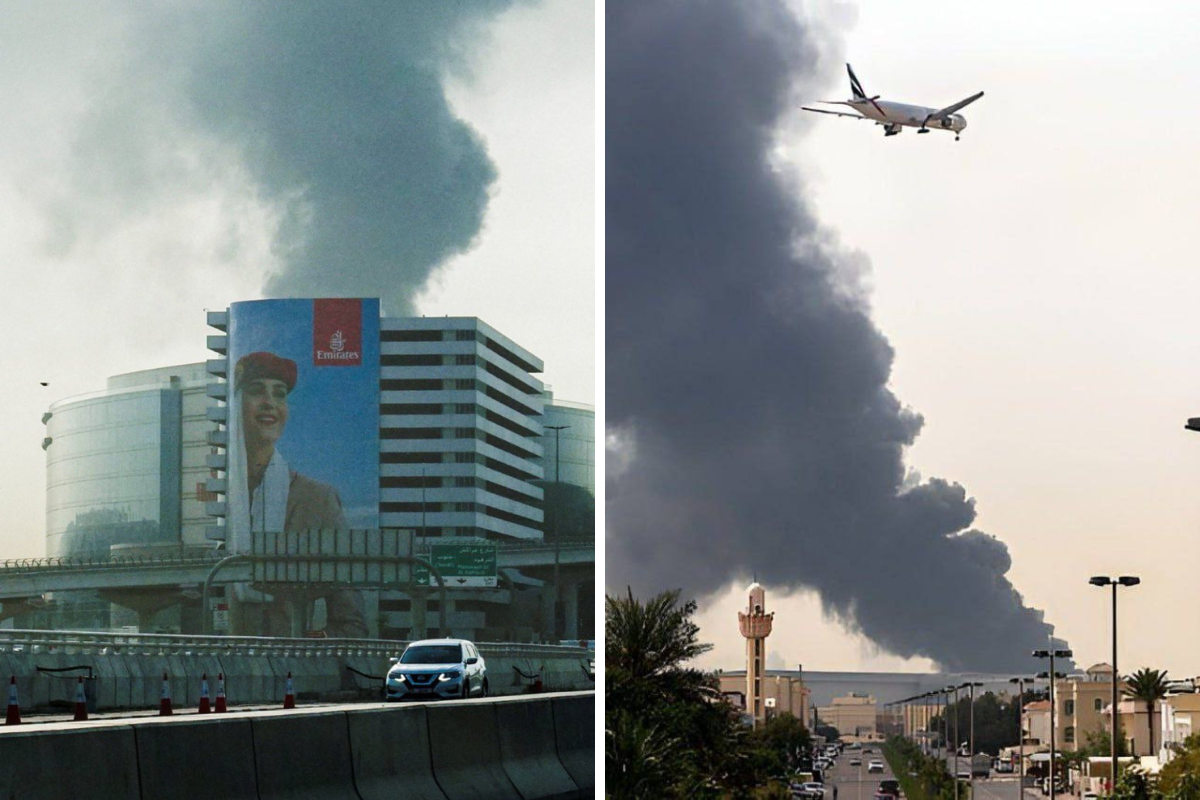
Civil aviation regulators in the United Arab Emirates announced the full closure of the country’s airspace to civilian flights in the early hours of Tuesday morning, saying the decision for the temporary grounding of planes had been made as an “exceptional precautionary measure” amidst the “rapidly evolving regional security developments.”
Confusion, however, reigned in the moments after the announcement was made by the General Civil Aviation Authority (GCAA) via the state-run WAM news agency. The announcement was published at 3:14 am on March 17, but by 4 am (local time), flights were still taking off and landing at both Abu Dhabi and Dubai International Airport.
Update: 10 am (Dubai time). It is now believed that the GCAA was referring to a very temporary airspace closure to deal with a specific threat posed by Iranian projectiles, although it has still not been confirmed by the authorities.
In the meantime, flights are continuing at this time, although airspace could be shuttered with little to no notice as the security situation develops.
Read on for more details about the announcement and background information.
The decision came around 24 hours after an Iranian drone slammed into a massive fuel tank on the outskirts of Dubai International Airport, which is adjacent to the VIP terminal known as the Royal Air Wing.
In the aftermath of the attack, flights were temporarily suspended but resumed at 10 am on March 16 with some cancellations. Emirates, Etihad Airways, and Air Arabia had been allowed to continue operating flights, while foreign carriers were banned from flying to the UAE due to safety concerns for the foreseeable future.
In a statement announcing the full closure of airspace, the GCAA explained that the “decision was taken following a comprehensive assessment of security and operational risks, and in full coordination with relevant national and international authorities, stressing that airspace safety and the protection of the UAE’s sovereignty remain absolute priorities.”
The GCAA noted that the airspace closure was temporary but did not give any indication of when flights would be allowed to resume.
The statement added: “The Authority stressed that the safety of passengers and flight crews remains its top priority, reaffirming its commitment to implementing all necessary measures to ensure the highest standards of safety.”
Nearly an hour after the statement had been published, flight operations in Abu Dhabi and Dubai were continuing as normal, at a busy time of day for aircraft arriving from around the world.
Emirates stated on its website that it was continuing to operate a “reduced flight schedule” which includes transit stops for passengers with connecting itineraries.
The GCAA did not note a time at which the airspace closure was meant to take effect or how long it would last.
On Monday night, the UAE armed forces had engaged yet another salvo of Iranian drones sent towards targets in the country. Dubai International Airport appears to have been repeatedly targeted in the last two weeks since the start of the Iran War.
Along with Monday morning’s attack on the fuel tank, another drone exploded close to Terminal 3 on March 7, injuring four people. In another incident on March 1, debris from a drone crashed through the roof of Terminal 3, injuring four people and causing damage to the concourse.
Aviation leaders, including Sara Nelson, who is dubbed the ‘world’s most powerful flight attendant’ as the head of the largest crew union in the United States, urged governments in the region not to put airline passengers and aviation workers in harm’s way.
Local authorities in the UAE have called on members of the public to rely only on official government sources for their information, but there was immediate clarification of what the GCAA’s airspace closure meant, given that flights still seemed to be operating.
Due to the damage to the so-called ‘fuel farm’ at Dubai International Airport, some long-haul flights departing from the airport on Tuesday night were making pit stops at Dubai World Central Airport to pick up additional fuel before continuing onwards.
A total closure of airspace over the UAE would be worst case scenario situation for the country. The aviation industry is responsible for at least 27% of Dubai’s GDP, providing an economic contribution of US $37.3 billion per year.
For every hour that flights are grounded, the Dubai economy is set to lose $4.25 million.
Related
Subscribe to our newsletter
No spam, just a weekly roundup of the best aviation news that you don’t want to miss

Mateusz Maszczynski honed his skills as an international flight attendant at the most prominent airline in the Middle East and has been flying ever since… most recently for a well known European airline. Matt is passionate about the aviation industry and has become an expert in passenger experience and human-centric stories. Always keeping an ear close to the ground, Matt’s industry insights, analysis and news coverage is frequently relied upon by some of the biggest names in journalism.