
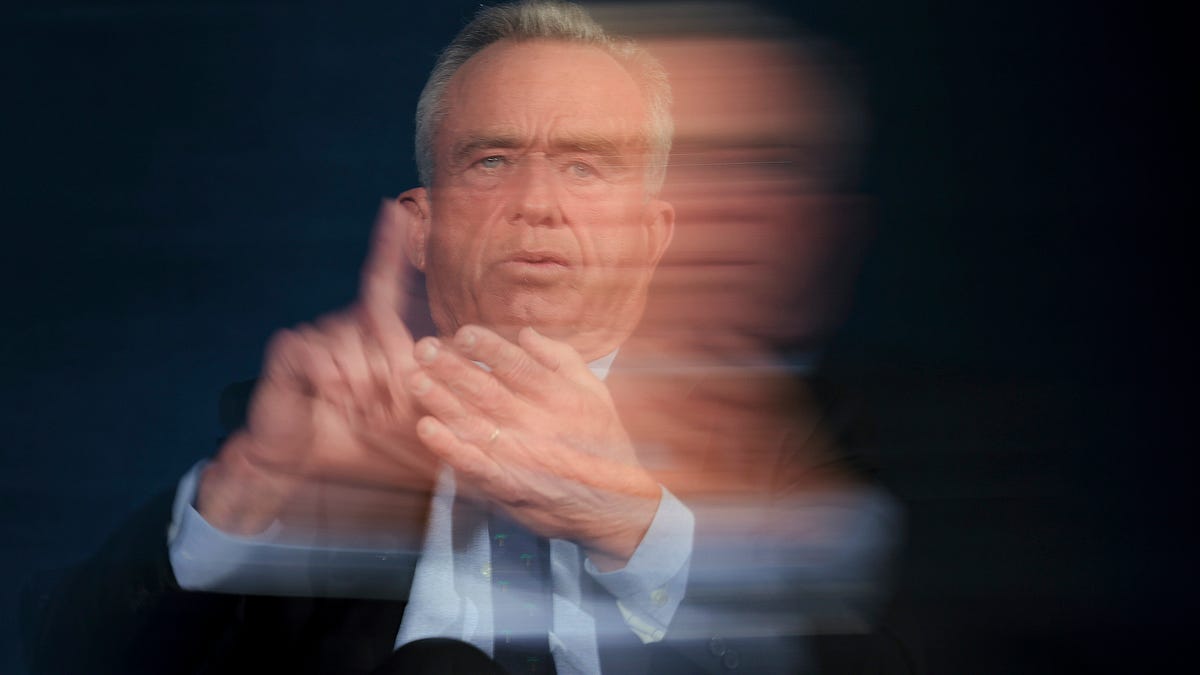
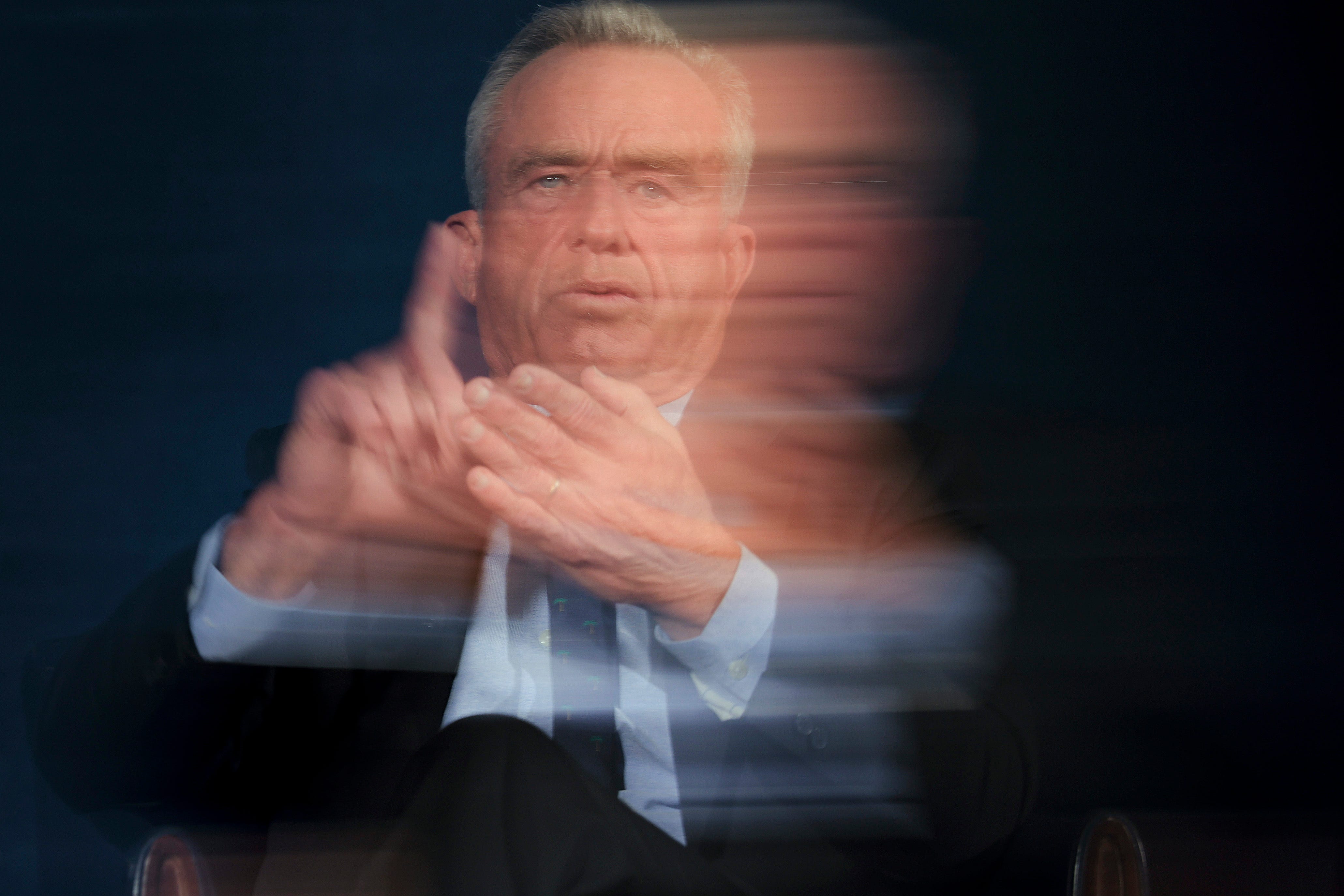
 HHS Secretary Robert F. Kennedy Jr. speaking in the National Press Building on February 2, 2026. (Photo by Heather Diehl/Getty Images)
WELL, WELL, WELL. The brainworm may finally have turned.
Robert F. Kennedy Jr. has spent the past year systematically dismantling federal support for vaccines. From his perch atop the Department of Health and Human Services, he has canceled funding for vaccine research, published misinformation about supposed vaccine dangers, forced out or fired respected scientists who might resist his agenda, and withdrawn federal recommendations for a half dozen childhood vaccines.
Until recently, Kennedy had run into little resistance. Donald Trump, who gave Kennedy all this power, has lauded Kennedy and amplified his attacks on vaccines. Bill Cassidy, the high-profile Senate Republican and Louisiana physician has—despite some angry statements—refused to use his chairmanship of the Health, Education, Labor and Pensions Committee to demand changes or even explanations for Kennedy’s actions.
But this week Kennedy suffered a major setback. And it came at the hands of the judiciary.
On Monday, a federal judge in Boston blocked several of Kennedy’s most consequential policy changes, arguing that he had violated legal rules for how the HHS secretary is supposed to make key decisions. The 45-page ruling was a big win for the plaintiffs—a group of medical organizations and affected individuals led by the American Academy of Pediatrics—who have been protesting Kennedy’s actions from the get-go.
“There is a method to how these decisions historically have been made—a method scientific in nature and codified into law through procedural requirements,” Judge Brian Murphy wrote in his opinion. “Unfortunately, the Government has disregarded those methods and thereby undermined the integrity of its actions.”
Murphy’s order “stays” several key actions taken by Kennedy’s department—meaning that they are not fully prohibited, but rather they are put on hold as the legal proceedings fully play out. Judges in higher courts may not see things the same way; they could reverse some or all of Murphy’s ruling if the Trump administration appeals, as officials are already promising to do.
“HHS looks forward to this judge’s decision being overturned just like his other attempts to keep the Trump administration from governing,” HHS spokesman Andrew Nixon told reporters after the ruling.
The underlying legal issues here include genuinely complex questions about which powers the HHS secretary really has and the extent to which judges can or should determine who qualifies as an expert. It also involves questions over who has legal “standing” to bring a lawsuit like this. Murphy is a Joe Biden appointee, with a reputation as a liberal. It’s not at all hard to imagine conservative judges—including Trump’s appointees on the Supreme Court, if the case gets that far—ruling differently.
But Murphy’s order will help keep vaccines in the news. And that alone has important consequences, given how the politics around the issue seem to be shifting.
In just the last few weeks, the White House has taken a series of steps to get a tighter grip on operations at HHS, and to tamp down on some of the anti-vaccine rhetoric coming from Kennedy and his camp. It’s not clear whether Trump is having second thoughts about his full-throated endorsements of Kennedy. What is clear is that people around the president have gotten nervous that the anti-vaccine agenda is alienating the majority of voters who support vaccination strongly.
In short, Team Trump would prefer to change the subject. Murphy’s ruling makes that harder.
Which, perhaps, is appropriate. The debate here isn’t simply about whether Kennedy is making decisions in ways that comply with the law. It’s also about whether he is making decisions in ways that are good for public health. And this case highlights multiple ways in which he is not.
Fearless reporting. Sharp analysis. And commentary that helps you see around corners. Support our independent journalism with a Bulwark+ membership—for 20 percent off the normal annual price.
MURPHY’S RULING FOCUSES on two important, highly controversial decisions Kennedy made.
The first involves the Advisory Committee on Immunization Practices (ACIP), a group of up to seventeen outside experts who vote on which vaccines the Centers for Disease Control and Prevention should recommend. Service on the committee is voluntary, but it’s considered a big honor and appointees have historically had sterling, widely recognized credentials. Typically they have served staggered terms, with a handful coming on or leaving each year.
“The point of an advisory committee is that it’s not overly controlled by the incumbent administration—it’s not controlled by day-to-day politics,” Sam Bagenstos, a University of Michigan professor and expert on health care law, told me. “Instead, it’s driven by the outside expertise of people who actually worked in the field.”
The HHS secretary does have final say over who serves on the committee. But Kennedy has exercised that power in unprecedented ways—first by firing all of the committee’s sitting members at once, then by replacing them largely with people with histories of criticizing vaccines, vaccine mandates, or both.
Murphy, in his ruling, said Kennedy overstepped his authority, violating requirements of laws governing both the composition of federal advisory committees generally and the makeup of ACIP specifically. Murphy went on to state that the people Kennedy picked for the committee didn’t satisfy legal requirements that membership represent a “balanced” set of perspectives, drawn from people with relevant experience.
“This charter says we need people who are experts in vaccines, immunologists, public health, and so forth,” Dorit Reiss, a law professor and expert on vaccine policy at the University of California, San Francisco, told me. “When the judge looked at these people, he wasn’t looking at the question, ‘Are these people good people to be on the committee?’ He was asking, ‘Is the appointment process—and the credentials—in compliance with what the charter requires and what the law requires that they represent?’ And so he looked at them and said, ‘Here, you need people who represent these kinds of expertise, and that’s not what we got.’”
After ruling that Kennedy had illegally sacked and replaced the old committee members, Murphy put on hold the decisions the ACIP made last year, including a December vote—later endorsed and implemented by the then-acting CDC Director Jim O’Neill—to withdraw a decades-old recommendation that all children get vaccinated against hepatitis B at birth.
But Murphy’s order also covered a separate, even more controversial change: the CDC’s decision in January to withdraw federal recommendations for a half-dozen other vaccines—including rotavirus and meningococcal disease. O’Neill didn’t even bother consulting with the committee on that decision. He made it on his own, citing an assessment memo written by scientists well known for the criticism of vaccines.
Circumventing the normal process in this way, Murphy ruled, was illegal because federal law requires CDC to consider ACIP’s views when making this decision. And on top of that, Murphy argued, the rationale CDC cited was conspicuously thin.
Instead of the sort of evidence-dense, lengthy guidance documents that CDC would typically review, it relied on a relatively thin memo that barely discussed some of the vaccines under consideration. And that memo relied heavily on selective, sometimes unsubstantiated arguments about the kinds of policies that might earn public trust, or how other countries have made their decisions about vaccines.
In issuing these findings, Murphy was stressing that officials legally had to take into account the law’s purpose—which is to ensure vital decisions about public health get serious, careful consideration in ways that take into account the best available evidence, as interpreted by people qualified to assess it.
“In a democracy, you don’t just get to do what you want—you have to operate within both the law and norms of good governance,” said Reiss. “The secretary has a lot of discretion, the secretary can determine the schedule and so forth, but he needs to go through legal procedure and have decisions that are well reasoned. . . . At the stroke of a pen, the secretary decided to overturn decades of careful decision-making that is aimed to protect children in the public health. And the court is saying you need to think about this a little more, because the law requires you to do that.”
Bagenstos, who served as HHS general counsel during the Biden administration, told me he could remember plenty of instances when officials were weighing complex decisions and would have loved to have acted quickly, bypassing some of the usual consultations and procedural steps.
“Look,” Bagenstos said, “it’s always faster to do things without procedure, right? The question is whether it’s better.” And when it comes to the decisions coming out of Kennedy’s HHS, there really isn’t any question, Bagenstos added.
“It’s haphazard and driven by some combination of whim and anti-vax ideology and the sort of weird obsessions of the particular people who’ve been put in positions of power in this administration,” he said.
MURPHY’S RULING MOSTLY REJECTED the Trump administration’s arguments, which focused less on how Kennedy and his lieutenants made their decisions and more on whether the courts had the right to intervene.
Kennedy has broad discretion over who serves on ACIP, the administration argued, and a judge has no business questioning—as Murphy did—whether the credentials of specific scientists meet the standards that HHS has set in the past. As for the vaccine recommendations, the administration argued, they are just that: recommendations. Because states, insurers, and ultimately individual patients and doctors are free to make their own decisions, the recommendations should not be subject to a judge blocking them.
Then there is the question of legal standing, which is the idea that in order to challenge a federal regulatory action somebody has to show they have suffered a direct harm from it. Groups like the American Academy of Pediatrics can’t show this, the administration argued, and thus have no right to bring a lawsuit.
But most of all, the administration argued, the groups behind the lawsuit are really just seeking a legal excuse to block a policy they don’t like, but have been unable to stop politically. That is pretty much how Robert Malone—whom Kennedy put on the ACIP, and whose claims on supposed vaccine dangers mainstream scientists keep refuting—characterized the ruling after it came out Monday.
“Secretary Kennedy and the Trump administration came into office with a clear mandate: restore transparency, scientific integrity, and parental choice to America’s public health apparatus,” Malone wrote in a lengthy Substack post. “What they encountered instead was a bureaucratic fortress built over decades, defended not by persuasive science but by procedural technicalities and sympathetic federal judges. Today’s ruling is the latest skirmish in that battle.”
THE LEGAL DOCTRINES here are subject to enough legitimate debate that even likeminded jurists might reach conclusions different from Murphy’s. But whether the case even moves ahead depends on whether the administration follows through on promises to appeal. And this is where the tricky politics of vaccines come into play.
Trump advisers have been warning about the electoral effects of Kennedy’s agenda for months, going back at least as far as August, when pollster Tony Fabrizio released the first of two surveys showing that most voters still support vaccination. Public polling has backed this up. In one particularly devastating finding, a recent survey found Kennedy had even less of the public’s trust than former top National Institutes of Health official Anthony Fauci, whom Kennedy and Trump—and their followers in MAHA and MAGA—have attacked relentlessly over his actions during the pandemic.
Earlier this year, not long after CDC issued the order pulling back on the childhood vaccine schedule, administration officials began telling reporters they wanted Kennedy to focus more on issues like encouraging physical activity, or discouraging consumption of ultraprocessed foods. That has basically happened. Kennedy hasn’t said much about vaccines recently, and neither has anybody else at HHS.
And it’s not just the rhetoric shifting. It’s the personnel too. Jay Bhattacharya has taken over as acting CDC director, even as he continues his duties as director of the NIH. He’s replacing O’Neill, who moved over to the National Science Foundation. Chris Klomp, a technocratic health care entrepreneur who had been working on Medicare and Medicaid, has become chief counselor at HHS. Ralph Abraham, a Louisiana physician and prominent vaccine critic whom Kennedy had installed as the number two at CDC, unexpectedly left just weeks after taking the job.
Officially, none of this was about the administration trying to make changes tied to vaccination. Abraham cited family reasons for his departure, for example. But it’s hard not to read between the lines. There’s been one conspicuous policy move, too. Last month, the Food and Drug Administration reversed a decision not to consider a new flu vaccine. And it did so, reportedly, after the White House objected.
Plenty of Kennedy’s followers were unhappy about this, just as plenty have grumbled that Kennedy hasn’t already done more on vaccines. But at least for the moment, the White House has given no indication that it is rethinking its strategy of doing what it can to avoid more headlines about vaccines.
That’s why Murphy’s ruling is so important, no matter what happens next. If it remains in force—and if the administration declines to appeal—then it will stop at least some of Kennedy’s most far-reaching policy moves from taking effect. And if it doesn’t—or even if the administration pursues appeals—then the case will continue to serve as a reminder of what Kennedy is trying to do on vaccines, keeping it on the minds of voters.
Malone was right when he said this lawsuit is really just a skirmish. With Kennedy in charge, it’s always one battle after another.