
Iran’s intelligence minister Esmail Khatib killed in strike, Israel defence minister says
The Israeli defence minister, Israel Katz, has claimed that Iran’s intelligence minister, Esmail Khatib, was killed in a strike overnight.
“On this day, significant surprises are expected across all arenas that will escalate the war we are conducting against Iran and Hezbollah in Lebanon,” Katz said during a briefing with military officials, according to Israeli media.
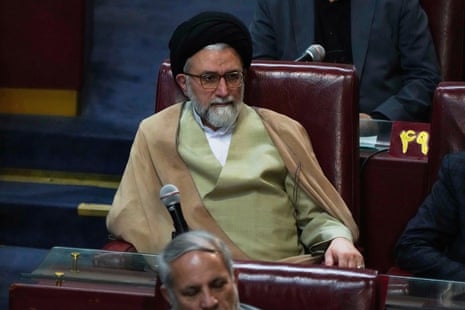 Iranian intelligece minister Esmail Khatib pictured in 2024. Photograph: Vahid Salemi/AP
“The intensity of the strikes in Iran is increasing. The Iranian intelligence minister Khatib was also eliminated overnight.”
He added that the Israeli prime minister, Benjamin Netanyahu, had authorised the military “to assassinate any senior Iranian official … without the need for additional approval”.
It comes a day after Iran confirmed the deaths of its security chief, Ali Larijani, and Basij force commander Gholamreza Soleimani.
There was no immediate comment from Iran on Khatib’s reported assassination.
Updated at 06.36 EDT
Key events
Show key events only
Please turn on JavaScript to use this feature
 William Christou
Shooting, honking and screaming: This was the sound of a desperate mass exodus on Tuesday night, as Israel placed the entire southern Lebanese city of Tyre under a displacement order. Residents knew what came next: planes and bombs and drones and missiles.
The Israeli military spokesperson gave clear orders. The entire city was to leave north of the Zahrani river more than 11 miles away ahead of what the spokesperson said would be strikes on Hezbollah military installations.
On the ground, the orders were not so straightforward. Panicked families hoisting suitcases collided into each other in the corridors in a hotel. “Are you leaving? No, why?” One wide-eyed woman asked another, a child in one hand, a bag in the other. A column of cars crammed into the narrow streets of the Christian quarter – the only part of the city to be spared from the order.
Emergency workers inspect a building that was hit by Israeli bombardment in Lebanon’s southern coastal city of Tyre. Photograph: Kawnat Haju/AFP/Getty Images
Others, displaced twice before in just two weeks, sat watching the chaos without moving, exhausted from running. The war in Lebanon was becoming more brutal. Israeli strikes had killed more than 900 people and wounded more than 2,200.
As the minutes ticked by, the window to make a decision narrowed. The dull thud of Israeli airstrikes in the distance and the Iranian missiles that streaked cherry-red overhead was a reminder that time was running out.
Numbers with random country codes started to call the phones of Tyre’s residents, telling them to leave.
“You are near Hezbollah facilities. Be careful, being south of the Zahrani river puts your life in danger,” a robotic voice repeated over the phone of a resident, calling from a Romanian number.
Tyre was the latest city to be put under an Israeli displacement order – already up to 13% of the territory of Lebanon had been ordered a no-go zone by Israel. More than a million people have been displaced by Israeli bombings and displacement orders.
Tyre has become one of the focal points of intense Israeli air strikes and clashes with Hezbollah. Photograph: Anadolu/Getty Images
The city is one of the largest in southern Lebanon, with about 200,000 residents in the greater metropolitan area. It is also home to ancient ruins, with roman columns that have remained standing through two wars, and it has been a refuge for people displaced from areas farther south.
Even before the order in Tyre, airstrikes hit the coast and mountains which ringed the port city throughout the day as people picked their way through the city’s rubble-strewn streets. At night, families ran out of their homes to watch the outgoing rockets from Hezbollah, waiting to see the night sky light up as Israeli interceptors rose up to meet them.
On Tuesday night, Hezbollah’s usual volleys were more intense than usual – 40 rockets and a swarm of drones were launched towards Israel. It was one of the most intense since Hezbollah struck Israel on 2 March, kicking off Israel’s military campaign.
Nato will deploy a new US Patriot missile defence system at Incirlik airbase in the southern Turkish province of Adana, Turkey’s defence ministry said.
“Another Patriot system… is being deployed in Adana, in addition to the existing Spanish Patriot system stationed there,” a ministry official said at a press briefing today.
The official said a third ballistic missile fired from neighbouring Iran entered Turkish airspace last Friday before it was shot down by Nato air and missile defence systems.
Video: moment building in central Beirut collapses after Israeli strike
Footage shows a multistorey building collapsing in the Bashoura neighbourhood after being hit by missiles this morning.
The Israeli military had issued a warning at 4am local time to evacuate the building and nearby area.
It was one of four Israeli strikes to hit central Beirut this morning. The Israeli military said in a statement that it had completed an overnight wave of strikes targeting Hezbollah infrastructure.
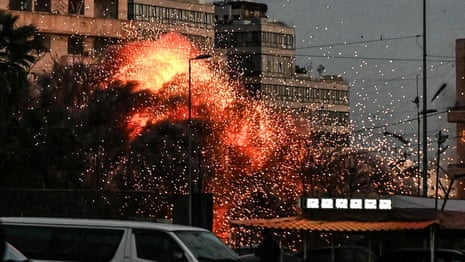 Moment building in central Beirut collapses after Israeli strike – videoShareIsraeli strikes in central Beirut kill at least 12 people, Lebanese health ministry says
Israeli strikes on central Beirut this morning have killed at least 12 people, the Lebanese health ministry said.
A further 41 people were wounded in the attack on Beirut’s Zuqaq al-Blat neighbourhood, the ministry added. It was the second Israeli strike on the densely populated area after a building in Bashoura, also in central Beirut, was struck some hours earlier.
The airstrikes were within walking distance of the city centre and the headquarters of the Lebanese government, according to Reuters. The news agency reported that there were four airstrikes over an eight-hour period, between 1.30am and 8am local time, with the Israeli military issuing a warning on social media before one of the attacks but not the other three.
Updated at 05.11 EDT
Iranian state media has reported that the funerals for security chief Ali Larijani as well as Gholamreza Soleimani, head of the Islamic Revolutionary Guard Corps’ (IRGC) Basij paramilitary force, will be held in Tehran today.
Both men were killed in Israeli air strikes, leading to retaliatory attacks against Israel this morning that killed at least two people.
The Israeli military has repeated its sweeping evacuation order for southern Lebanon, extending more than 25 miles from the Israeli border.
Avichai Adraee, the Israeli army’s Arabic-language spokesperson, ordered people to head north of the Zahrani river this morning before the Israel Defense Forces (IDF) began a bombing campaign against what he said were Hezbollah targets.
“The strikes are ongoing as the IDF is operating with considerable force in the area,” he posted on X. “Therefore, for your safety, we reiterate our call for you to evacuate your homes immediately and head north of the Zahrani river.”
The order, first issued on Thursday and repeated again yesterday, covers major Lebanese cities, including Nabatieh, and dozens of villages. The Israeli military has already issued displacement orders for people south of the Litani river and Beirut’s southern suburbs. Nearly a million people – roughly 20% of the Lebanese population – have been internally displaced since the fighting began. Lebanese authorities say more than 900 people have been killed by Israeli attacks.
ShareIranian strikes hit near Australian airbase in UAE, Albanese confirms
Iran launched an attack on an airbase in the UAE where Australian soldiers are stationed, causing a fire that damaged medical and accommodation facilities, the Australian prime minister, Anthony Albanese, said.
An Iranian projectile hit a road just outside the Al Minhad base, which hosts more than 100 Australian military personnel.
Albanese confirmed that no Australian personnel were injured.
It was not clear if the projectile was a missile or drone strike, but Albanese said it started a fire that caused “minor damage” to an accommodation block and medical facility.
He could not confirm if Iran directly targeted the Al Minhad base while maintaining Australia was not at war.
“The Iranian regime is engaging in random attacks right across the region. We know that is the case,” he said.
It is the second time that the base has been targeted in recent weeks, with an Iranian drone strike hitting the facility in the first few days of the conflict.
Dan Jervis-Bardy, chief political correspondent for Guardian Australia, reports:
We have pictures from the newswires of the Israeli strikes on the Bashoura neighbourhood in central Beirut this morning. Most of Israel’s attacks have so far focused on the southern suburbs of the capital and southern areas of Lebanon, but local authorities told the AP news agency that the strikes against central Beirut have destroyed the illusion of safe areas in the city.
A fireball rises from the site of an Israeli airstrike that targeted a building in Beirut’s Bashoura neighbourhood. Photograph: Fadel Itani/AFP/Getty ImagesSmoke engulfs a building hit by an Israeli missile. Photograph: Fadel Itani/AFP/Getty ImagesPeople gather at the site of the strike. Photograph: Ibrahim Amro/AFP/Getty ImagesA firefighter walks past rubble after a building in central Beirut’s Bashoura neighbourhood was hit. Photograph: Ibrahim Amro/AFP/Getty Images
In a warning to residents at just before 4am local time in Beirut (2am GMT), Avichai Adraee, the Israeli army’s Arabic-language spokesperson, shared a map on X marking the building that was about to be hit by the Israel Defense Forces (IDF).
“To everyone present in the building marked in red on the attached map and the adjacent buildings: You are located near a facility belonging to the terrorist group Hezbollah, which the IDF will be targeting,” he said.
“For your safety and the safety of your families, you must immediately evacuate the marked building and the adjacent buildings and move at least 300 metres away from them.”
Updated at 03.45 EDT
 Hannah Ellis-Petersen
It was yet another heavy night of Iranian missiles and drones being launched over the United Arab Emirates, as the onslaught on the Gulf shows no sign of relenting.
In Dubai, once seen as a regional safe haven, several loud booms rang out over its popular marine area this morning. Six military helicopters were also seen flying low over the bay.
Alerts on Dubai resident’s phones went off throughout the night and into this morning, warning them of the risk of missiles and drones and to seek shelter away from windows and open areas.
Footage sent to Al Jazeera showed missiles and drones being intercepted in Dubai overnight, with fiery debris raining down on the city’s international convention centre.
In a statement this morning, the UAE’s ministry of defence confirmed that “the sounds heard in scattered areas of the country are the result of air defence systems intercepting ballistic missiles, as well as fighter jets intercepting drones and loitering munitions”. They said in a follow-up statement that all air interception operations had been successful.
While tens of thousands of residents and tourists fled Dubai as the conflict broke out, many people have stayed behind. The city’s beaches, bars and restaurants have begun filling up again, as Dubai’s rulers have tried to maintain a sense of safety and security in the city.
However, the nightly missile alarms and booms from drone interceptors are a stark reminder that, as the Middle East war rages on, Dubai and the rest of the Gulf remains on the frontlines.
ShareIran’s stance on nuclear weapons won’t significantly change, says FM
Iran’s stance against the development of nuclear weapons won’t significantly change, foreign minister Abbas Aragchi told Al Jazeera, in remarks relayed by Iranian media on Wednesday, cautioning that the new supreme leader is yet to publicly express his view on the matter.
Iranian foreign minister, Abbas Araqchi. Photograph: Sayed Hassan/Getty Images
Former supreme leader Ayatollah Ali Khamenei, who was killed early in the US-Israeli war against Iran, opposed the development of weapons of mass destruction in a fatwa, or religious edict, issued in the early 2000s.
Western countries, including the US and Israel, have for years accused Tehran of seeking nuclear weapons, while Iranian authorities have said their nuclear programme is solely for civilian purposes.
Aragchi said fatwas depend on the Islamic jurist issuing them and added he was not yet in a position to judge the jurisprudential or political views of Mojtaba Khamenei, Iran’s new supreme leader.
ShareInterim summary
Hello and welcome to our live coverage of events in the Middle East.
If you are just joining us, here is a quick recap of the latest developments:
Iran’s foreign minister Abbas Araghchi said the global repercussions of the Middle East war “will hit all”, suggesting more western officials should push back against the conflict.
In an interview with Al Jazeera, Araghchi also said that Iran’s stance against the development of nuclear weapons would not significantly change.
His comments came after the Iranian army vowed revenge for the killing of security chief Ali Larijani in an Israeli airstrike, with Iran’s army chief threatening to launch a “decisive and regrettable” retaliation.
Donald Trump continued to lash out at Nato allies, claiming “we don’t need” their help in the Iran war after pressuring them to help the US secure the strait of Hormuz.
The US military said it targeted sites along Iran’s coastline near the strait of Hormuz because Iranian anti-ship missiles posed a risk to international shipping there. US Central Command said US forces successfully employed “multiple 5,000-pound deep penetrator munitions” in the strikes.
The International Maritime Organization will begin an extraordinary session today to discuss establishing “a safe maritime corridor” to allow the safe evacuation of tens of thousands of seafarers and thousands of ships stranded in the Persian Gulf.
An Iranian missile barrage killed two people in Ramat Gan, near Tel Aviv, and Israel’s national railway company said shrapnel had disrupted train services.
In Lebanon, Israeli airstrikes have targeted central Beirut, with the Israeli military issuing a statement urging residents to evacuate ahead of the first attack targeting Iran-backed militant group Hezbollah.
Iran has confirmed the death of the Basij militia commander Gholamreza Soleimani, after Israel earlier claimed its military assassinated him. It marks the highest level assassination in the war since joint US-Israeli strikes killed the former supreme leader Ali Khamenei on 28 February.
A projectile hit the premises of Iran’s Bushehr nuclear power plant on Tuesday night. But no damage to the plant or injuries to staff were reported, Iran told the UN nuclear watchdog International Atomic Energy Agency.
ShareSecond Israeli strike hits central Beirut, in Zuqaq al-Blat neighbourhood
A new Israeli strike has hit central Beirut’s Zuqaq al-Blat neighbourhood, state media reported, the second on the densely populated area since the early morning without prior warning.
A blast was heard throughout the capital, and AFPTV’s live broadcast showed plumes of smoke rising from the area as the war between Hezbollah and Israel continued.
Firefighters spray water on a burning residential building after an Israeli airstrike in central Beirut on Wednesday. Photograph: Hassan Ammar/AP
As we posted earlier, a building in Bashoura, also in central Beirut, was struck some hours earlier after an Israeli warning.
In a quick update on an earlier post, Iran and Russia both allege a projectile struck the grounds of the Bushehr nuclear power plant in the Islamic Republic, raising the specter of a radiological incident in Tehran’s war with Israel and the United States.
Neither Iran nor Russia say there was any release of nuclear material in the incident Tuesday, but it underlines a longtime worry of Iran’s neighbours – that the power plant on the shores of the Persian Gulf could be stricken by either an attack or an earthquake.
The plant and Iran’s wider nuclear program remains a reason US President Donald Trump says he started the war alongside Israel against Iran.
Russia’s state-run Tass news agency quoted Rosatom CEO Alexey Likhachev late on Tuesday saying there were no casualties and that the strike hit an area adjacent to the metrology service building at the Bushehr plant, and close to to the operating power unit.
The Atomic Energy Organization of Iran later issued a statement saying “no financial, technical, or human damage occurred and no part of the plant was harmed”, while the The International Atomic Energy Agency said it was told about the strike by Iran but understood there was no damage or casualties.
It unclear what the “projectile” was, and the US military’s Central Command, which is in charge of forces launching airstrikes across southern Iran, did not immediately respond to Associated Press’s request for comment.
ShareInternational shipping regulator to discuss possible ‘safe maritime corridor’ for stranded ships, seafarers
The International Maritime Organization will begin an extraordinary session today to discuss shipping, including establishing “a safe maritime corridor to allow the safe evacuation of seafarers and ships stranded in the Persian Gulf”.
The meeting of the London-based UN agency – responsible for regulating international shipping safety – comes as fears grow over the fate of thousands of ships and seafarers stranded by the war. Iran’s retaliation to Israeli-US strikes has crippled commercial shipping in or near the strait of Hormuz.
Although, as we noted in an earlier, post Iran is still managing to export millions of barrels of oil.
An effective Iranian blockade of the strait has dramatically spiked oil prices, spooked markets, and left about 20,000 seafarers stranded on approximately 3,200 vessels west of the strait, according to the IMO.
At least 21 ships have been hit, targeted or have reported attacks since the start of the conflict, according to an AFP tally based on data from the UK Maritime Trade Operations, the IMO and Iraqi and Iranian authorities.