
Mayor Brandon Johnson on Wednesday pledged to veto a move by aldermen to freeze wage increases for waiters and other tipped workers in Chicago, vowing to protect the change he passed early in his term and often touts as a key win for his progressive agenda.
“I’m not going to stand idly by and watch Black and brown women suffer at the hands of corporate interests,” Johnson said after the City Council meeting, calling a veto “the only fair thing to do to make sure that we’re standing up for working people.”
The measure halting the gradual raises approved by the City Council in 2023 passed in a 30-to-18 vote, leaving its supporters four aldermen short of the supermajority needed to overturn a Johnson veto. Johnson did not say before the vote whether he would veto the freeze, but signaled stiff opposition.
After the vote, Far Northwest Side Ald. Sam Nugent, 39th, declared a win with the coalition she amassed Wednesday to halt the policy.
Asked if she can find four more votes to meet the 34-vote threshold to override a mayoral veto, Nugent said, “I do think that you’re going to get more support if a veto does come.”
But the original sponsor of the 2023 One Fair Wage legislation, Ald. Jessie Fuentes, 26th, said after the vote that she considers the matter closed because of the veto.
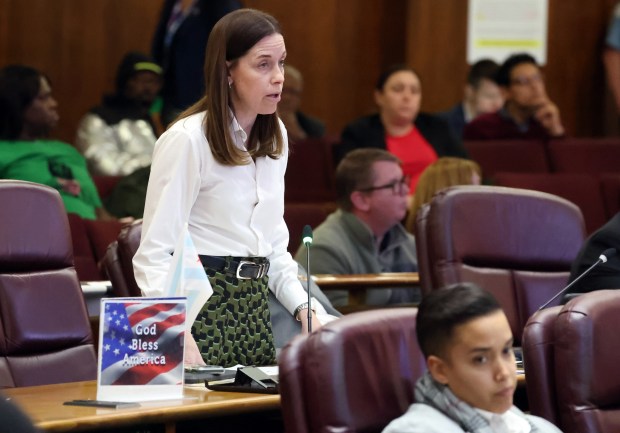 Ald. Samantha Nugent, 39th, speaks during a City Council meeting at Chicago City Hall, March 18, 2026. Ald. Jessie Fuentes, 26th, listens at lower right. (Terrence Antonio James/Chicago Tribune)
Restaurant industry groups led the effort jump-started last week to freeze the planned wage increases. They argue the legally required pay bump — which will eliminate subminimum wages for tipped workers by 2028 — is hurting restaurants and harming jobs.
“We are losing the restaurants we love … People are losing their jobs. Shifts are being eliminated. Prices have increased,” Illinois Restaurant Association President Sam Toia said during a City Hall news conference Wednesday morning. “Everyone says the very same thing: The elimination of tip credit is the reason why.”
But worker-backed groups have described the effort to undo the City Council’s past decision as a bid to “go backwards” to benefit wealthier owners while taking expected raises away from more poorly compensated workers.
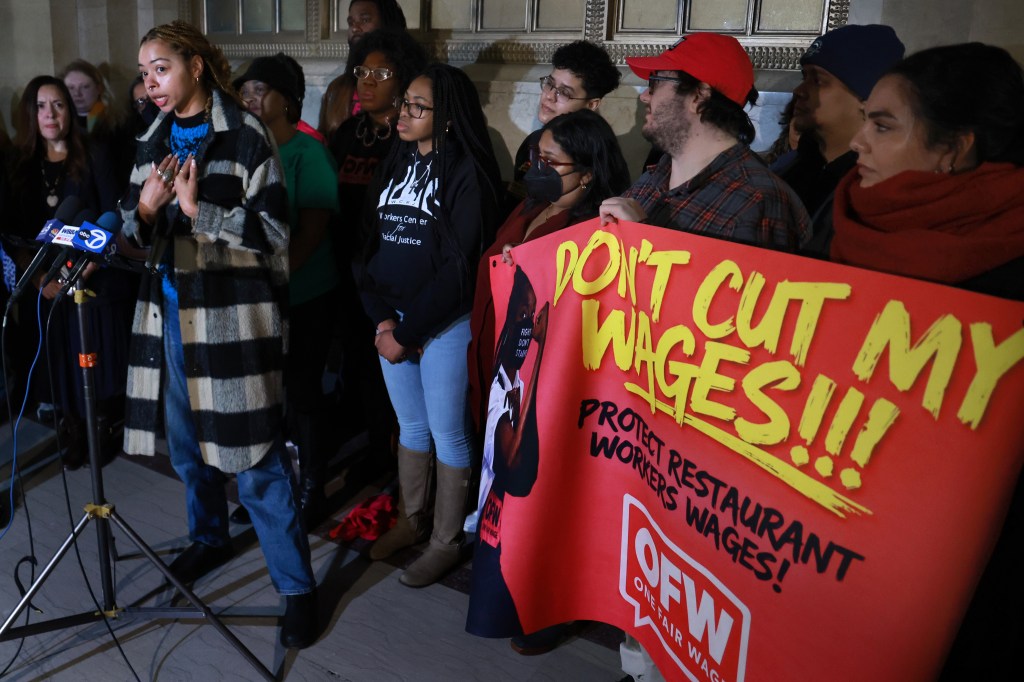
“Our folks deserve minimum wage. They deserve more than that. They deserve to keep their tips on top,” Fuentes said during a dueling Wednesday news conference. “We can’t roll back.”
The subminimum wage was set at $9.48 an hour when aldermen passed the increase in a 36-to-10 vote in 2023. At all times, employers have been required to make up the difference between the lower rate and the city’s minimum wage when tips do not make up the difference. After the first two planned pay increases, the sub-minimum wage is now $12.62 an hour, roughly three quarters of the city’s $16.60 hourly minimum.
Johnson adviser Kennedy Bartley said in a statement Wednesday that there is “little evidence” for Toia’s claims that the increased wages are leading to more restaurant closures and fewer work opportunities. Since the pay raises began to gradually be implemented in July 2024, there has been a net increase of 1,344 licensed food establishments, she said, citing Department of Business and Consumer Affairs data. The renewal rate for such licenses also rose, from 81% in 2024 to 83% in 2025, a sign fewer closures occurred after the mandated raises, she added.
Asked if fewer closures were occurring in the industry notorious for high turnover, Toia scoffed at the data Bartley cited.
“Did you hear me earlier?” he asked. “One in five restaurants did not renew. Do you think that’s good? That 17% of our restaurants are going out of business?”
Toia spoke alongside several restaurant owners and tipped staff who said the measure would force staff cuts and price raises.
“The tables still need to be served, the dishes still need to be washed, but the jobs disappear,” said Gina Barge, owner of Wax Vinyl Bar in West Town.
Toia reiterated several times that workers who make the subminimum wage are guaranteed to make at least the city’s minimum wage and often make more when tips are factored in.
But restaurant industry workers speaking at a news conference hosted by the One Fair Wage political campaign Wednesday morning challenged the notion, arguing workers deserve the higher pay, the stable guarantee of the minimum and often face wage theft.
“The most common workplace abuse that we get from folks is wage theft. They’re not getting their tips, they’re not given the full minimum wage, they’re not given their overtime,” said Raeghn Draper, a bartender at Avondale’s Consignment Lounge and a One Fair Wage organizer.
Draper also argued that One Fair Wage represents far more tipped workers than the coalition organized by restaurant owner groups and added that tipped workers are facing the same economic challenges that restaurants face: expensive gas, rising rents and high food costs.
“Owners and industry groups are asking y’all to protect empty spaces over the people that make them what they are,” Draper said.
Several aldermen who previously supported the wage increases voted against them Wednesday. Ald. Michael Rodríguez, who opposes the freeze, called the backtracking effort “election year tactics.”
“Folks are lining up for reelection,” he said. “The Illinois Restaurant Association has a powerful lobby, but I’m working on behalf of working-class people who deserve a raise.”
Ald. Derrick Curtis, 18th, who voted in 2023 in favor of the raises, but now supports the freeze, pinned his change of heart on being in a “border ward” where businesses can escape city regulations by opening up in an adjacent suburb.
“When employees start seeing that their wages are going down and they’re not making the tips that they were making before, they want to change it back,” he said. “It was a good idea at first, because everyone felt that everyone should make a decent salary to live. But now, it didn’t work.”
The freeze measure was first introduced last May, but Johnson allies at the time used a parliamentary maneuver to prevent its consideration. Nugent used another procedural maneuver to trigger Wednesday’s vote, a move she and her allies only signaled they would make last week.
Ald. Anthony Quezada, a Johnson ally, defended the wage increases, calling the freeze effort “a huge mistake.”
“We’re living in a second Gilded Age where billionaires and corporations are making record profits,” he said.
But Ald. Nick Sposato, 38th, countered that the low wages many tipped workers make are appropriate for jobs and argued they should not make more.
“Let’s face it, everybody, we can’t compare a person that works at Denny’s to somebody that works at Gibson’s,” Sposato said. “There’s no comparison. You can’t compare the Cadillacs to the Volkswagens.”
The City Council also voted Wednesday to approve an ordinance designating Civilian Office of Police Accountability the investigating body for cases of Chicago police violating the Welcoming City ordinance that bans them from cooperating with immigration officials.
The move stemmed from a violent protest in June 2025 at a downtown U.S. Immigration and Customs Enforcement office, where several progressive aldermen clashed with federal agents. The council voted 28-20 to hear the item before it passed.
Johnson also introduced an ordinance during the meeting aimed at protecting Chicago elections — but without the so-called “democracy zones” that he had billed as a means to stand up to President Donald Trump.
Named after the late Rev. Jesse Jackson, who was honored in front of family members in an array of floor speeches Wednesday, the legislation would punish those who harass or endanger election workers and require landlords to protect their mailboxes. A provision to add an extra layer of “democracy zones” around the existing no-electioneering area outside polling sites was shelved, however, as the mayor said the ordinance would instead include a working group to make “recommendations.”
“As far as democracy free zones, that’s something that I think that we still should look at,” Johnson said Tuesday. “All of that is on the table. The goal is to get that done in advance of November. We can’t take it for granted that this president and ultra-ultra-rich corporations, millionaires and billionaires are working overtime to squeeze every bit of life out of the working class.”
Aldermen also approved Johnson’s nominee to lead Chicago Animal Care and Control, Susan Cappello. Several aldermen had pushed against Cappello’s appointment in recent weeks, but backed off the resistance Wednesday while citing conversations organized by the mayor as they shared praise for her and called for the department to receive more funding.