
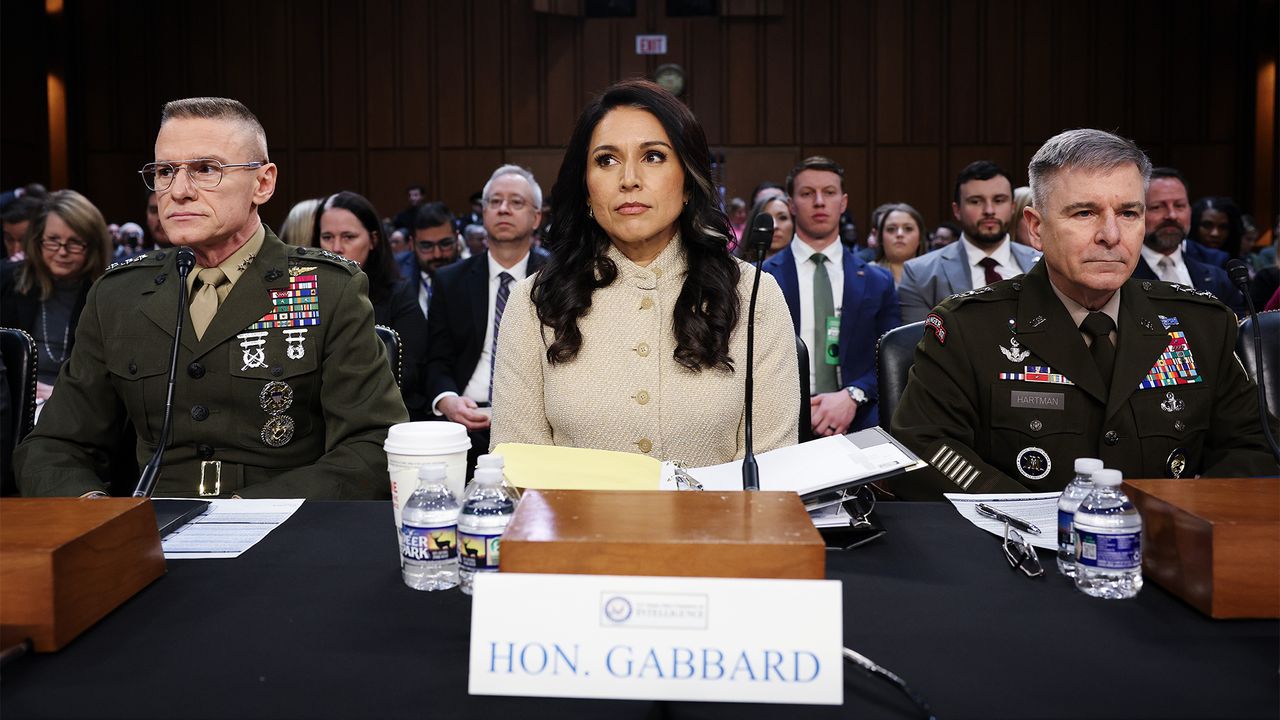
As she sat before the House Intelligence Committee this week to present the annual “worldwide threats” briefing, Director of National Intelligence Tulsi Gabbard was stone-faced. When she spoke, she looked sheepish, particularly when confronted with a speech she delivered on the House floor in 2020 after President Donald Trump bombed Iran during his first term.
“President Trump has committed an illegal and unconstitutional act of war, pushing our nation headlong into a war with Iran without any authorization from Congress,” Gabbard said at the time. “A war that would be so costly and devastating it would make our wars in Iraq and Afghanistan look like a picnic.”
“Director Gabbard,” asked Representative Ami Bera, “do you still believe that strikes against Iran that don’t have congressional authorization constitute an illegal and unconstitutional act of war?”
Gabbard refused to say. When pressed repeatedly, she could only muster a meek reply: That she had to check her personal opinions at the door in order to serve as the president’s top intelligence adviser.
The bashful display marks rock-bottom for Gabbard’s career. A combat veteran and former House Democrat, the Hawaiian spent her time in Congress advocating against America’s senseless wars. Now she finds herself carrying water for one she can’t explain.
The hearing “was a crucifixion of her credibility,” says Curt Mills, the executive director of The American Conservative magazine and a prominent critic of the war with Iran.
It cannot be overstated how much of a reversal this is for Gabbard, who once sold T-shirts stating “No War With Iran” and who said in a statement in 2020, the first time Trump bombed the country: “To all who voted for Trump bc of his antiwar rhetoric, it’s time to realize he lied to u. Stand with me against Trump’s Iran War!”
And now Gabbard sat before the Intelligence Committee and had to explain why, despite her lifelong opposition to a war with Iran, she is continuing to serve in an administration that’s prosecuting one—while making little effort to explain or justify its wisdom to the American public.
“She’s serving as an ornament,” says Glenn Greenwald, a longtime defender of Gabbard in part because of her opposition to foreign intervention. Now, he says it’s clear that whatever power she might have had to dissuade Trump from war is gone. “She’s being exploited. She’s not manipulating anybody. For her own dignity, she ought to resign.”
Gabbard did little to defuse the criticism in her testimony this week. She responded to questions about whether the White House was briefed on the war’s potential fallout with canned, prewritten statements reciting the alleged conclusions of US intelligence agencies.
“The idea of putting Tulsi Gabbard in charge of the intelligence community was as a stake in the heart of the deep state,” Mills says. “And if all that we’re getting here is the deep state’s conclusion through the more sympathetic voice of Tulsi Gabbard, it’s to an extent a distinction without a difference of the rotten status quo that so many people sought to overthrow with Trump’s election.”
But it’s not just the reversal of Gabbard’s long-held beliefs that poses a problem for her. The conclusions of the intelligence community she leads do not appear to support Trump’s claims about the war.
When Senator Jon Ossoff questioned Gabbard on the apparent contradiction between her claim about Iran’s nuclear capabilities and Trump’s case there was an “imminent threat,” she refused to answer, instead insisting—laughably—that only the president can determine whether threats to the United States are imminent.
“That’s just bananas,” Representative Jim Himes told me when I called him after the hearing. “The intelligence community says, ‘Here’s what we think is going to happen and here’s when.’ Imminence is absolutely core and arguably the most important element of intelligence reporting. And the president, to be sure, can disagree with that, but presidents don’t determine imminence.”