
Our homes are integral to our wellbeing. A safe and comfortable living space informs our mental and emotional health, but for many people, it’s our home that unknowingly makes us sick. According to Health Canada, 16 per cent of lung cancer deaths are related to radon exposure in the home.
Michael Martin, a radon gas mitigation expert based in Ontario, says all homes contain some level of radon. The problem lies in long-term exposure to elevated levels of radon, which is a Class 1 carcinogen that can damage cells and lead to lung cancer.
But what is radon, and how do we know if our homes are safe? Keep reading to learn more.
D?
Radon is a radioactive gas found naturally in the ground. It’s an odourless, tasteless gas produced as uranium and other radioactive elements in rocks and soil begin to decay. Radon can occur in groundwater, including private and community wells, and is also present in outdoor air at very low levels.
This article is for informational purposes only and is not a substitute for professional medical advice, diagnosis or treatment. Contact a qualified medical professional before engaging in any physical activity, or making any changes to your diet, medication or lifestyle.
How does radon cause lung cancer?
Exposure to high levels of a carcinogen, even a low-grade carcinogen like radon, can increase your risk of developing cancer. Our bodies inhale and break down the radioactive gas particles that get trapped in our lungs. Cells can become damaged over time, leading to abnormal, cancerous cell growth.

Exposure to radon gas can lead to the development of lung cancer. (Image via Getty Images)
(Thing Nong Nont via Getty Images)
Radon exposure is the number one cause of lung cancer in non-smokers. According to the Canadian Cancer Society, people who smoke and live in homes with high levels of radon have an increased risk of developing lung cancer. Approximately 3,200 Canadians die each year from radon-induced lung cancer.
How does radon get into our homes?
Radon gas can enter a home through any point where its structure contacts the ground, such as cracks in the foundation, walls, or floor slab. It can also enter through construction joints, floor drains, window casements, sump pumps, and gaps between service pipes and support posts.
As warm air rises in the home, a vacuum effect, or “stack effect,” occurs, drawing cooler air containing radon through any available opening in the home’s lower level. Since radon gas accumulates in the lowest level of a home, basements will have higher radon gas readings than the main floor. The second level of a home will have a lower radon level than the main floor — and so on.
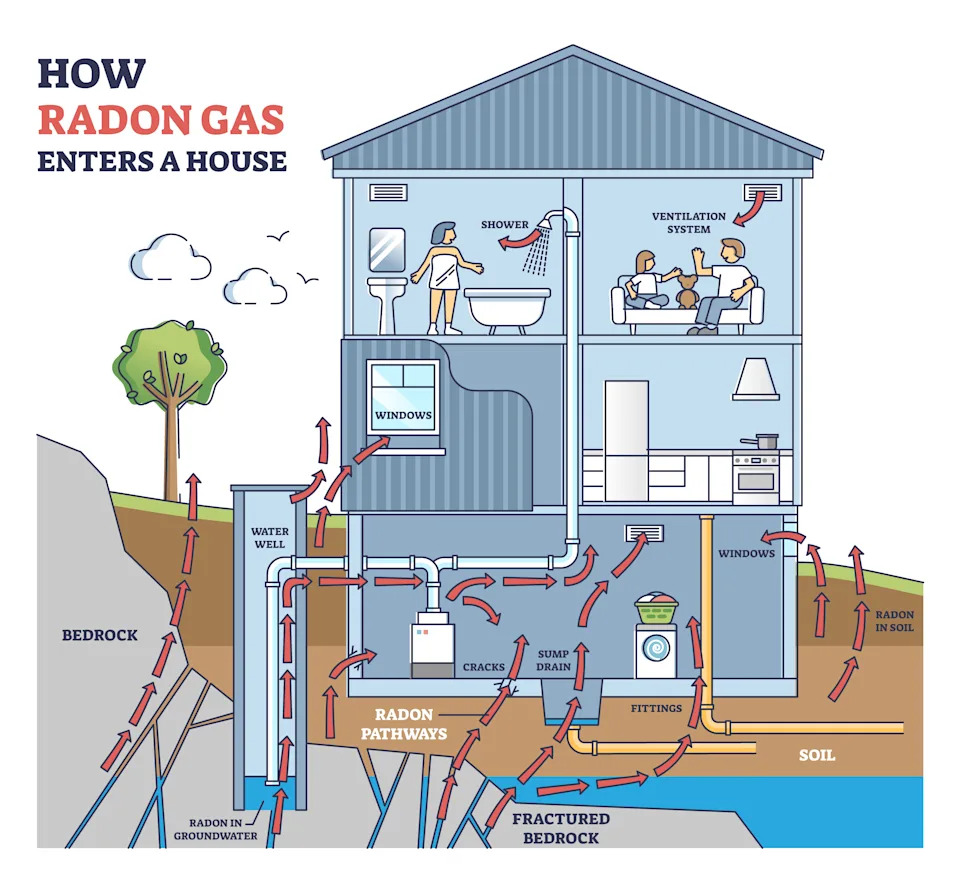
Radon gas can enter the house through cracks in the foundation, sump pumps and other pathways. (Image via Getty Images)
(VectorMine via Getty Images)
“We have many people working from home, who have offices in the basement, children living in the basement or a bedroom in the basement… so in many homes, basements are heavily used,” Martin says.
Although newer homes tend to be more tightly insulated than older homes, Martin says that elevated radon levels can occur in any age of dwelling.
What is considered a ‘safe’ level of radon gas?
The current Canadian guidelines for indoor radon levels are 200 Becquerels per cubic metre (200 Bq/m3) or lower. Any reading higher than 200 Bq/m3 should proceed with mitigation to reduce a home’s radon levels. However, Health Canada notes that there’s no radon gas level that is “risk-free” and that it’s up to each homeowner to decide “what level of radon exposure they are willing to accept.”
Martin notes that the World Health Organization’s (WHO) guidelines for indoor radon levels differ significantly.
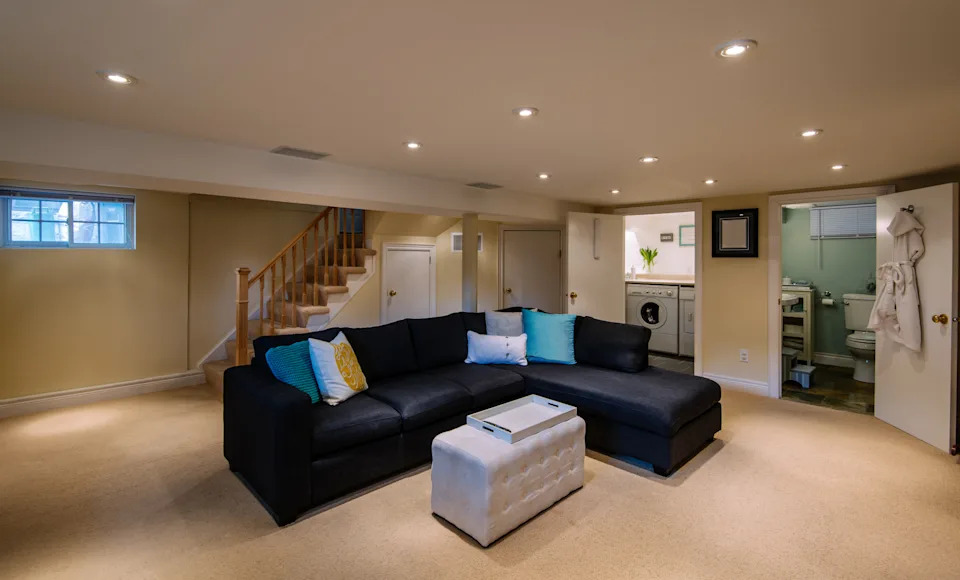
People in basement apartments who who have basements on the lower level of their homes can be exposed to higher levels of radon. (Image via Getty Images)
(FOTOGRAFIA INC. via Getty Images)
The WHO currently recommends that countries adopt a radon mitigation threshold of 100 Bq/m3, but states that national guidelines should not exceed 300 Bq/m3. For comparison, the United States currently considers readings of 148 Bq/M3 actionable for mitigation.
According to recent data, approximately 1 in 5 residential buildings in Canada have radon levels exceeding recommended guidelines.
For Martin, many of his clients are people who have high or borderline levels of radon in their homes. However, a third of his clients only learn of their home’s dangerous radon level after a lung cancer diagnosis.
“That’s a regular feature of my work life. I’m in a house, or someone is sick, essentially every week. It’s a pretty tragic circumstance. Often, people have done everything right, they’re exercising, they have a gym in the house, they eat well and take care of themselves, but now have a diagnosis at a very young age that’s very challenging for the family to deal with,” he says.
Radon test kits: Detectors to help keep your home safe
Although there are experts who can guide you through testing, Martin says there are at-home radon detectors from brands like EcoSense and AirThings that are fairly accurate,
“They’re all solid devices that give a good indication of what’s going on,” he adds. “You move it around throughout your home and you determine hot spots in the home. That’s what makes it a great value.”
For Martin, every homeowner must be comfortable with the radon level in their home. If they have a reading that’s higher than they would like or exceeds recommended guidelines, a radon mitigation expert can help find ways to lower your home’s levels.
New builds are covered for radon mitigation under the builder’s warranty, which varies by province. In Ontario, the Tarion Warranty requires builders to pay up to $50,000 in mitigation costs for up to 7 years for new builds with radon levels exceeding the Canadian guidelines. In B.C, radon levels are typically covered under a general five-year building envelope warranty. Health Canada offers information regarding radon levels and building warranties, grants, subsidies and incentives across the country.
“In my opinion, awareness saves lives,” Martin says. “In my mind, it should be part and parcel of every real estate transaction. It’s something that people should be aware of and test when they are in a new environment; when they’re in a new home, when they’re renovating their home and before and after renovation.”
Let us know what you think by emailing us or threading us @yahoocanada. Follow us on TikTok, WhatsApp and Instagram.