
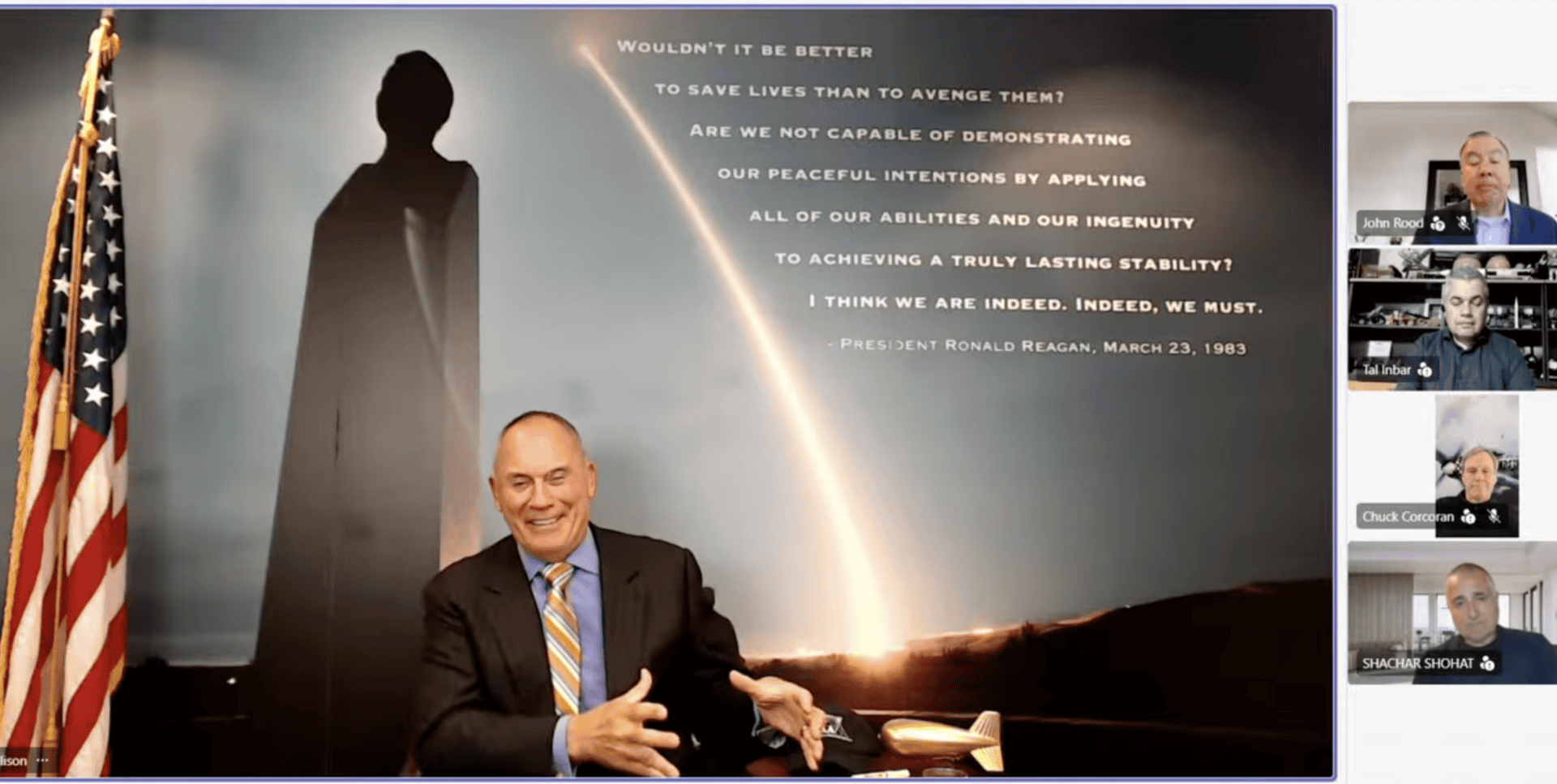
“Good afternoon, ladies and gentlemen, from a beautiful spring day here in Alexandria, Virginia.
I’m Riki Ellison. I am the founder and chairman of the Missile Defense Advocacy Alliance. Our whole purpose, our whole existence is for the advocacy of missile defense, its evolution, its deployment, its development to make our world a safer place, to make our allies a safer place, and to make our nation a safer place. And no time, I keep saying that on the, this is our 94th congressional roundtable, but every time I say that, that it’s making it safer and safer, it gets better and better in terms of the deployment and the effects of missile defense, which in the last 18 days is defending 170.5 million people in the Middle East and over 12 countries. It’s a capability that has to be there. It has to get better. It will get better.
I’ve been involved, my organization was built 20 years ago, but I’ve been involved with missile defense for over 46 years. And I’m going to walk it back because it’s relevant. I was in Los Angeles, California in 1979 when the embassy at Iran, the U.S. embassy got taken down. In LA, we had riots or protests of Iranians storming the Shah’s residence in Beverly Hills. We had an uproar on that. A new president, Ronald Reagan, came in because of that, one of the reasons. And I was in college in 1980 with his national security advisor in that campaign, pushing hard for missile defense and the beginning of the critical thinking behind the Strategic Defense Initiative that came forward three years later in 1983.
In 1982, we had Lebanon invade Israel and Hezbollah formed in late 1982. Somehow, after my rookie year, losing the Redskins in a championship game, I ended up in the Kibbutz in northern Israel, where remnants of rockets were around me from that invasion or that movement in Lebanon.
I’ve been part of the love of Israel and the importance of Israel as we move forward, as our country moves forward together with Israel. And it started in 1983 when we did the Strategic Defense Initiative. In 1986, President Reagan signed the first MOU with Israel. Caspar Weinberger signed it to create the missile defense capabilities, the layered missile defense capabilities that Israel has today that nobody in the world has. It started in 1986 with that relationship that was built.
We had an SDI organization. And then we moved to a ballistic missile defense organization. And in 1991, Iraq hit Israel and it hit Saudi. And we had Patriots used for the first time. We had to force that. That happened. And the movement to get missile defense accelerated. And we were in an ABM treaty. We couldn’t do anything at that level, at the higher level. But Israel and the United States moved together to start forming that capability, that layered capability.
In 1999 is when we really took off. When we had Ron Kadish, the director of the ballistic missile defense organization, just from Les Lyles, and we had Arieh Herzog of IMDO that came together to start building capabilities together. And U.S., our Congress and our government funded MDA to support Israel in creating this layered defensive capability, which is also on water. Let’s not forget about the Aegis capabilities that have been in place, at Haifa, on that coast, Red Sea. That’s been a shore point of defending Israel from that.
In 2001, and when John Rood was working at the National Security Council, and we made a decision to withdraw from the ABM treaty. And we made a decision after 9/11 to go forward and enhance our capabilities as much as we could for our nation and for Israel. We created the Missile Defense Agency. And that’s when I first came, I think I first came over and met Ariel, and Shachar was an Arrow commander, I believe, way back then, where we moved to get capabilities in place. We were, I think it’s Sadat, where the Iron Dome was created.
So we sat with MDA and Arrow-1, Arrow-2, Arrow-3, David Sling, the Iron Dome, Green Pine radar. We have U.S. Patriots over there, we have the U.S. THAAD, AN/TPY-2 radars over there, to be able to build that out. And so since then to where we are last year, the Golden Dome was really the Iron Dome in the beginning, because of it representing how good Israel has been in being able to defend themselves in a layered capability. And that is now the Golden Dome.
And now here we are today in marvel of what Israel has done in the defensive capabilities of its citizens in a layered defense unlike anywhere in the world. And we’re seeing them cooperate with the GCC across those 12 nations. We’ve seen MDA flourish. There’s a lot of credits got to go to the Missile Defense Agency in being able to integrate all this and play into this.”
—Riki Ellison, MDAA 94th Virtual CRT Opening Remarks
Executive Summary
I. Introduction
The Virtual Congressional Roundtable “Missile Defense of Israel” brought together MDAA Chairman Riki Ellison, Tal Inbar, Maj Gen (Ret.) Charles Corcoran, Brig Gen (Ret.) Shachar Shohat, and former Under Secretary of Defense for Policy John Rood to assess the performance, strategic meaning, and future implications of Israel’s missile defense architecture during the ongoing regional war with Iran. The discussion argued that Israel’s layered defense, built over decades through close U.S.-Israel cooperation, is now demonstrating its real-world value not only in protecting Israeli lives but in shaping a wider regional and global model for missile defense integration.
II. Strategic Context: Israel’s Layered Defense as the Product of Decades of U.S.-Israel Cooperation
Riki Ellison opened by tracing the modern missile defense relationship between the United States and Israel from the Reagan-era Strategic Defense Initiative, the 1986 U.S.-Israel missile defense MOU, the experience of the 1991 Gulf War, and the institutional work of the U.S. Missile Defense Agency and Israel’s defense establishment to build Arrow, David’s Sling, Iron Dome, Green Pine radar, and supporting U.S. Patriot, THAAD, AN/TPY-2, and Aegis capabilities. The roundtable’s basic premise was that the system now defending Israel is the result of a multi-decade investment in layered architecture, interoperability, and shared strategic vision.
III. The Current Conflict: A Test of Integrated Missile Defense at Regional Scale
Speakers described the present war as a new and more intense phase of conflict in which Iran is launching ballistic missiles, drones, and submunition-equipped systems not only at Israel but across the Gulf and wider region. Tal Inbar emphasized that Iran’s missile salvos are still dangerous but have been degraded by preemptive strikes, interception, and attacks on launchers and depots. He noted that Iran is using a mix of systems including Ghadr, Emad, Khorramshahr-4, Kheibar Shekan, and Sejjil missiles, with a notable increase in submunition warheads intended in part to complicate missile defense. He also stressed that many Gulf states remain more vulnerable than Israel because they lack comparable layered defense systems.
IV. Israel’s Layered Defense Is Working
A central conclusion of the discussion was that Israel’s multi-layered defensive architecture is proving highly effective. Shachar Shohat argued that years of U.S.-Israel collaboration have produced a defense “orchestra” in which Iron Dome, David’s Sling, Arrow, Patriot, THAAD, TPY-2, Aegis, and shared early warning are functioning together with a high rate of success. He added that preemptive offensive action has also reduced the size and complexity of incoming salvos, making the defensive challenge more manageable than it otherwise would have been. Panelists consistently presented Israel as the world’s leading model of national layered missile defense.
V. Interoperability, Partnership, and Teamwork as the Decisive Advantage
The discussion repeatedly emphasized that missile defense is not a stand-alone technical function but a team sport requiring sustained integration across services, nations, governments, and industry. Corcoran highlighted the importance of partnerships among the U.S. Army, Air Force, Navy, Space Force, special operators, Israel, Gulf partners, and defense industry. Rood similarly stressed that the current degree of data-sharing, early warning coordination, and fire-control integration is the result of decades of painstaking work and should not be taken for granted. Shachar added that interoperability matters on both the defensive and offensive sides and remains one of the key enablers of success in the present conflict.
VI. Offense Still Matters, but It Cannot Replace Defense
Another major theme was that offensive action is critical but insufficient on its own. Corcoran argued that air superiority and preemptive strike operations have enabled Israel and the United States to attrit Iranian ballistic missiles, coastal defense cruise missiles, storage sites, and other high-value targets. At the same time, he cautioned that no campaign will completely eliminate mobile launchers, drones, or dispersed threats. Rood reinforced this point, stating that suppressive offense is essential but will never fully substitute for a robust and resilient defensive architecture. The message across the panel was clear: victory requires the integration of offense and defense, not a choice between them.
VII. The Next Urgent Problem: Cheap Drones, Underlayer Defense, and Protection of the Defenders
The panel underscored that modern conflict is being reshaped by the spread of inexpensive drones and lower-cost attack systems. Corcoran described this as the “democratization of cheap drones,” noting that adversaries can now attack broad surfaces affordably and force defenders to protect more targets than ever before. Multiple speakers warned that radars and other missile defense enablers are themselves vulnerable and must be defended through layered systems, mobility, deception, redundancy, and resilient sensing networks. Rood argued that although the United States claims to be learning lessons from Ukraine, it has not moved fast enough to close these gaps, increase production, or field lower-cost solutions at the speed required.
VIII. Passive Defense and Civil Preparedness Are Essential
One of the most distinctive aspects of Israel’s defense model discussed in the roundtable was the role of passive defense. Shachar explained that Israel’s warning systems, shelters, civilian training, and disciplined public response are indispensable to limiting casualties, particularly from debris and residual effects that active missile defenses cannot always eliminate. In his framing, national missile defense is not only about interceptors and radars, but about population preparedness and the integration of civil defense into the architecture of national survival. Riki Ellison echoed this in closing, describing Israel’s passive defense system as one of the most important lessons for other Western nations.
IX. Regional Integration: Missile Defense Is Driving New Strategic Relationships
A recurring strategic point was that Iran’s attacks across the region are creating incentives for deeper cooperation between Israel and Gulf states. Tal Inbar and Corcoran both argued that Iran is striking weaker and less defended regional targets in part to generate political and economic pressure on the United States and Israel. Shachar and Rood suggested that the conflict may accelerate practical regional defense integration, including shared missile defense, shared warning, industrial cooperation, and broader trust-building. Riki framed this as the beginning of a wider “global Golden Dome” logic: a data-sharing and defense architecture that starts in the Middle East but could expand across the Western alliance system.
X. Emerging Technologies: Directed Energy, AI, and Space-Based Resilience
The discussion also looked forward to the next generation of missile defense technologies. Shachar described early Israeli success using lasers against UAVs, while noting that harder targets such as tactical ballistic missiles remain more challenging. Corcoran pointed to AI-enabled sensor fusion and automated effectors as especially promising for affordable point defense at scale. Tal Inbar cautioned that vulnerable fixed infrastructure such as aerostats may not be the answer and argued for greater emphasis on resilient space-based sensing and future satellite constellations as part of a larger Golden Dome architecture.
XI. Strategic Conclusions: Missile Defense Is Central to Modern Warfare
John Rood’s broader strategic argument was that the United States and its allies must finally accept that missiles and drones are now a central instrument of warfare. He warned that current conflicts are exposing both the value of missile defense and the costs of underinvesting in it, while also revealing the coordinated challenge posed by Iran, Russia, China, and North Korea. His conclusion, echoed by the rest of the panel, was that missile defense must be treated as a central pillar of deterrence, warfighting, alliance-building, and strategic stability, not as a niche or secondary mission.
XII. Conclusion
The roundtable’s core conclusion was that Israel’s missile defense is not just defending Israel; it is showing the world what a modern, layered, integrated missile defense enterprise looks like in combat. Speakers argued that the present conflict has validated decades of U.S.-Israel cooperation, exposed urgent gaps in regional and Western defensive capacity, and created a new strategic opportunity to expand missile defense collaboration across the Middle East and beyond. In Riki Ellison’s closing formulation, Israel is the “superstar” of missile defense, and the task now is to extend the lessons of that success into a broader regional and global architecture capable of protecting populations, preserving deterrence, and making the world safer.
Speakers:
Mr. Tal Inbar
MDAA Israel Fellow
Maj Gen (Ret.) Charles Corcoran
Former Assistant Deputy Chief of Staff Operations, USAF
Brig Gen (Ret.) Shachar Shohat
Former Commander, Israel Air Defense Forces
Mr. John Rood
Former Under Secretary of Defense for Policy
Mr. Riki Ellison
MDAA Founder & Chairman
Click here to view transcript.
Winners Associate with Winners to Win!