
The Iran war has had a punishing impact on global oil and gas prices over the last three weeks. And beyond the Middle East — where airstrikes, missiles and drones have already killed thousands — pain at the pump is how most of the planet’s population will actually be feeling the consequences of combat.
“Look, gas prices are up. And we know they’re up. And we know that people are hurting because of it,” Vice President JD Vance said in Michigan on Wednesday. “We’ve got a rough road ahead of us.”
Vance vowed that the strain would be “temporary,” insisting that “you’re gonna see energy prices come back down” over “the next few weeks.” He also said the Trump administration is “doing everything we can to make sure [gas prices] stay lower” in the meantime.
But what should you really expect going forward? Here’s a guide to why energy prices are rising so rapidly — and why other things could soon get more expensive, too.
How much oil and gas prices have shot up so far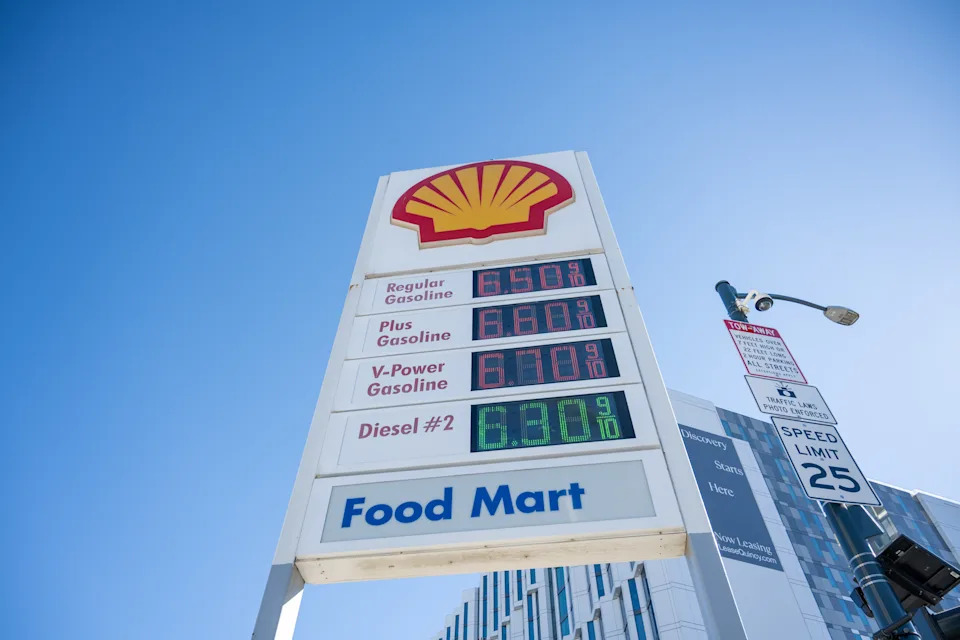
Shell gas station in San Francisco, California showing high gas prices, with Regular fuel priced at $6.50 per gallon on March 12, 2026.
(Smith Collection/Gado/Getty Images)
The international “benchmark” for oil prices is called Brent crude. (Brent is a type of oil, mostly from the North Sea; traders buy and sell Brent “futures” on a financial market, affecting its price.) Over the last month, the price of Brent futures has soared from $71 per barrel to about $110 per barrel — a 54% increase. On Thursday, that number briefly hit $119 per barrel.
Brent crude is easy to refine into gasoline, so gas prices tend to rise along with Brent prices. Since Feb. 20, the average price of a gallon of regular gas in the U.S. has shot up by one whole dollar, from $2.93 to $3.91, according to the American Automobile Association.
That’s a 33% increase — the single largest one-month jump in the last 30 years. Neither Hurricane Katrina in 2005 (30%), the start of the war in Ukraine in 2022 (24%), the post-recession surge of 2009 (21%) nor the 1999 cuts by the Organization of the Petroleum Exporting Countries (21%) can compare.
The last time the average U.S. gallon of gas cost more than $3.90 was in 2022.
Why oil and gas prices are rising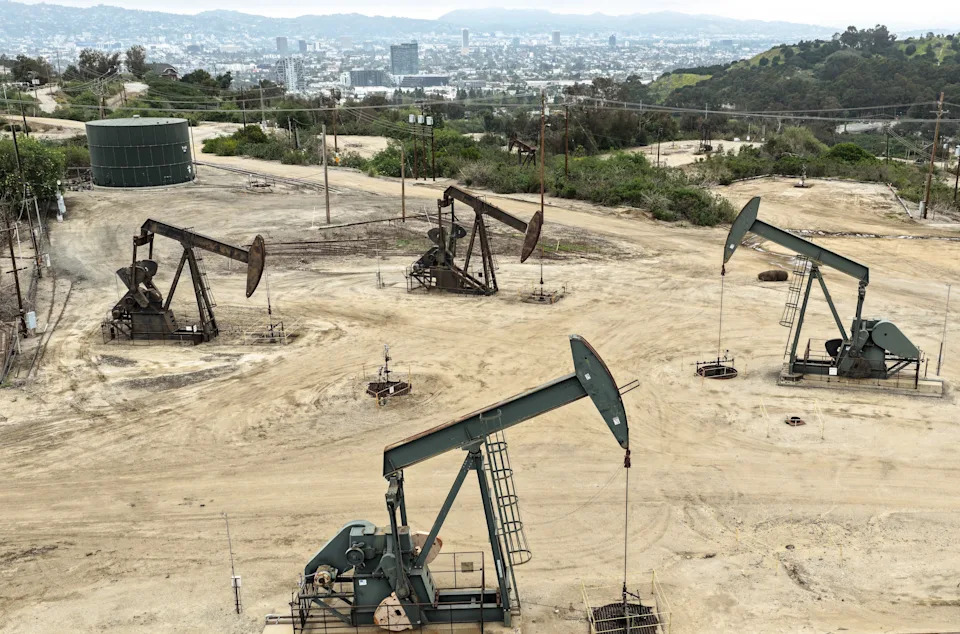
An aerial view as oil pumpjacks operate while others stand idle in the Inglewood Oil Field on March 10, 2026 near Los Angeles, California.
(Mario Tama/Getty Images)
The biggest reason why oil prices have skyrocketed is that Iran has the power to effectively halt shipping through the Strait of Hormuz, a narrow, winding waterway along the country’s southern coastline that connects the Persian Gulf to the rest of the globe.
The strait is considered the world’s most vital shipping lane. Why? Because one-fifth of our oil flows through it. But Iran has been threatening to attack ships there, and the country’s new leader has vowed to maintain the blockade. U.S. officials say Iran has also been booby-trapping the strait with mines. As a result, almost no non-Iranian ships have been risking the journey — and the supply of Gulf oil has plummeted.
The Wall Street Journal reported on March 13 that top military officials told President Trump before the war “that an American attack could prompt Iran to close the Strait of Hormuz.” But Trump dismissed the risk, according to the Journal’s sources, telling his team that Tehran would capitulate before closing the strait — and even if they tried, he continued, the U.S. military could handle the situation.
“Planning around preventing this exact scenario — impossible as it has long seemed — has been a bedrock principle of U.S. national security policy for decades,” a former U.S. official who served in Republican and Democratic administrations told CNN.
How events on the ground can make things worse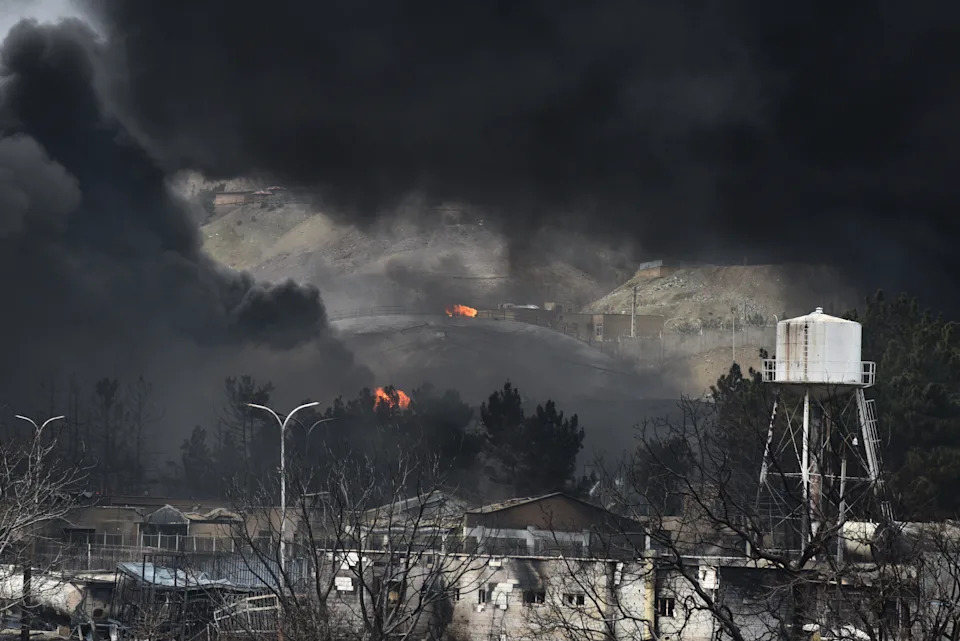
Plumes of smoke rise over the oil depot tanks hit by joint Israel-U.S. over night in a station north west of the capital on March 8, 2026 in Tehran, Iran.
(Kaveh Kazemi/Getty Images)
When oil prices peaked earlier this week at $119 a barrel, that was a direct reflection of the latest events in the Middle East — namely, a series of tit-for-tat attacks on energy infrastructure throughout the region.
On Wednesday, Iranian state media reported that airstrikes had hit its giant South Pars natural gas field — as well as nearby oil and petrochemical facilities — in the southern city of Asaluyeh. International oil prices jumped more than 6% to nearly $110 a barrel following the news. Natural gas prices also shot up. Most of the energy from South Pars is used domestically in Iran. Qatar blamed Israel for the strike.
In response, Iran launched retaliatory strikes on energy sites in Qatar, Kuwait, Saudi Arabia and the United Arab Emirates. Qatar’s Ras Laffan terminal, the largest liquefied natural gas facility in the world, was seriously damaged. This is when oil prices briefly hit $119 a barrel.
Before the situation could spiral further out of control, Trump stepped in to insist the U.S. and Qatar were not involved in the South Pars strike, which he attributed to Israel. At the same time, he threatened to “massively blow up” the gas field if Iran retaliated again — a signal that the prospect of further energy attacks has spooked the administration.
“I do not want to authorize this level of violence and destruction because of the long term implications that it will have on the future of Iran,” Trump wrote, “but if Qatar’s LNG is again attacked, I will not hesitate to do so.”
On social media, Iran’s foreign minister warned that his country would show “ZERO restraint” if its energy infrastructure were struck again.
Oil prices eased slightly after the attacks, but remained well over $100 per barrel.
How the Trump administration is trying to lower oil and gas prices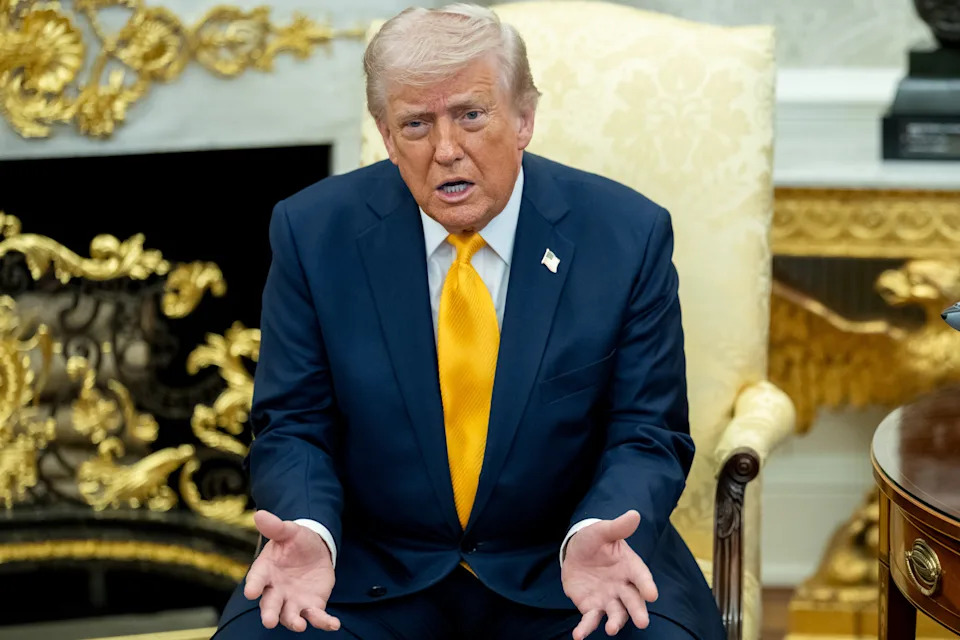
US President Donald Trump during a meeting on Thursday, March 19, 2026.
(Aaron Schwartz/CNP/Bloomberg via Getty Images)
Trump has tried to address the issue in many ways: lifting sanctions on some Russian and Venezuelan oil to increase supply; moving to release oil from America’s Strategic Petroleum Reserve; boosting oil production off the coast of California; and temporarily waiving the Jones Act, a law that requires all goods traveling between U.S. ports to be moved on American-made and American-crewed ships. The White House has signaled that it could ask U.S. oil companies for more supply as well.
But as one energy expert told The Hill, “at the end of the day, there is only one real solution to the energy price issue, and that is to reopen the Strait of Hormuz and allow more oil supply onto world markets.” Everything else is marginal, he explained.
So the administration’s focus has increasingly shifted to the strait in recent days — and possible military solutions to the blockade. U.S. forces struck Iran’s 30 mine-laying ships earlier this week, and on Friday, warplanes and attack helicopters began to ramp up their assaults on Iranian drones and naval vessels in the area.
At the same time, Trump has repeatedly called on U.S. allies to send warships to escort merchant vessels through the strait.
“I’m demanding that these countries come in and protect their own territory — because it is their territory,” Trump said on Sunday. “You could make the case that maybe we shouldn’t even be there at all, because we don’t need it. We have a lot of oil.”
But the reception to the president’s entreaties has been cool so far. Top officials from Japan, Italy, Australia and Germany rebuffed Trump on Monday, saying their countries would not participate in efforts to reopen the strait. “This is not our war,” said Germany’s defense minister. “We did not start it.”
Some of those countries joined a statement on Thursday expressing support for a potential coalition to reopen the strait — but they pointedly did not commit to sending naval vessels or other resources. Axios characterized the statement as “largely a gesture to placate President Trump.”
The big question going forward is whether the president will deploy ground troops to force Iran’s hand.
Axios reported on Friday that the administration is now considering plans to occupy or blockade Kharg Island, which sits 15 miles offshore and processes 90% of Iran’s crude oil exports.
Previously, the U.S. bombed more than 90 missile storage sites and mine facilities there. Trump said at the time that U.S. forces “totally obliterated every MILITARY target” but left the island’s oil infrastructure intact. He threatened to reverse that decision if Iran does not reopen the Strait of Hormuz to commercial shipping.
U.S. officials told the Associated Press on Friday that three warships, along with roughly 2,500 Marines, are now bound for the Middle East from San Diego. The news comes just days after the U.S. sent another group of amphibious assault ships carrying Marines to the region. In total, about 5,000 additional troops are now headed to the Middle East.
When asked on Thursday if he planned to put boots on the ground in Iran, Trump was cagey. “I’m not putting troops anywhere,” Trump told a reporter. “If I were, I certainly wouldn’t tell you.”
How rising energy prices could make everything more expensive (and affect the economy as a whole)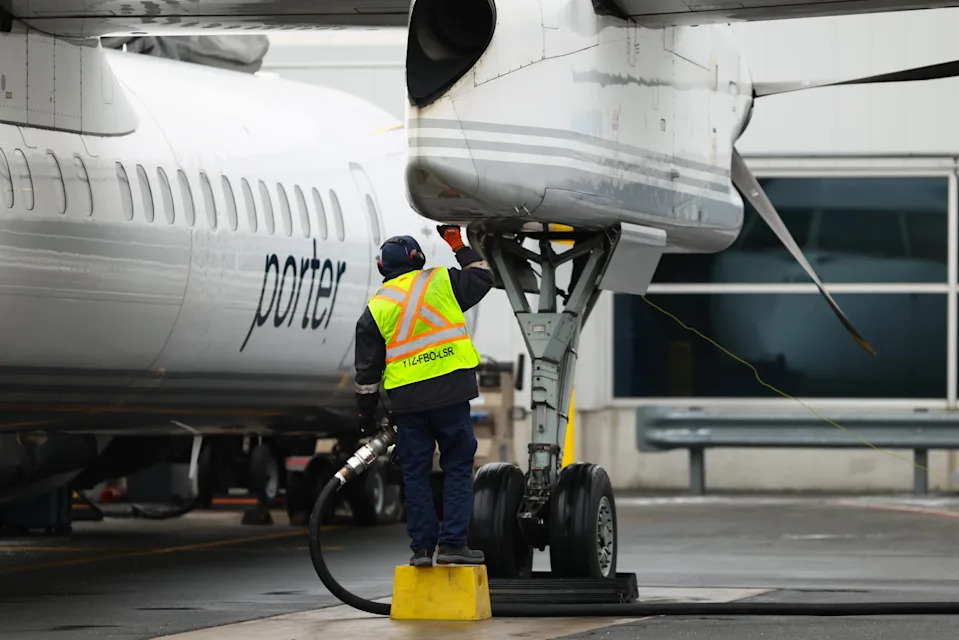
A Porter airplane refuels at Toronto Island Airport in Toronto, Ontario, Canada, on Wednesday, March 18, 2026.
(Cole Burston/Bloomberg via Getty Images)
The U.S. is the world’s largest oil producer, so Americans are more insulated from price shocks than their counterparts in other countries.
That said, nearly all goods — including food — have to travel from where they’re produced to where they’re bought and sold. So it’s not just driving by car that gets costlier when oil prices climb. Shipping gets a lot more expensive too — by boat, by truck and by plane. U.S. consumers could eventually shoulder those increased costs at the grocery store and elsewhere.
Already, airfares are spiking as airlines try to cover the rising cost of jet fuel. Heating your home and cooking with natural gas are also likely to cost more as the war grinds on. The same goes for products made from natural gas, such as plastic, rubber, fertilizer and petrochemical feedstock. (The last two have the potential to make food more expensive as well.) Overall inflation could rise, and consumers could start spending less.
“The longer this lasts, the more significant the shock would be,” one economist told the AP.
How long this could last
Nobody knows. Trump initially said the war would last four or five weeks. Since then, he vacillated between claiming that the war was “over” in “the first hour” — and “we won” — to insisting that the U.S. could continue attacking Iran “for as long as it takes.”
Oil is going to play a huge part in how the rest of the war unfolds. The problem, as Iraq veteran David French recently explained in a New York Times analysis, is that “if America declares victory now, when the Iranian regime is still in power and the strait is closed, then Iran perversely can claim that it won. It took a huge punch, absorbed the blow, and still forced America to climb down.”
Conversely, if Trump commits “to opening the strait (and keeping it open) by force,” French continued, “the U.S. may well find itself in yet another open-ended, costly conflict with at least some American soldiers on Iranian soil.”
In a note published on Thursday, Goldman Sachs analysts predicted that if the strait remains closed for more than two months, oil prices are likely to hover above $110 a barrel through the end of 2027; if the strait reopens in April, the price would likely fall to pre-war levels by the end of 2026.