
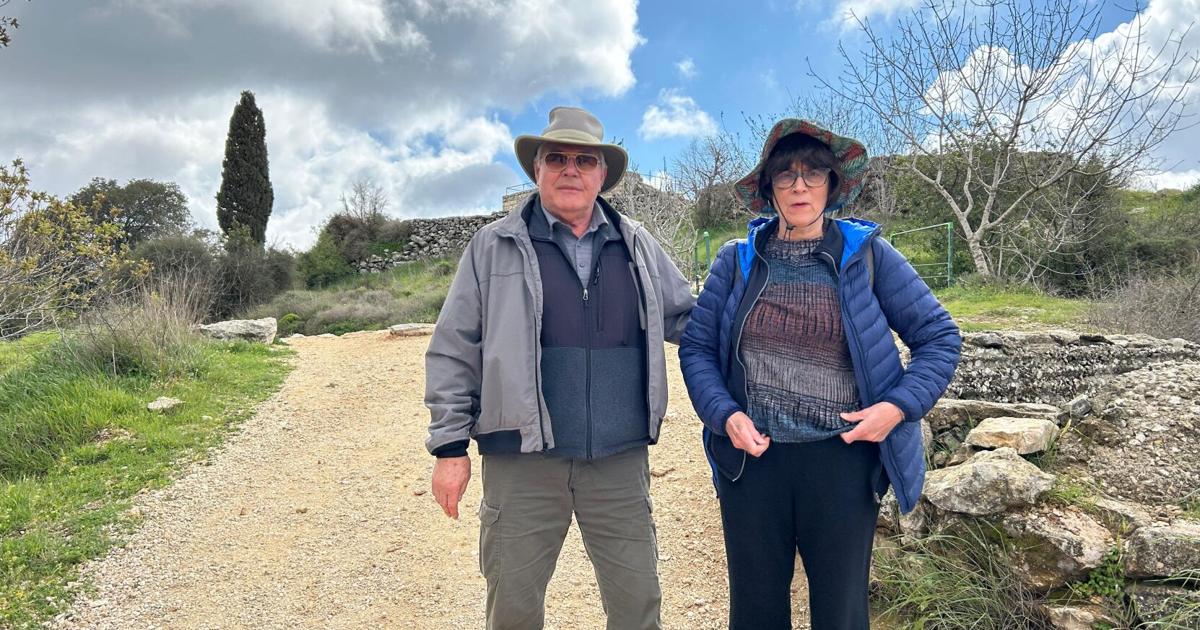
MUKWONAGO — The distant boom of intercepted missiles and the rattle of shrapnel hitting rooftops are no longer sounds on the news for one Mukwonago couple, they’re part of daily life in central Israel. Rich and Deb Hacker are experiencing the realities of war firsthand as they volunteer through a Jewish organization and visit their daughter and son-in-law, who is currently serving in the Israeli military.
They travel to Israel at least once a year on volunteer “mega missions” through their Jewish organization. This time, their purpose was twofold: to serve and to spend time with their daughter, son-in-law, and grandchild who live there.
That visit now coincides with a widening war. Israel is facing an expanded regional conflict, including an ongoing war with Iran. Israeli forces also continue operations in Gaza and have been fighting with Hezbollah in southern Lebanon.

Despite the tension, Rich Hacker said he never doubted his safety, noting heightened vigilance since the Oct. 7, 2023 attacks.
On that day, Hamas-led militants launched coordinated air and ground assaults on Israel, killing nearly 1,200 people and taking more than 250 hostages. Israel responded with counterattacks.
Rich has since returned to the United States, but his wife remains in Israel with their family.
“I feel strongly to say that the reason I’m here and the reason I’ve been here 15 times over the last 18 years is because of my love for Israel and my family who lives here,” Deb said.
Deb and Rich are proud of giving their three children a Jewish education in Waukesha County. Their youngest immigrated to Israel in 2008.
Their son-in-law, a reservist in the Israel Defense Forces, has now been called up for active duty for the sixth time since the war began. The repeated deployments have taken a toll on family life.
Speaking via WhatsApp from just outside the protected space in her family’s apartment in central Israel, Deb described a country trying to maintain normalcy amid constant uncertainty.
The people live under threats of rockets and drone attacks.
“You get an early warning on the phone app, most times about 10 minutes before the siren will go off, this gives you a chance to go to your shelter or protected space … but if you don’t you must go to a public shelter or a nearby building. This affects how you live your daily life such as where you go if you’re driving, you must leave your car and go into a ditch and cover your head,” Deb said.
Schools have been closed for two weeks, forcing parents and grandparents to juggle work and childcare, though some remote learning continues.
Rich said people are living life as normal as they can despite the rocket attacks that can be heard.
He also pointed to the oftenoverlooked role of women during wartime. “The women are holding the country together while the men are gone and do not get enough credit. They are heroes,” Rich said.
Even the smallest routines carry added weight. Children, Deb said, are acutely aware of the dangers around them.

SPECIAL: $6 FOR 6 MONTHS
Start a new FREEMAN digital subscription for only $6 for the first 6 months.
“I know the children are anxious when they go out because they ask where is the shelter. What happens if we’re in the grocery store and the siren goes off ? They need to be reassured, and the safe space shown to them before they proceed. They miss their friends, their routines,” she said.
As Passover approaches, concerns are growing over travel disruptions and the ability of families to reunite.
“A lot of people travel back and forth between North America and other locations,” she said.
Still, Deb finds strength in the close-knit communities around her.
“People have very strong, family networks here and help and know their neighbors,” Deb said.
Moments of beauty persist alongside the danger. Early mornings bring chirping of birds but also the distant booms of intercepted missiles.
“That shrapnel has landed on a house across the highway, and on a rooftop two blocks from here. No injuries. People follow the rules here. We didn’t have a siren now for more than 24 hours until this last one,” Deb said.
Travel plans have been disrupted. A planned trip to northern Israel to explore Druze communities was canceled when their guide was stranded abroad, and safety concerns have made the region inaccessible.
“We were fortunate to have our traveling done at the front end of the trip and family time was planned at the back end of the trip. But I’m sorry to miss out from this fascinating part of Israel and minority cultures here also thrive,” she said.
Through it all, Deb avoids political commentary, focusing instead on the human experience.
“They are not afraid and hunker down in a bomb shelter. People make tremendous sacrifices to live here, mandatory military service for one, reserve duty for another. It’s largely an urban culture here, but the nature in this country is also beautiful, very precious and varied to me,” Deb said.
Her days are now centered on supporting her family, particularly her daughter and grandchild as her son-in-law serves.
“My son-in-law has been called up to the reserves and has been away most of the time. This has been his sixth call up since the start of the Oct. 7 war. That’s obviously hard on the family. It’s hard on his work situation. His family comes from the Middle East. They are known as Mizrachi Jews. … And as I mentioned, it’s hard to work and to raise a family when your spouse is in the reserves away from home. …People are resilient here and they’re going to get through this.”
Rich echoed that sentiment from back home.
“The people are so resilient. You have no idea what they live through on a day-to-day basis, even though they don’t seem too concerned, deep down they are,” Rich said.