
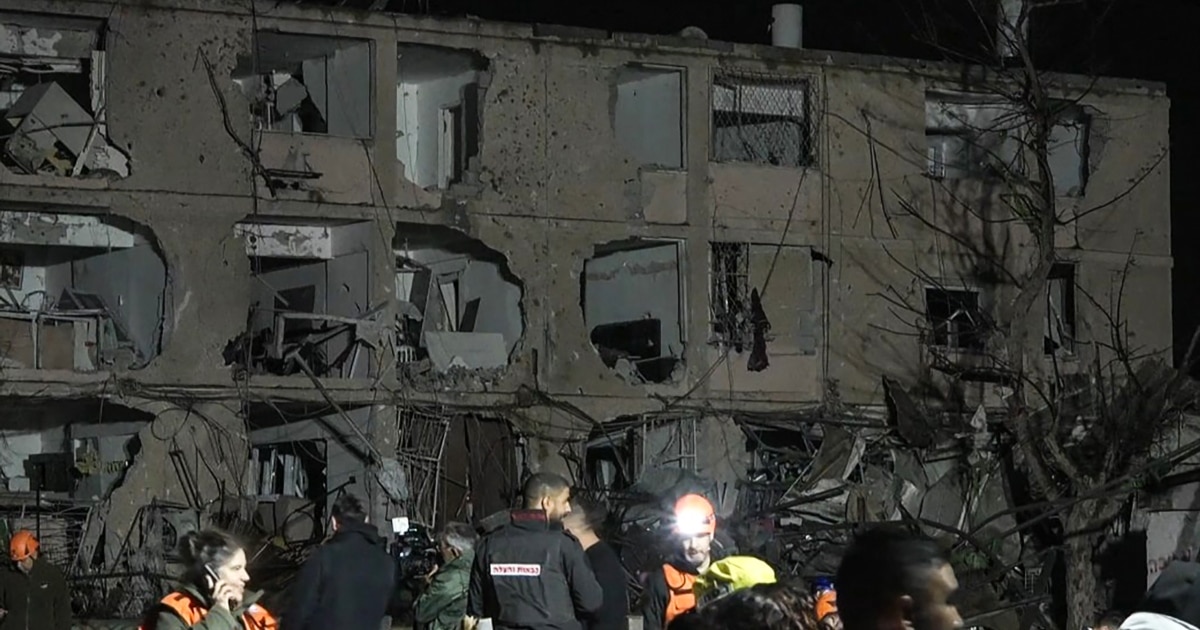
Israel and Iran appeared to intensify risks of a major disaster, with each side striking close to nuclear facilities of the other combatant, raising the rhetoric level in Tel Aviv and Tehran and worrying the UN atomic watchdog.
An Iranian missile on March 21 hit the Israeli town of Dimona, which is home to a nuclear facility, in what Tehran said was in retaliation for strikes on its Natanz uranium enrichment facility earlier in the day.
Israel has never publicly acknowledged that it has a nuclear weapon and the Dimona complex is officially described as a research facility. The site, just outside the main town, is widely believed to possess Israel’s nuclear arsenal, the only such holding in the Middle East.
After the earlier strike on Iran’s Natanz site, the International Atomic Energy Agency (IAEA) reiterated its call for “military restraint to prevent a nuclear accident.”
The IAEA then repeated the call for “maximum military restraint” following Iran’s missile launch against Dimona.
“The IAEA is aware of reports of an incident in the city of Dimona, Israel, involving a missile impact and has not received any indication of damage to the nuclear research center Negev,” the agency said on X.
“Information from regional states indicates that no abnormal radiation levels have been detected,” it added.
‘Direct Missile’ Strike
The Israeli army told AFP there had been a “direct missile hit on a building” in Dimona as first responders said at least 33 people were injured at multiple sites.
“There was extensive damage and chaos at the scene,” paramedic Karmel Cohen told AFP.
A second Iranian missile strike blasted the southern Israeli town of Arad, injuring at least 59 people, local officials said.
“Paramedics are providing medical treatment and transporting 59 patients to hospitals via dozens of ambulances,” Israel’s Magen David Adom first responder organization said.
“Among them are six patients in serious condition, 13 patients in moderate condition, and 40 patients in mild condition,” it added.
Firefighters said that “in both Dimona and Arad, interceptors were launched that failed to hit the threats, resulting in two direct hits by ballistic missiles with warheads weighing hundreds of kilograms.”
Meanwhile, Israel also said its forces had struck a facility within a Tehran university that it claimed was being used to develop components for nuclear weapons.
“The Malek-Ashtar University facility was utilized by the Iranian terror regime’s military industries and ballistic missiles array to develop nuclear weapon components and weapons,” the military said.
“The Malek-Ashtar University was subordinate to the Iranian Defense Ministry, and is sanctioned internationally due to its activities and efforts over the years to advance the Iranian nuclear program and to develop ballistic missiles,” the military added.
‘Battle For Our Future’
Israeli Prime Minister Benjamin Netanyahu vowed to continue striking Iran after what he called a “very difficult evening” following the attacks on Dimona and Arad.
“This is a very difficult evening in the battle for our future,” Netanyahu said in a statement. “We are determined to continue striking our enemies on all fronts.”
Israeli Defense Minister Israel Katz warned that Israel and the United States would begin intensifying their air strikes on Iran beginning on March 22.
“The intensity of the strikes to be carried out by the IDF and the US military against the Iranian terror regime and the infrastructure on which it relies will rise significantly,” Katz said in a statement.
Elsewhere, an Iraqi officer was killed in a drone attack targeting an Iraqi intelligence services facility in a residential Baghdad neighborhood.
Also in Iraq, security sources early on March 22 told Reuters that air strikes were targeting Iran-backed Popular Mobilization Forces positions in Mosul.
Iraq has been increasingly feeling the effects of the conflict in Iran, with air strikes targeting Iran-backed groups, which themselves have launched attacks on US interests in Iraq.
Iraq, like Iran, has a Shi’ite Muslim majority but, unlike Iran, has a large Sunni population as well, often a source of tensions within Iraq.
Iran’s Longest Shot
The world continued to react to Iran’s surprise launch of ballistic missiles toward the joint US-UK base on the island of Diego Garcia, some 4,000 kilometers from Iranian territory.
Israel said Iranian forces had for the first time fired long-range missiles, expanding the risk of attacks beyond the Middle East. Neither missile hit the site.
“These missiles are not intended to strike Israel. Their range reaches European capitals — Berlin, Paris, and Rome are all within direct threat range,” Israeli military chief Eyal Zamir said.
The rising casualty toll and property damages continued despite remarks by President Donald Trump that the United States was close to achieving its goals and was considering “winding down” military activity.
But even as he spoke, the Pentagon was sending thousands of additional ground forces to the region aboard US Navy ships to bolster military assets in the war with Iran, multiple media outlets have reported. The Pentagon hasn’t commented officially on the reported deployments.
Trump also insisted that other countries take the lead in policing the Strait of Hormuz, the shipping lane whose near-closure threatens a global energy shock.
With reporting by RFE/RL’s Radio Farda, Reuters, and AFP