
Strait of Hormuz – why is it significant?published at 03:37 GMT
03:37 GMT
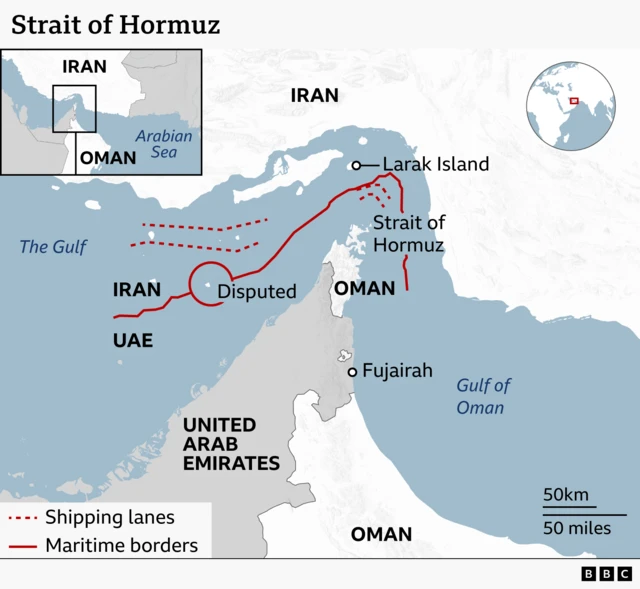
As a reminder, Iran has effectively blocked the Strait of Hormuz, one of the world’s busiest oil shipping channels, since the US and Israel attacked the country on 28 February.
Bounded to the north by Iran and to the south by Oman and the United Arab Emirates (UAE), the waterway – only about 50km (31 miles) wide at its entrance and exit, and about 33km wide at its narrowest point – connects the Gulf with the Arabian Sea.
About 20% of the world’s oil and liquefied natural gas (LNG) usually passes through the strait, with oil coming not only from Iran but other Gulf states such as Iraq, Kuwait, Qatar, Saudi Arabia and the UAE.
What is the impact of closing the strait?
About 3,000 ships usually sail through the strait each month but this has dramatically decreased recently, with Iran threatening to attack tankers and other ships.
At least 21 vessels have been hit or targeted, or have reported attacks, since the start of the war, according to an AFP news agency tally on 18 March.
Global fuel prices have soared in the wake of the war. Crude oil has risen above $100 a barrel – up almost 70% this year and nearly 50% from a year ago.
You can read more about why the Strait of Hormuz matters so much here.