
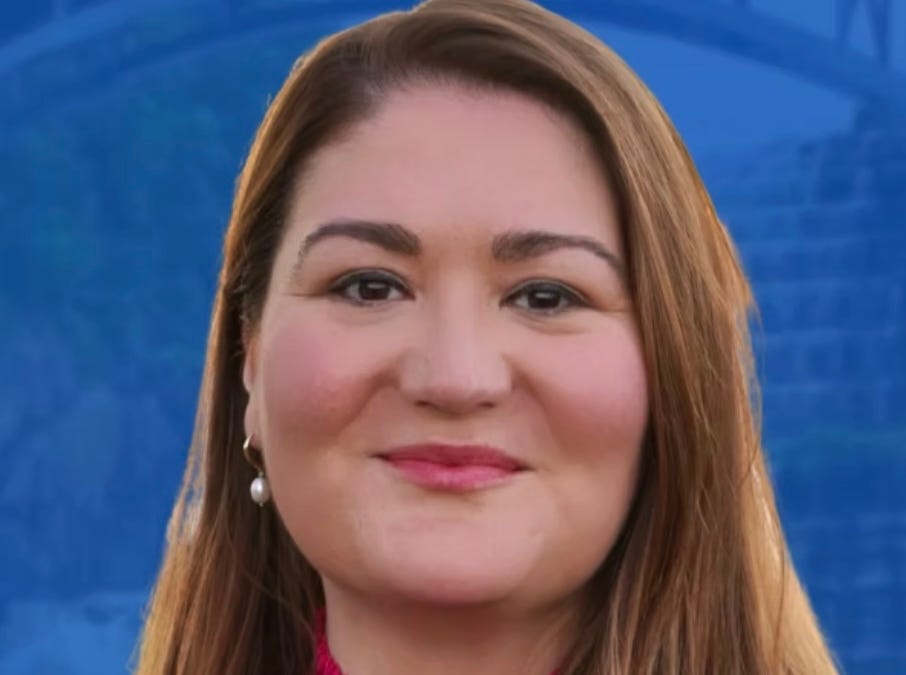


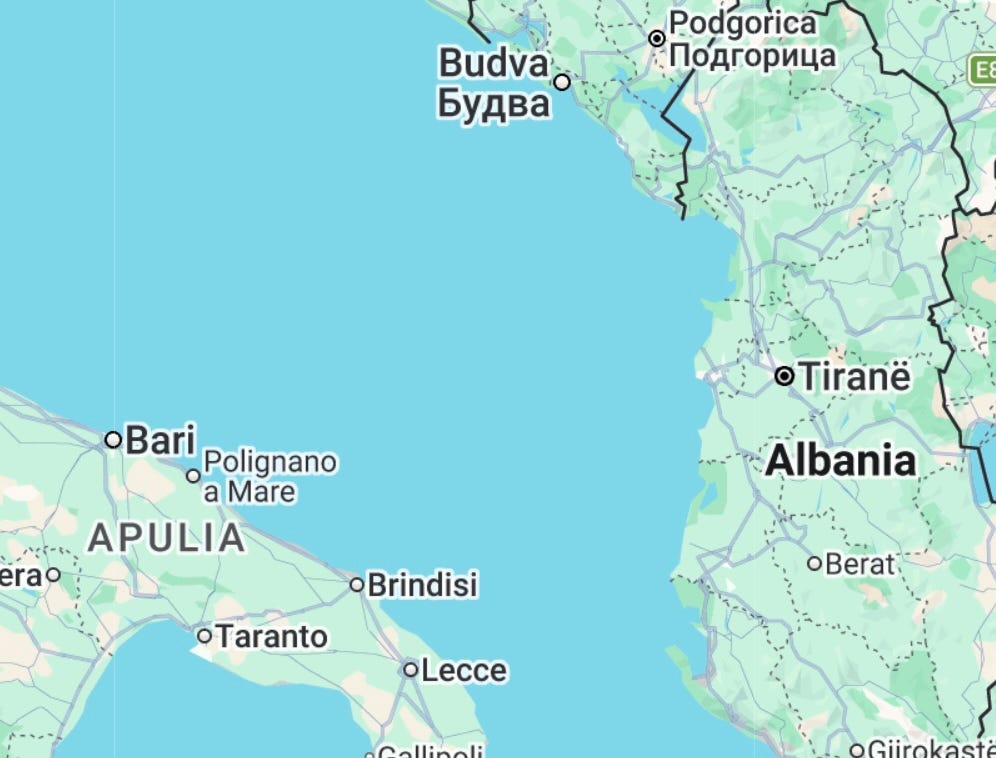
In 1997, when Emiljana Ulaj was ten years old and living with her family in the northern Albanian city of Scodra (also known today as Shkodër), a family cousin knocked on the door to say there was a fishing boat selling tickets to leave the country and go to Italy. The family made an immediate decision to leave. Five of them made their way to the boat, carrying just one suitcase between them.
Albania was in the midst of a civil war, the culmination of a series of events that followed the death of long-time communist leader Enver Hoxha, the fall of Communism itself, the first multi-party elections of 1991 and 1992, and a nationwide, government supported pyramid scheme that eventually collapsed and led to violent protests.
Emiljana’s family, especially on her mother’s side, had experienced persecution under the Hoxha regime. While the country was about 70% Muslim overall, her family was from the north, where Catholics, including in Scodra, made up nearly half of the population. Emiljana was secretly baptized in a secret room by a secret priest.
On Sunday, March 22, Emiljana Ulaj told her story, in probably more detail than most of her constituents have ever heard, to a Brotherhood Breakfast at Temple Israel of Northern Westchester in Croton. The temple’s Brotherhood Breakfasts are a regular event, and feature a special guest or topic accompanied by copious platters of bagels and lox, whitefish, and other Jewish delicacies.
Croton Deputy Mayor Len Simon, who moderated Emiljana’s visit, explained that it was “important for this temple to connect to our elected officials.” He pointed out that her immigrant experience “mirrors our ancestors,” since close to 100% of the temple’s members could trace their own origins to Jews who migrated to America.
As our local District 9 county legislator, Simon said, Emiljana “is really Temple Israel’s voice in county government.”
As Emiljana’s family made its way down to the dock, they were not sure whether there really was a fishing boat there and if they would be able to get on it. Fortunately, they were lucky, and boarded the vessel packed with other refugees. They landed in Bari, Italy, just across the Adriatic Sea, and spent the next year in a tent in a refugee camp. The authorities sent the children to school within a week of their arrival.
“But we knew we wanted to come to America,” Emiljana said. “The opportunities for children were so much better. For generations this country has meant so much to refugees around the world… it’s a beacon. If you work hard and give it your all” you can make it.
The family was eventually granted asylum in the United States, where they first lived in Bedford Hills. Emiljana began attending 5th grade and quickly learned English. At first her parents found what work they could: Her mother worked as a house cleaner and her father as a day laborer. Then Emiljana’s father got a union job as a custodian at a local school.
“Very early on I learned what a union job could mean for a family,” Emiljana said. Today, her day job, in addition to being a county legislator, is as an organizer for the New York State United Teachers (NYSUT), the same union her father joined so many years ago.
Simon asked Emiljana how she got started in politics.
“I’ve always been interested in politics,” she said. She told the story of being in Middle School and listening to a presidential debate, where the main topic was immigration policy. “The Republican candidate was saying they only wanted immigrants to do the jobs Americans didn’t want to do,” she recalled. “The Democrat’s answer was kinder and gentler.”
Another turning point was the Iraq war, when Emiljana found out that then Vice President Dick Cheney had worked for the Halliburton corporation, which had oil contracts in the country. “As an immigrant I had idolized this country,” she said, but then she realized that the government had started a war for oil and that Americans were dying as a result.
“It made me realize the people in charge mattered,” Emiljana said. As a student at Bard College, she became politically active. When attorney and law professor Zephyr Teachout came to talk about the Citizens United Supreme Court case, which allowed pretty much unlimited corporate contributions to election campaigns, Emiljana volunteered for Teachout’s 2014 campaign for governor. (Teachout lost the Democratic primary to Andrew Cuomo with 33% of the vote.)
As for how she decided to run for county legislator, Emiljana said that she was encouraged to do so by her predecessor in District 9, Catherine Borgia, who could not run again due to term limits. The two women met at the Black Cow to discuss it; when Emiljana’s union said they had no problem with her running, she decided to do it.
Simon then asked Emiljana about her recent trip to Israel, which generated a fair bit of controversy among activists critical of that country’s conduct of the war in Gaza and ongoing settler violence against Palestinians in the West Bank.
“It feels like we’re only getting one side of the story here,” Emiljana responded. While in Israel, she said, her delegation—sponsored by the Westchester Jewish Council—visited joint projects by Israelis and Palestinians that were doing “hopeful work.” Emiljana said “I kept thinking, why is no one talking about this. Israel is really trying hard to build peace. They are constantly under attack. They have the right to defend themselves.”
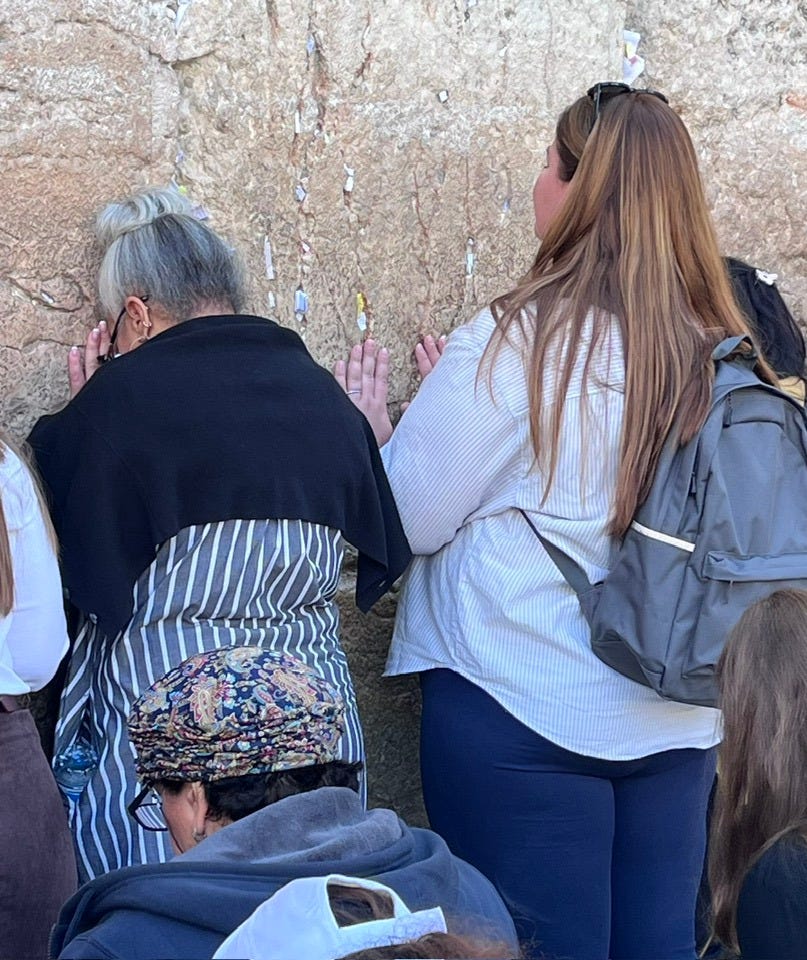 Emiljana Ulaj (right) at the Temple Mount in Jerusalem
Emiljana added that while it was “not my role to get involved in foreign policy,” since the trip “I feel more confident to speak up. We are being misled here.” Emiljana also mentioned the rise of antisemitism in the United States, and the need for synagogues like Temple Israel to have extra security. “When I go to a temple it is the only time I see a police officer outside,” she said. “I don’t see that at a church.”
During the question and answer session, Emiljana reemphasized her progressive politics, especially her criticisms of the Trump administration’s immigration policies—”ICE is now being misused to terrorize communities without regard to constitutional rights and basic decency,” she said—but then the subject returned to the question of Israel. Emiljana made clear that on this issue she parted company with most Democrats. She said that Israel had become “a wedge issue” for those who were trying to divide Democrats, and that “it is working. It benefits only one party.”
Recent polls do show that Emiljana is in the minority of Democrats with her staunch defense of Israel. After two and a half years of the war in Gaza, and a severe rise in settler violence against Palestinians in the West Bank, support for Israel has declined sharply among Americans as a whole, and Democrats in particular. For example, a Gallup poll in 2014 found that 58% of Democrats sympathized with Israel; today, that percentage is down to 17%, with 65% of Democrats sympathizing more with the Palestinians. The drop in support is particularly dramatic among voters aged 18-34, as well as among young Jews.
Nor surprisingly, a report prepared by top Democratic Party officials, still not released, found that the Biden administration’s political and military support for Israel’s war in Gaza was a major factor in Kamala Harris’s loss to Donald Trump.
The night before Emiljana gave her talk, settlers in the West Bank rampaged through a number of Palestinian villages, setting fire to cars and houses and spreading terror among people there, one of the worst such episodes in years of attacks on local residents. (In 2024, the International Court of Justice ruled that Israel’s occupation of Palestinian territories, including the West Bank, is a violation of international law.)
 A car set on fire in the West Bank by settlers on Saturday.
The Chronicle has reported earlier, as have other media, on the large number of human rights organizations and experts, along with experts in international law, who have reached a consensus that Israel has committed a myriad of war crimes in Gaza; these include human rights organizations in Israel itself, such as B’Tselem, which has joined Amnesty International and Human Rights Watch in concluding that Israel’s actions amount to genocide.
Another dramatic sign of international rejection of Israel’s actions is the decision of Germany, long a staunch ally of the Jewish state, not to intervene on Israel’s side in the case before the ICJ brought against it by South Africa, and recently joined by the Netherlands and Iceland.
At Temple Israel itself, opinion is divided. Last August, in a powerful Friday evening sermon, Rabbi Dan Polish spoke out about Israel’s actions in Gaza. As we reported at the time:
“Horrible things have happened in Gaza,” [Rabbi Polish] said. “Horrible things are happening in Gaza. We are horrified and saddened. Gaza is a stain on Israel, and by extension a stain on us. Some say the real villain is Hamas. But we are talking about us right now.”
Rabbi Polish made reference to a recent visit he made to the Hiroshima Peace Memorial in Japan. “I feel the same guilt and shame about Gaza as I felt at the memorial in Hiroshima,” he said. “This moment demands that we speak the truth about it,” even if it sometimes means condemning Israel’s actions.
But that does not mean, he added, that Jews should reject Israel or turn against it. “Gaza calls upon our responsibility to reclaim the Israel of our dreams. May God grant us the fortitude and the courage to rise to our responsibilities. May God grant Israel’s leaders a new wisdom and a new understanding that they may turn away from vengeance” and find the way to peace with the Palestinians, he concluded.
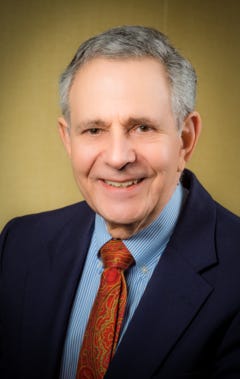 Rabbi Dan Polish
Right now, of course, Israel and the United States are deeply involved in a war against Iran—and Israel in a war against Hezbollah in southern Lebanon—that started off unpopular among Americans and is getting more unpopular by the day, as its widespread consequences become more obvious.
While many at the Brotherhood Breakfast applauded Emiljana’s strong stand in defense of Israel, it remains to be seen whether that position will be tenable as time goes on—and whether, in the end, uncritical support of Israel will be what is best for American Jews themselves.
**********************************************************************************************************
To share this post, or to share The Croton Chronicle, please click on these links.
Comments policy: No hate speech, personal attacks, or trolling. Please be polite and respectful at all times.