
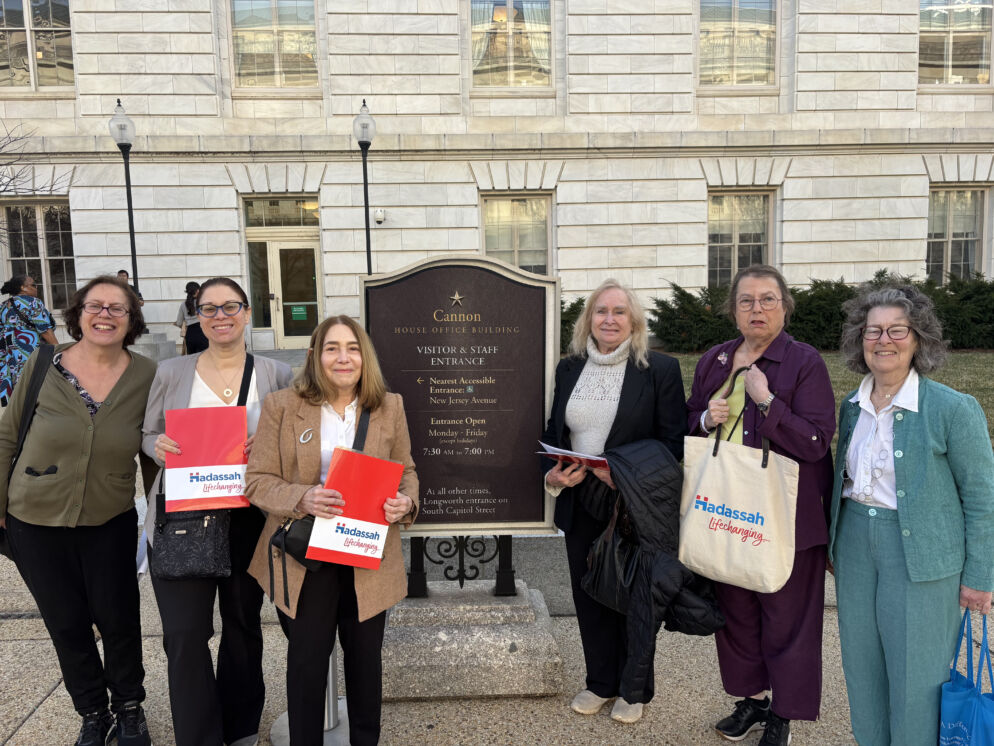
 Iris Tishkoff, second from right, with fellow Hadassah advocates who lobbied on Capitol Hill on March 10. (Courtesy of Hadassah, The Women’s Zionist Organization of America)
Though Hadassah’s Day of Impact had been planned months in advance, Iris Tishkoff felt that the current geopolitical landscape demanded action.
She was among the 200 leaders of Hadassah, The Women’s Zionist Organization of America, who lobbied on Capitol Hill on March 10, urging lawmakers to maintain a strong U.S.-Israel relationship, combat antisemitism and protect women’s health, according to a press release.
The Day of Impact comes amid rising antisemitism in the United States and increasingly tense debates about U.S.-Israel ties.
“The situation in Israel at the moment with the war is motivation enough,” said Tishkoff, a member of Hadassah’s philanthropy committee and National Portfolio Council.
“We are bringing the combined strength of our nearly 300,000 members, donors and supporters directly to Congress to stand firm against antisemitism, to uphold the strategic US-Israel alliance and to safeguard the health and well-being of women everywhere,” Hadassah’s National President Carol Ann Schwartz said in the press release.
Tishkoff and five other advocates from Rockville, Bethesda or Gaithersburg visited the aides or chiefs of staff for Reps. Randy Weber (R-TX), Sarah Elfreth (D-Md.), Jamie Raskin (D-Md.) and Steny Hoyer (D-Md.).
Tishkoff kicked off each lobbying session with an “elevator pitch” for Hadassah, introducing the country’s largest Jewish women’s organization. “We support two hospitals in Israel. We [treat] whoever comes through the door, no matter of religion, race, whatever,” she explained.
In addition to sharing personal stories and policy priorities with the congressional aides, the local advocates discussed breast cancer awareness and other women’s health issues.
“We talk[ed] about how women are discriminated against when it comes to research,” Tishkoff told Washington Jewish Week, adding that most medical research is done on men, leaving women underrepresented and their health misunderstood.
“Women are treated differently when they go in [to doctors’ offices] and present symptoms that might trigger [a proper diagnosis] if it were a man,” she said.
Hadassah and its advocates support medical innovation and U.S.-Israel medical partnerships, including the MIRACLE Act, which requires the Department of Health and Human Services to implement a program for both nations to collaborate on developing and delivering health care products and services, according to the press release.
The organization also prioritizes federally funding women’s health research, especially for conditions that disproportionately affect women.
Tishkoff said each of the four congressional aides listened attentively during the lobbying sessions and jotted down “extensive notes” to relay to the representatives.
“They took notes on everything, and hopefully that gets back to their congressperson,” she said. “Some of them have already sponsored some of the House bills we were talking about, so that was good.”
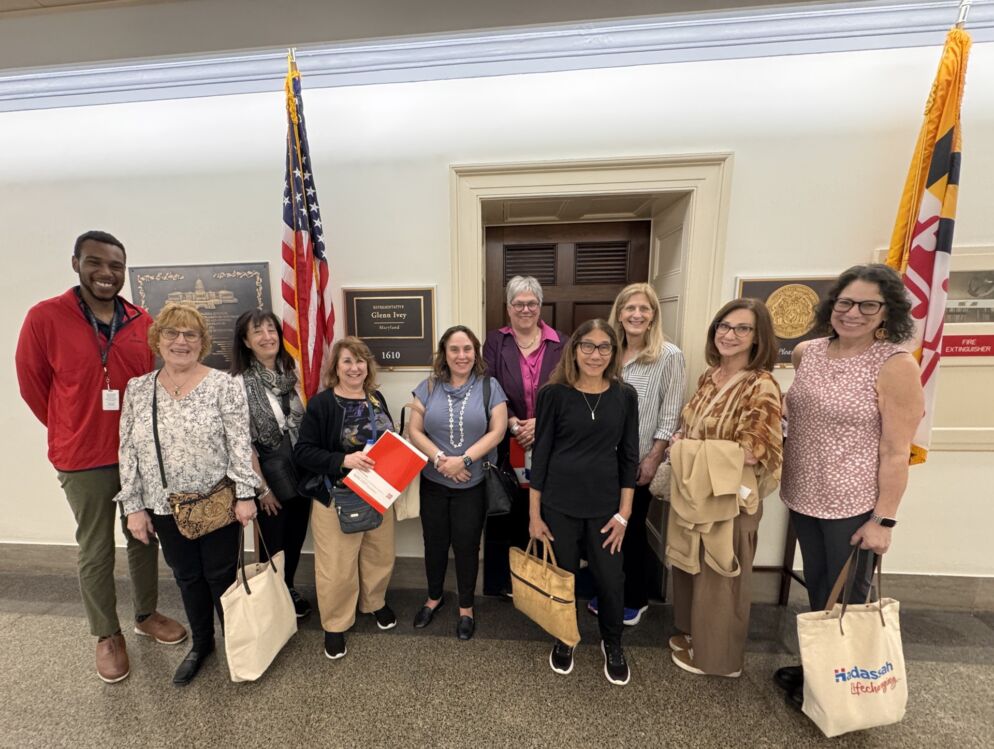 A group of Maryland Hadassah advocates outside Rep. Glenn Ivey’s office at the Capitol. (Courtesy of Hadassah, The Women’s Zionist Organization of America)
Tishkoff said she was also pleased to learn that the four representatives support Israel and understand the importance of treating women’s health issues.
“It’s important for the world,” she said of addressing these topics. “A lot of things have been maybe not cured, but at least helped, and [Hadassah Medical Center in Israel has] done extensive work on [treating multiple sclerosis].”
She has seen this impact firsthand by meeting Hadassah patients through her decades with the nonprofit organization.
A Texas woman living with MS had been using a wheelchair and was able to walk again following gene therapy. “She had made frequent trips to Israel to get this treatment,” Tishkoff recalled. “I’ve seen that myself. I met her years ago.”
A Florida resident with Stage 4 skin cancer survived after receiving treatment at one of Hadassah’s two Jerusalem hospitals, she said.
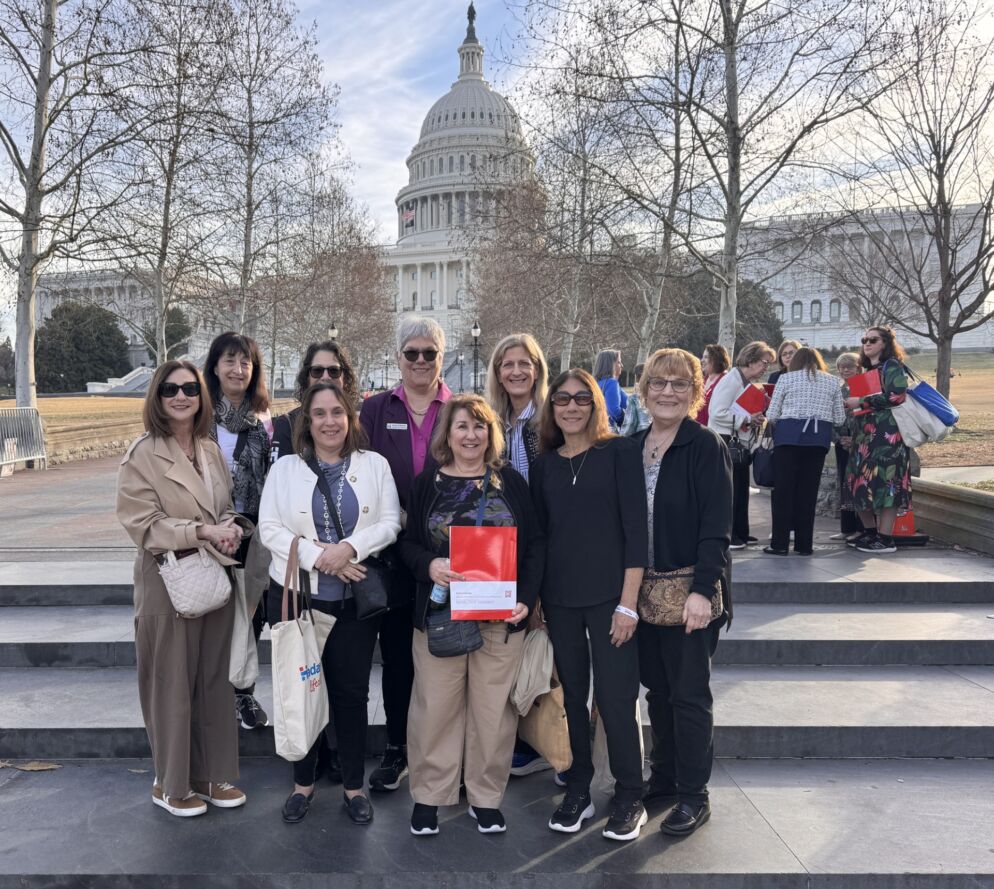 A group of Hadassah advocates from Maryland pictured outside the U.S. Capitol for Hadassah’s annual Day of Impact.
(Courtesy of Hadassah, The Women’s Zionist Organization of America)
Overall, Tishkoff said she left the Capitol building feeling with a sense of purpose. She said while it can be impactful to send letters or email one’s representatives, it’s different to speak face-to-face with those who report directly to congressional leaders.
“I think it says something to people when you show up. Why do people go to rallies and that sort of thing?” Tishkoff said.
“Advocacy is central to who we are and what we stand for,” Hadassah’s CEO Ellen Finkelstein said in the press release.
“It was very, very fulfilling,” Tishkoff said of her day on the Hill.