
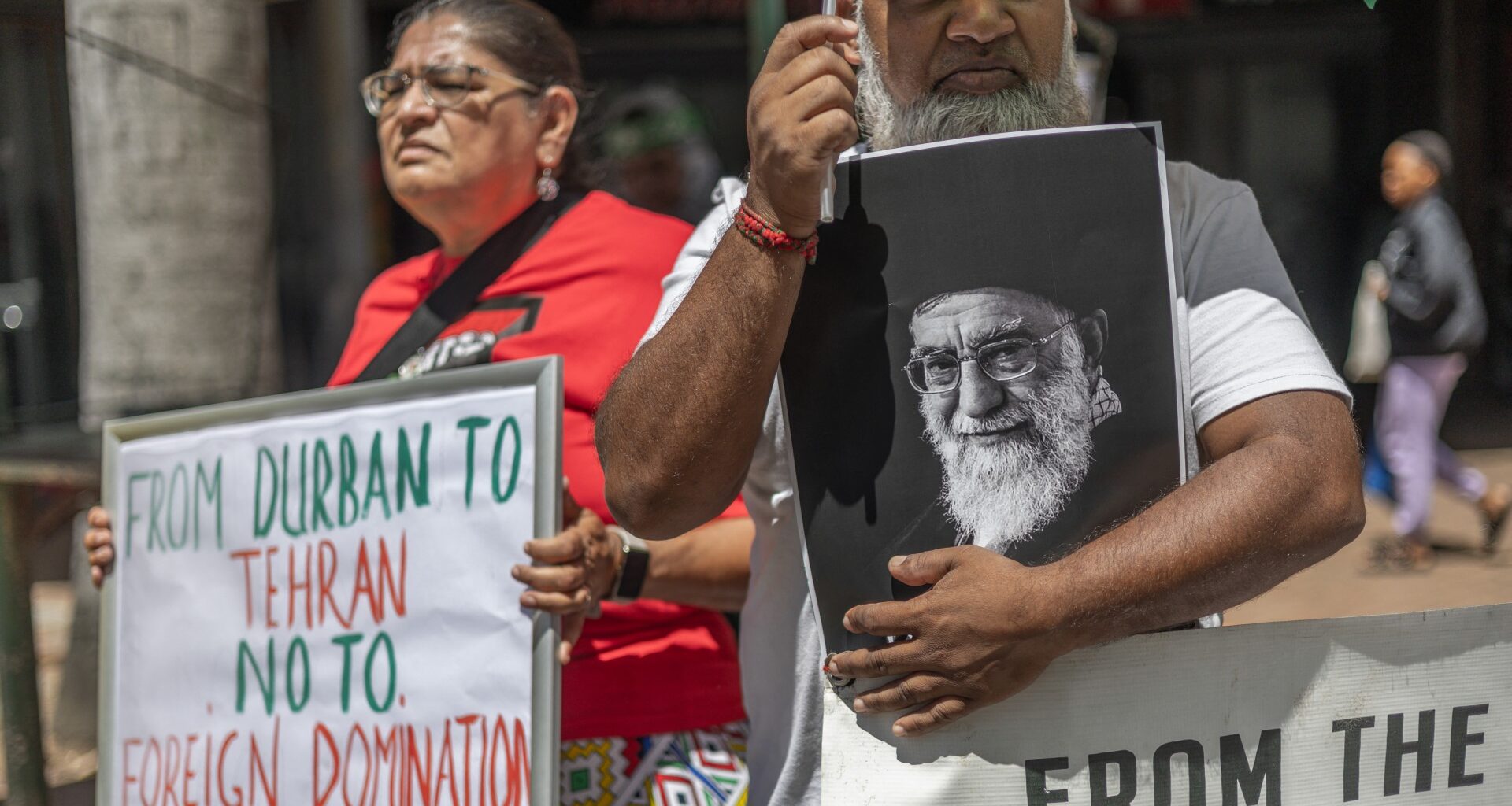
Africa’s muted response to the US–Israeli war on its territory has led Iran to accuse Israel of leveraging its expanding diplomatic footprint across the continent to deflect criticism of its actions in the Middle East.
Since the war began in late February, most African states – alongside continental bodies such as the African Union – have largely skirted the crisis.
Instead, they have issued general calls for de-escalation while condemning Iranian retaliation against US-Israeli targets in the Gulf.
While analysts attribute this cautious posture to the continent’s “limited” geopolitical leverage and exposure to global economic shocks, Tehran has provided a more pointed explanation, claiming that political pressure, particularly from Israel, is shaping Africa’s response.
“It appears that the Israeli regime pursues specific objectives through its relations with African countries, including the whitewashing of its 70-year-long crimes and occupation against the people of Palestine and the West Asia region,” Mansour Shakib Mehr, Iran’s ambassador to Pretoria, told Middle East Eye.
New MEE newsletter: Jerusalem Dispatch
Sign up to get the latest insights and analysis on
Israel-Palestine, alongside Turkey Unpacked and other MEE newsletters
Mehr did not offer concrete examples, but characterised Israel’s approach as an attempt “to reverse the roles of oppressor and victim,” adding that “our brothers and sisters in Africa remain mindful of this reality”.
“Iran is paying the price for supporting the Palestinian people and for rejecting Israel’s occupation and genocide,” he added.
The remarks come as US and Israeli strikes on Iran intensify, fuelling concerns that Gulf states may eventually be drawn deeper into the conflict.
Scholars tracking Israel’s engagement with Africa say that, while Tehran’s claims are politically charged, they are not entirely without foundation.
Expanding footprint
Raouf Farrah, the co-author of Rising for Palestine: Africans in Solidarity for Decolonisation and Liberation, told MEE that Israel has steadily expanded its diplomatic and political presence across Africa over the past two decades.
“This trajectory has not slowed in the wake of the genocide in Gaza, despite popular mobilisation across the continent,” Farrah said.
‘The AU is unlikely to take a more forceful position because its institutional and financial dependence on western donors constrains its room for manoeuvre’
– Tendai Mbanje, University of Pretoria
“On the contrary, it continues to evolve in increasingly assertive ways – as illustrated by recent developments involving Somaliland, as well as earlier efforts in 2023 to secure observer status at the African Union, a bid notably blocked by countries such as South Africa and Algeria.”
He added that openly pro-Israel positions tend to come from countries with closer ties to Tel Aviv, including Morocco, Rwanda and Cameroon.
In August, Israel opened an embassy in Lusaka, Zambia – part of what officials described as a renewed diplomatic push into Africa.
“Israel is returning to Zambia. Israel is returning to Africa,” Israeli Foreign Minister Gideon Saar said at the time.
But Farrah says the reasons for Africa’s trepidation are invariably linked to a concern over punitive actions from the US.
He said that new deals with the US in sensitive sectors such as digital infrastructure and health data systems “deepen structural dependencies in areas tied to sovereignty, increasing the political cost of taking positions that could jeopardise these relationships”.
Strategic caution
Under US President Donald Trump, Washington has come to be viewed as transactional, unpredictable and, at times, aggressively unilateral.
“This has encouraged restraint,” Farrah said.
“Rather than taking strong public positions on the US–Israel confrontation with Iran, several states are opting for strategic ambiguity to avoid potential diplomatic or economic repercussions,” he added.
This calculus, balancing principle against risk, has left many African governments reluctant to articulate positions that could imperil critical partnerships.
War on Iran: How Algeria and Morocco manoeuvre the fallout
The African Union has mirrored this cautious approach. On Sunday, AU Commission chairperson Mahmoud Ali Youssouf reiterated that he was “concerned” by the joint US-Israel strikes on Iran, calling for restraint, urgent de-escalation and adherence to international law.
The statement echoed an earlier intervention in late February when Youssouf warned of a “serious intensification of hostilities” in the Middle East.
However, when Iran retaliated against US-Israeli targets in the Gulf, the tone shifted noticeably.
In a separate statement, Youssouf “strongly condemned” Iranian missile and drone attacks on Bahrain, Qatar, the United Arab Emirates, Kuwait and Saudi Arabia.
Responding to MEE, AU spokesperson Nuur Sheekh said the commission had been consistent in urging restraint and compliance with international law.
He said that the AU Commission “was the first multilateral body that expressed deep concern, and called for immediate de-escalation by all parties in this conflict”.
He added that the AU Commission “has been consistent in all situations of conflict, whether regional or global [and] always emphasises the need for all actors to exercise restraint and act fully in accordance with international law”.
Pressure beyond Africa
Analysts, however, say that if Iran expects more African countries or the AU overall to adopt a stronger stance, it is likely to be disappointed.
“The AU is unlikely to take a more forceful position because its institutional and financial dependence on western donors, particularly the US and Europe, constrains its room for manoeuvre,” Tendai Mbanje, a governance expert at the University of Pretoria, told MEE.
He warned that openly confronting Washington or Israel could jeopardise critical partnerships.
‘It is necessary for the world to respond appropriately to the spread of insecurity and war’
– Mansour Shakib Mehr, Iranian ambassador
“Moreover, there is no consensus among member states,” Mbanje said. “Some, like South Africa, have condemned Israeli actions, while others benefit from US or Israeli cooperation and prefer silence.
“This divergence makes neutrality the default position, as the AU cannot forge a unified response without risking internal divisions or external backlash.”
In practice, the AU’s cautious diplomacy reflects both structural dependence and the fragmented interests of its members, he added.
This fragmentation is echoed beyond the AU.
Ebenezer Obadare, a fellow of the Council on Foreign Relations, said Africa’s response has been shaped by a combination of economic interests, political calculations and the strength of bilateral ties with the United States, Israel and Iran.
Mehr, meanwhile, extended his criticism to Brics, calling on the bloc to take a clearer stance. The grouping, made up of 11 states, has faced mounting criticism for failing to stand up, even rhetorically, for its permanent member Iran.
He warned that failing to respond to what he described as “the invasion of a United Nations member state” and a “blatant violation of international law” would establish a dangerous precedent.
“It is necessary for the world to respond appropriately to the spread of insecurity and war,” he said.
“Tomorrow, the same approach could be applied against them. No one should be allowed to use their power to impose its will on others.”