
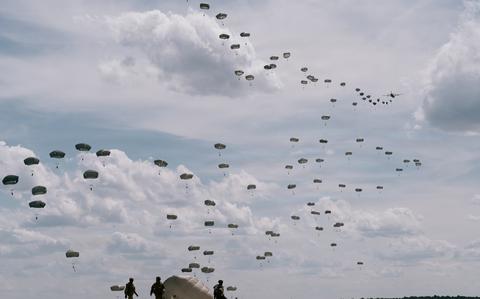
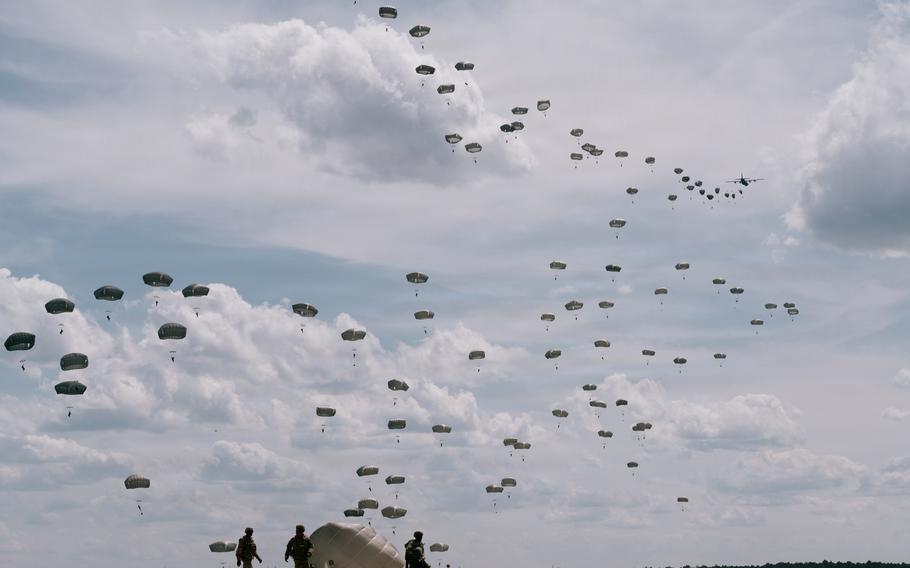
Paratroopers assigned to the 82nd Airborne Division participate in a training event at Fort Bragg, N.C., on June 10, 2025. The 82nd AD’s Immediate Response Force is being considered for deployment in support of operations in Iran, the New York Times reported Tuesday. (Nicole Miller/U.S. Army)
The 82nd Airborne Division’s quick reaction brigade is being eyed for a possible deployment tied to operations in Iran, The New York Times reported as thousands of Marines also make their way to a region where questions swirl over the potential for a ground operation.
No final order has been issued to dispatch the 82nd Airborne’s “Immediate Response Force” comprised of 3,000 soldiers, but “prudent planning” was underway, senior defense officials told the Times in a late Monday report.
The Fort Bragg-based brigade can be deployed anywhere in the world in under 24 hours and serves as the Army’s emergency response force.
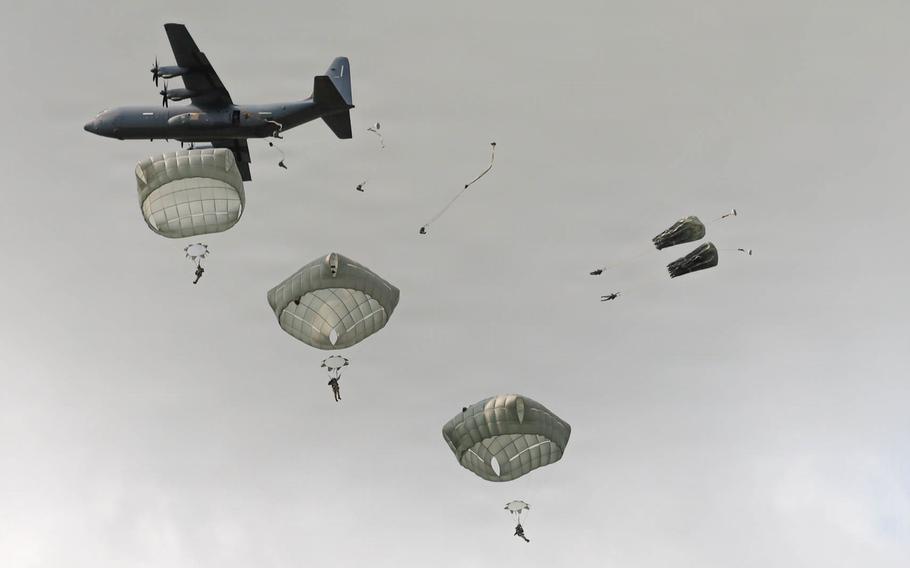
Soldiers assigned to 82nd Airborne Division deploy their parachutes after jumping out of a C-130J Super Hercules as part of an airborne operation at Sainte-Mère-Église, France, on June 8, 2025. The 82nd AD’s quick reaction brigade is being eyed for a possible deployment tied to operations in Iran, according to a New York Times report. (Devin Klecan/U.S. Army)
If President Donald Trump decides to send in ground forces, a possible mission could revolve around Iran’s Kharg Island, a small 5-mile landmass that handles 90% of Iran’s oil exports. The island already has come under heavy fire from U.S. forces since the start of the conflict. The island is packed with oil infrastructure and a civilian population of industry workers and an unknown number of military personnel.
Trump, who ordered a large bombing raid on the island earlier this month, has described the location as Iran’s “crown jewel.” But he hasn’t indicated whether using ground forces to seize the territory is in the works.
Still, the potential for an assault on the island, whether through an amphibious landing, paratroopers flying directly in, or a combination of those tactics, is being hashed out in political and defense circles.
Sen. Lindsey Graham, the influential Iran hawk and South Carolina Republican, garnered headlines Sunday when he favorably compared a potential Marine invasion of Kharg to the Corps’ famous attack on Iwo Jima during World War II that killed thousands of Marines.
“We got two Marine expeditionary units sailing to this island. We did Iwo Jima. We can do this. My money is always on the Marines,” Graham said on Fox News Sunday. “I don’t know if you take the island or you blockade the island. But I know this: the day we control that island, this regime, this terrorist regime, has been weakened. It will die on a vine.”
Critics of the idea have countered that such an operation would be high risk and put Marines and other forces called upon into the line of fire from missiles and drones, potentially causing significant casualties.
The 31st Marine Expeditionary Unit out of Okinawa, Japan, is expected to arrive by week’s end in the Central Command area while a second Marine force from San Diego could arrive within a few weeks.
Retired Adm. James Stavridis, the former supreme allied commander of NATO, said if their mission is to control Kharg, the first challenge for the Marines is to get the MEU’s ships through the Strait of Hormuz.
The Iranians should be expected to fire “massive drone attacks; small boats, some loaded with explosives for unmanned and potentially suicide missions” along with missiles directed at the MEU, Stavridis said in a Bloomberg op-ed Tuesday.
The ground force would likely land on Kharg by air, from tilt-rotor Ospreys and helicopters, Stavridis said.
“Any Iranian ground troops still effective following pre-attack strikes should be easily overcome by the first waves of US forces,” Stavridis wrote.
Still, such an operation carries “significant risks and potential pitfalls,” he said.
For example, much of the island could be booby-trapped. There also is the danger that the Iranians could manage to get a direct hit on one of the Marines’ amphibious ships, which would be a significant blow.
A less risky option would be to use the Marine expeditionary force to blockade the island rather than seize it, “which would likely result in fewer casualties and could achieve a similar economic effect,” Stavridis said.
Ultimately “such an invasion would likely be far from surgical — expect rising casualties on both sides and among civilians — and still leave Iran with plenty of other potential steps to create mayhem and improve its bargaining position,” Stavridis said.