
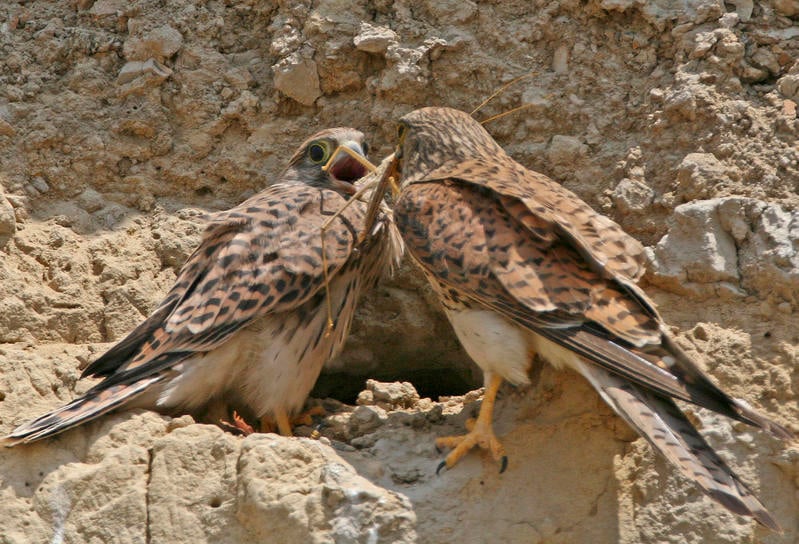
Road traffic noise could be affecting bird breeding in nearly half of Israel’s open space, including just under a quarter of its environmentally protected areas, according to a new study from Ben-Gurion University of the Negev.
Researchers reached these conclusions by developing what they say is the first wildlife-oriented soundscape map.
Analyzing scientific literature and spatial data, they combined birds’ behavioral responses to traffic noise with the distances at which the birds were disturbed, different traffic volumes, and a variety of habitats across Israel.
The latter, covering 18,903 square kilometers (7,300 square miles), ranged from orchards, dense shrubland, and planted pine forests to fields, grasslands, and wetlands. All monitored habitats were level with a road.
“Exposure to noise pollution is known to disrupt fundamental survival behaviors, including foraging, predator avoidance, and parental care,” said the research, published Sunday in People and Nature. “However, until now, conservationists lacked a tool to quantify exactly how much land is ‘lost’ to these behavioral shifts.”
Get The Times of Israel’s Daily Edition
by email and never miss our top stories
By signing up, you agree to the terms
One of the researchers, Yael Lehnardt, said, “The fact that nearly half of our non-urban environments are losing their appeal to nesting birds should be a wakeup call for authorities. The technology to reduce road noise exists. We just need the policy shift and targeted management to apply it to wildlife conservation.”

Yael Lehnardt. (Ron Efrat)
Some birds avoid breeding within 3 kilometers (1.86 miles) of roads, the researchers wrote, with variation according to vegetation thickness.
When traffic was low, birds’ behavioral changes were more pronounced in areas of dense vegetation, they found, possibly because the creatures there couldn’t see what was creating the noise and became more stressed. Conversely, in open areas, where there were no trees to act as acoustic barriers, heavy traffic noise impacted more greatly.
The researchers proposed integrating noise-reduction techniques commonly used to protect human residential areas into environmental planning to protect biodiversity. Solutions included improved road maintenance, strategic landscape design, and the creation of acoustic corridors in areas of high ecological value.
“While we can model and map physical noise levels, those measurements don’t tell us directly how an animal experiences its environment,” said Lehnhardt, who carried out the research with Dr. Gopal Murali. “By adapting soundscape mapping, a method usually used by urban planners to measure human subjective experience, we can finally see the world from the perspective of the animals.”
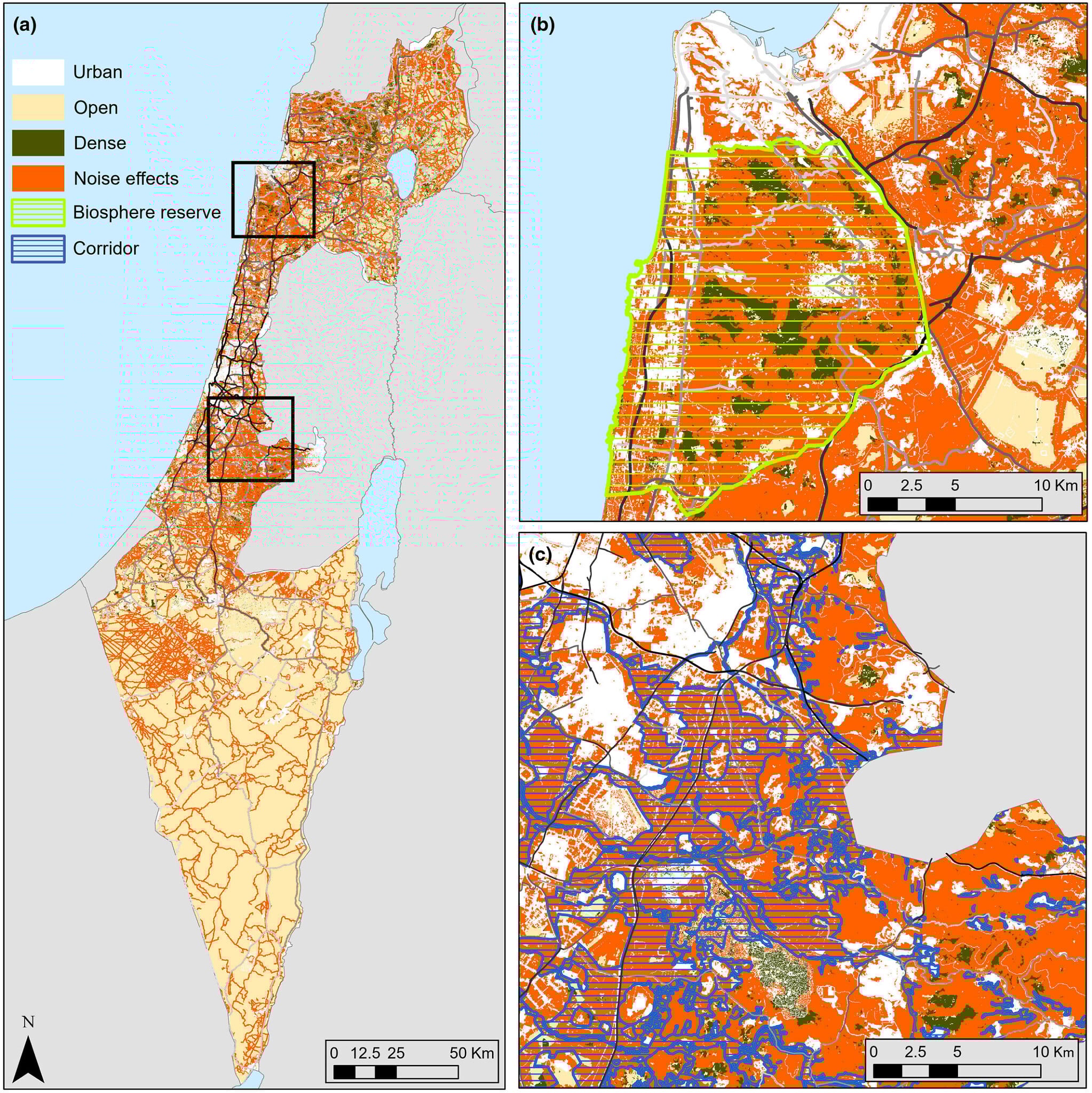
The map highlights open habitats (sand color), dense habitats (dark green), and areas affected by noise pollution (orange), with urban areas (white) excluded from the analyses. Road width and shade of colour indicate traffic volume category. Two black rectangles indicate the locations of regions of particular interest, enlarged —the Mt. Carmel Biospheric Reserve in northern Israel (light green stripes, top right) and the statutory ecological corridor in the Modi’in region of central Israel (blue stripes). This latter corridor is legally recognized for maintaining ecological connectivity but lacks the formal protection status of nature reserves.
Prof. Oded Berger-Tal, who supervised the research together with Prof. Uri Roll, said, “Expanding this research to other species and noise sources will help us identify where noise is causing ‘invisible damage.’ This is a critical step in promoting policies that treat noise as a primary environmental pollutant.”
The study was supported by the Israel Nature and Parks Authority, the Israel Science Foundation, and the US-Israel Binational Science Foundation.
You appreciate our wartime journalism

You clearly find our careful reporting of the Iran war valuable, at a time when facts are often distorted and news coverage often lacks context.
Your support is essential to continue our work. We want to continue delivering the professional journalism you value, even as the demands on our newsroom have grown dramatically during this ongoing conflict.
So today, please consider joining our reader support group, The Times of Israel Community. For as little as $6 a month you’ll become our partners while enjoying The Times of Israel AD-FREE, as well as accessing exclusive content available only to Times of Israel Community members.
Thank you,
David Horovitz, Founding Editor of The Times of Israel