
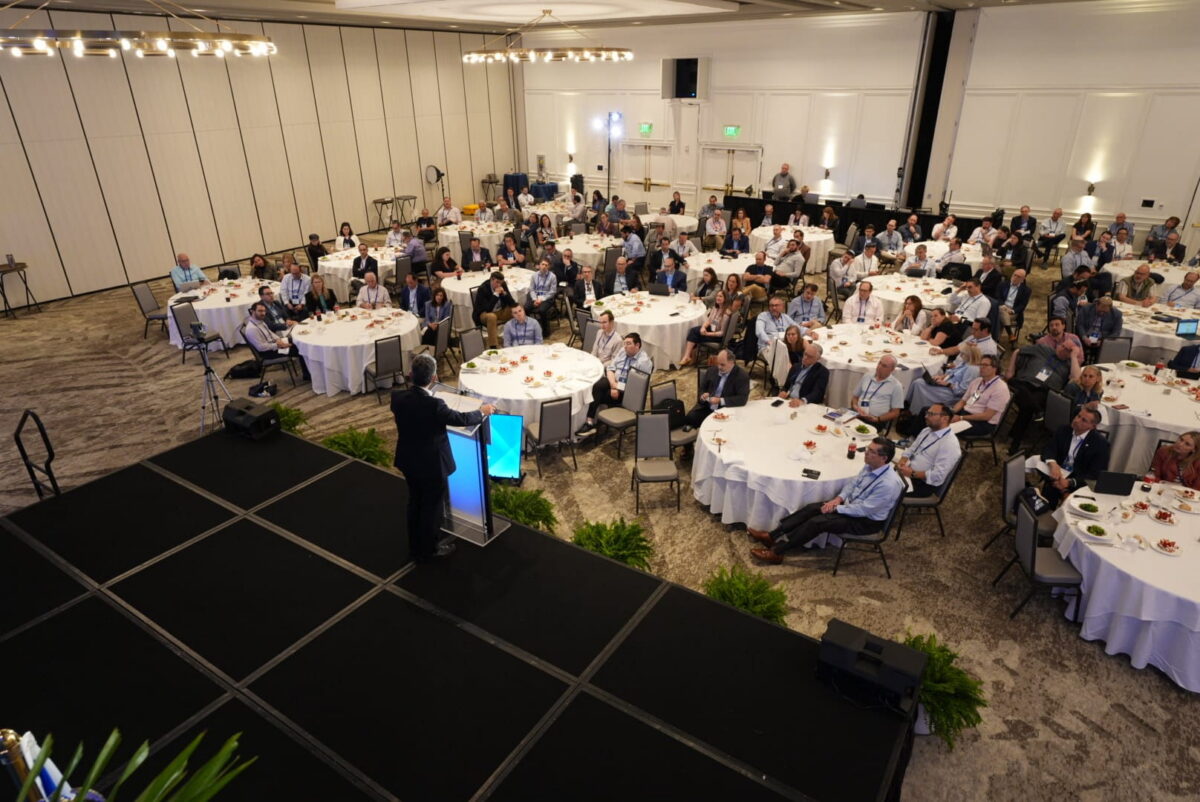
As 150 North American rabbis gathered at a luxury Palm Beach, Fla., resort this week for the third annual “Zionism: A New Conversation” conference, several described the event as representing a pivotal shift from “defense to offense” on Israel-related issues.
“There’s a desire that one day we’ll be able to do what rabbis do and not have to constantly focus on crises [related to] Israel,” Rabbi Samuel Klibanoff, who leads the Modern Orthodox Etz Chaim congregation in Livingston, N.J., told eJewishPhilanthropy. “We’re always defensive about Zionism because we have to be. But we want to be in a place where we’re proud of our Zionism.”
“There’s a lot of focus this year on switching from defense to offense,” Klibanoff continued. “Everyone here is proud to be a Zionist, but they’re being attacked in so many different places, either internally or externally, that it makes it so challenging. Here, people got a lot of tools, whether it’s educational tools or pragmatic, on how to say ‘I don’t want to be a defensive Zionist, I want to bring it out to the world in a positive way.’”
The three-day gathering also provided a rare opportunity for rabbis — who are typically caring for their communities — to “feel seen, respected and taken care of,” said Klibanoff, who was a member of the event’s planning committee.
The annual conference, which concluded on Tuesday, was the largest one yet, according to its organizers. It was hosted by the Lisa and Michael Leffell Foundation, with additional funding from Maimonides Fund, the Paul E. Singer Foundation, the Marcus Foundation and the Zalik Foundation Fund.
The conference aims to discuss how to bring Zionism to the pulpit at a time when pro-Israel spaces can be increasingly difficult to find, even in Jewish communities. Klibanoff noted that North American rabbis are confronting numerous challenges, including navigating the Jewish community’s different opinions regarding the current American-Israeli war with Iran, as well as more internal issues, such as “challenges within our rabbinical schools,” he said. “And we have a variety of opinions [about Israel] from our congregants that we have to deal with on a daily basis, so how do we manage that?” Klibanoff added.
A 2025 study conducted by Jewish Federations of North America found that a plurality, but still a minority, of American Jews, roughly 37%, actively identify as “Zionist.” The topic has become especially fraught in some Jewish spaces, due in large part to the aftermath of Oct. 7, including the ensuing war in Gaza.
The conference opened with a plenary address from author Dara Horn, who spoke about “the need to understand the role of Am Yisrael and to recenter education for our children and communities around this idea,” she told eJP.
“I frame this as a paradigm shift akin to several others that have taken place in the American Jewish community in the years since World War II,” continued Horn. “There was a consensus effort after World War II, and a lot of it came from rabbinic leaders, to reframe Jewish identity as a religion … There’s another paradigm shift about Holocaust education that starts in the late 1970s and gets broad national traction in the 1990s, and a wave of training students in Israel advocacy about 15 years ago. Each of these waves of educational or public-facing efforts are no longer meeting us where we are now.”
Horn told eJP that the conference dispels the myth that “the American Jewish community [doesn’t] talk to each other across denominations.”
Other speakers included Mark Dubowitz, CEO of the Foundation for Defense of Democracies, who spoke about policy execution in Washington; Darius Jones, the founder and director of the National Black Empowerment Council, who spoke about Black-Jewish relations; and Ahmed Fouad Alkhatib, a senior fellow at the Atlantic Council, who spoke about Gaza and regional geopolitics.
Rabbi Brigitte Rosenberg, senior rabbi of the Reform United Hebrew Congregation in St. Louis, the oldest Jewish congregation west of the Mississippi River, said she “looks forward to attending [the conference] every year … I always walk away with nuggets of things I can bring back.”
Horn’s talk especially resonated with her. “She flipped the script on Jewish education and what we’re teaching our kids and how we teach the Jewish story. How she did it was magnificent, so much food for thought. In terms of antisemitism, she said we often think of it as something that only happens to us. That’s not true, she said, hatred happens to everybody, but what’s extraordinary is that Judaism is still around. They now have a curriculum that can be used to teach Jewish students and non-Jewish students the Jewish story … I’m so intrigued by that curriculum and thinking about bringing it to my own students in my synagogue.”
“What I also appreciate about the conference is that colleagues present the Torah. To have Torah woven through ‘experts’ that are speaking to us was just beautiful,” continued Rosenberg.
While “war in Israel” has been a theme of all three conferences, said Rosenberg, she echoed that there was a “slight pivot” this year in “shifting to an offense,” especially during Horn’s talk.
“It’s like, what do we need to do in our community, for ourselves? How are we training our kids? It’s not about Israel and war or antisemitism, it’s also about, how we are telling our own story? Do we know enough about our own story or did the past two years of war unmask something in us that was this recognition of ‘wow, maybe we didn’t do such a great job of teaching our story’? Now we’re focusing on that.”
The Leffell Foundation, which spearheads the conference, has brought more than 250 rabbinical students to Israel since 2012 as part of the Leffell Fellowship. “We felt that seminaries were not focusing enough on Zionism, and people were then entering the rabbinate without a fulsome understanding of modern Israel. We saw there was a hunger for this kind of information and support,” Michael Leffell told eJP on Sunday, before the conference started.
The fellows also used to attend the annual AIPAC policy conference, which would bring hundreds of rabbis together with thousands of other pro-Israel advocates. But AIPAC ceased running policy conferences after 2020, leaving a void that the Leffell Foundation said it is trying to fill with its Zionism conference.
The concept for the conference was conceived in January 2023 “when there was [division] going on in Israel over the government judiciary reform and that was translated here in the U.S. with people ripping apart Israel because of the government,” said Leffell.
“We felt it would be helpful to bring together rabbis, and create a forum for them to remind themselves — regardless of our point of entry into the Jewish world, at the end of the day we’re all one people, and Zionism is the foundation for our peoplehood,” he continued.
Following Oct. 7, the first conference, held in early 2024, “changed direction a bit and took on a lot [more] impact,” said Leffell.
Sara Birnbaum, a rabbinical student at the Conservative movement’s Jewish Theological Seminary and a participant of the Leffell Fellowship, described the conference as a rare opportunity to “have conversations with each other.”
“When you’re in your congregation, you don’t have the luxury of listening to experts in your field and having conversations with your colleagues — both like-minded and not like-minded peers — about these poignant issues in Israel. It’s nice to have that dialogue across denominations,” Birnbaum, who is in her last year at JTS, said. “There were tough conversations around topics including Haredim serving in the army and what our perspectives are on the Iran war. This couldn’t have come at a more perfect time. To have this pause in our day-to-day lives to be immersed in taking all of this information in and being able to talk about it is really a gift.”
“We discussed how to preserve our Zionist ideals while not pushing people out,” continued Birnbaum, adding that it was helpful not only to hear from rabbis who could become mentors but “to have voices like Dara Horn help with our own framing as we talk about Israel from the pulpit, write about it or just have conversations.”
In a speech to his fellow rabbis, Rabbi Ammiel Hirsch, a prominent leader in the Reform movement, called for expanded Jewish education. “Our task is more urgent, our responsibilities heavier, than ever. More than half of the Jewish community is disengaged from Jewish communal life. Even with all of Jewish tradition now available at the click of a button, the extent of Jewish illiteracy is unprecedented.”
Speaking just over a week before Passover, Hirsch said that at the Seder “we shall read about the fourth child, the one who doesn’t even know enough Judaism to know what to ask. P’tach lo, the Haggadah instructs parents — take the first step, teach the kid some Judaism. It never dawned on any past generation of Jewish sages that there would arise a generation of parents who do not know enough Judaism to even p’tach lo — to take the first step in teaching their children.”
Rosenberg reflected on a “light moment” at the gathering, which she said also demonstrated interdenominational unity.
Before Hirsch, who leads the Stephen Wise Free Synagogue in Manhattan, spoke, he was introduced by an Orthodox rabbi who mistakenly called Hirsch’s synagogue the Isaac Wise Free Synagogue — referring to a different leader of the denomination’s establishment.
After the audience corrected the mistake, the Orthodox rabbi made a joke about rabbis in his movement not knowing the history of Reform Judaism. “It was this very light moment,” said Rosenberg. “Where else are you going to be in this space with collegiality and camaraderie where this Orthodox rabbi is introducing a Reform colleague who is about to come up and offer some Torah? It was beautiful.”