
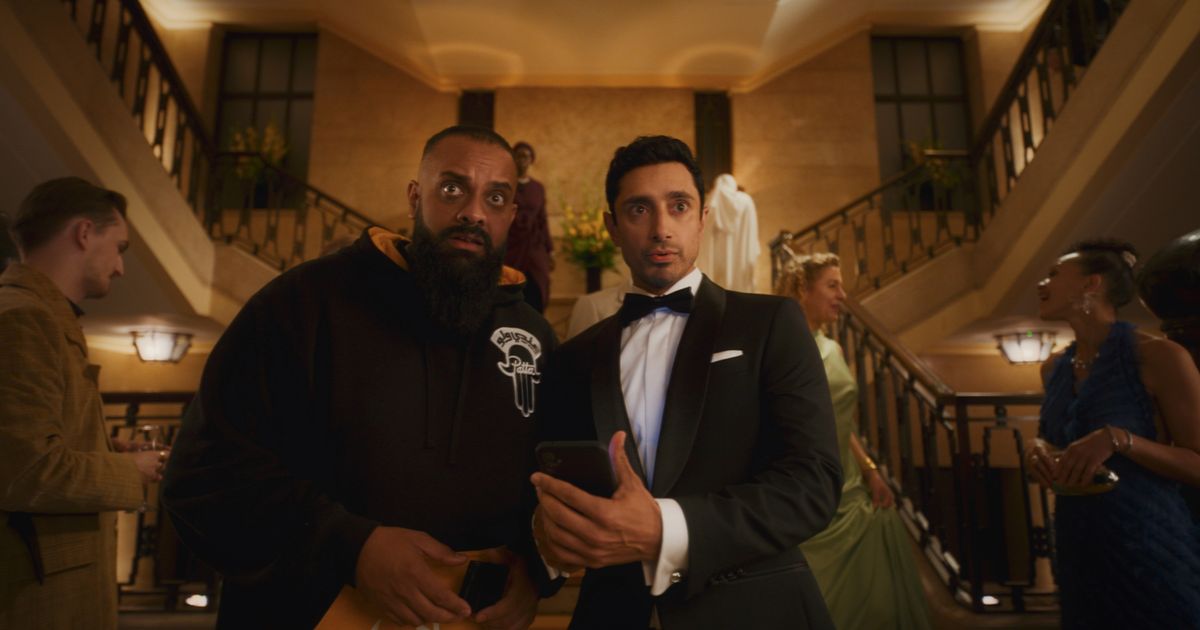
The question of who gets to play James Bond inspires a heady, meta, and highly watchable variation on ideas the actor has spent his entire career considering.
Photo: Prime
Nearly every Riz Ahmed project shares a certainty and a question: the certainty of Ahmed’s presence, of course, and the question of what his presence means, a query that is now so embedded within Ahmed’s career that it also requires an “of course.”
Bait, the new Prime Video miniseries Ahmed created, wrote, and stars in, is both an exercise in self-analysis and an interrogation of it, a breakneck romp through farce, satire, thriller, family drama, and romantic walk-and-talk that transforms itself in each of its six episodes. Sometimes Bait, which resuscitates the much-debated question of whether a POC actor should play James Bond, is so enamored with the idea of Ahmed as 007 that you’ll suspect the whole series is just a proof of concept. Sometimes its characters’ conversations about Muslim life are so breathtakingly inside baseball that you have to admire the gumption it took to willingly exclude an unaware portion of the audience. Sometimes a single episodic observation about the hypocrisy of the entertainment industry is so incisive and compelling that you’ll wish Bait had devoted a little more time to it and a little less time — and I’m being serious here — to Patrick Stewart voicing a pig’s head. And yet. Flaws, deviations, and all, the series always feels like a singular, boldly conceived experiment in service of two questions pervasive through Ahmed’s career: Where has representation gotten us, and what has looking to the ruling order to provide that representation cost us?
What does it mean for Ahmed, a British Pakistani Muslim man, to play not just an aspiring terrorist (Four Lions), a radical leader (The Reluctant Fundamentalist), and a young man accused of murder by an Islamophobic NYPD (The Night Of) but also an ambulance-chasing videographer (Nightcrawler), a utopian in the American Old West (The Sisters Brothers), a hardcore drummer losing his hearing (Sound of Metal), and an ally for whistleblowers (Relay)? Does Ahmed’s presence make a project more authentic, more edgy, more controversial, more inclusive? When does an actor become a representative of their racial, cultural, or religious identity, and when does that representation become a liability? Through his work as an actor, producer, rapper, and activist, Ahmed’s been considering all this for years, surfacing these queries and prodding them under bright lights, and Bait is another go-round in this ongoing reflection.
This could be dismissed as repetitive. But the repetition feels like the point, like Ahmed keeps reconsidering how to tangibly manifest progress because change is so slow and so incremental. In 2017, Ahmed’s speech to the British House of Commons about the importance of diversity in storytelling inspired the Riz Test, a five-criteria measure of how Muslims are portrayed in the media; in 2022, a study by the USC Annenberg Inclusion Initiative found that Muslims are “rendered invisible” onscreen. The strides forward for South Asian, Middle Eastern, North African, and Muslim actors are tangible, but they’re not yet transformational. Ahmed was nominated for the Best Actor Oscar for Sound of Metal, won an Oscar for his 2022 short film The Long Goodbye, and co-starred in arguably the world’s biggest franchise with Rogue One: A Star Wars Story, but these successes are anomalies, not the norm. The very premise of Bait is a hypothetical exactly because there still hasn’t been a non-white Bond and because the character — like so many figures in our biggest IPs — is inherently a representative of a status quo that excludes brown and Black people from its uppermost echelons. Idris Elba was fan-cast for years as Bond, but he was knighted sooner than that became a reality! The industry’s flaws are ongoing and obvious.
Into all this enters Bait, in which Ahmed plays a struggling actor named Shah Latif. Years ago, he was a popular left-leaning rapper and an up-and-comer winning film-festival awards (yes, Shah’s a pretty recognizable analog for Ahmed); now he’s keeping the tags on his Prada sweaters to return them after auditions. One role might change his fortunes: Bond. The series opens mid-audition, and Shah is suave, sophisticated, and self-composed until a sexy baddie asks him, “Do you even know who you are?” Shah’s been tripping over that question every time they run the scene, because it hits at a core uncertainty in his own life. Is he brown enough, British enough, Muslim enough? With the cameras on him, he can’t find an answer — but Shah, once he is politely but firmly dismissed from set, is at least clever enough to know that if he’s photographed walking out of the building, he’ll spark casting rumors that will set the Internet on fire. So he purposefully leaves via the wrong door, flashes a sphinxlike half-smile at the paparazzi, and goes viral, generating attention both from within and outside his community.
His cousin Zulfi (a perpetually scene-stealing Guz Khan), who has been by Shah’s side since the two of them survived a traumatic racist attack as kids, razzes him in Khan’s delightfully thick Punjabi-meets-Coventry accent: “Do they know about the height? Are they gonna give you special shoes?” Shah’s mother, Tahira (Sheeba Chaddha), despite all her prayers, hasn’t gotten a Google alert with her son’s name for a while, so she’s excited to brag about his new Bond status to her friends and reaffirm her high placement in their social pecking order. However, Shah’s casting isn’t a done deal. There’s a running gag about how often people mistake Shah for the far more famous Dev Patel, and another successful brown actor is up for the part too (Himesh Patel, having a grand, smug time), and some fellow Pakistani Brits sneer at the idea of a POC Bond at all, calling it a “vanilla distraction” from discussions of real political agency.
The person leading that charge just happens to be Shah’s ex-girlfriend, Yasmin (Ritu Arya), and Bait almost resembles Scott Pilgrim vs. the World in how it serves up foe after foe for the increasingly anxious and unmoored Shah to grapple with before reaching his next audition. A museum curator who claims she’s one-eighth Indian but doesn’t understand why protestors would find Britain’s theft of worldwide antiquities immoral blocks Shah from giving an Islam-inflected speech at a fundraiser. An activist influencer who implies that Shah’s become a “coconut” as he’s become more famous demands an apology for an awkward run-in that made headlines. A family friend (Nabhaan Rizwan) who works in finance, a job that Shah’s relatives understand and respect more than his own, takes attention away from him. Each introduction takes Bait in a different cinematic direction, from punch-’em-up action flick to paranoid thriller to romantic bottle episode to Bollywood bonanza to, yes, Bond movie.
All those detours, breezily paced in sub-30-minute episodes, ultimately return to the series’ overarching ideas about what it costs — culturally, commercially, personally, domestically, romantically, professionally — to exist as a minority within a majority. Bait is most intriguing when it refuses to answer that question in a tidy way: when it depicts the Pakistani community as having its own classist, racist, and sexist biases; suggests that backstabbing within minority groups is sometimes driven by a proximity to whiteness, sometimes not; and takes jabs at other international locales or nationalities. (Dubai does not escape unscathed, nor does any Brit who volunteered for the invasions of Afghanistan and Iraq and then came back with “tremendous respect” for the countries they helped destroy.) The intention isn’t for Shah, or Ahmed and his collaborators, to insult their own community, but to sink us into the currents and eddies and riptides that complicate it.
Stewart as the voice of the aforementioned pig’s head is Bait’s biggest provocation, simultaneously so brazenly creative and so flatly ludicrous that it could derail the entire show. Initially thrown through the Latifs’ front window to intimidate them, the dead-eyed, pink-skinned porker almost immediately becomes Shah’s therapist, acting coach, taskmaster, and abuser. Stewart is in full-on Shakespearean thespian mode, his enunciations staccato and his tone sharp, as he embodies and amplifies Shah’s own self-loathing during their many conversations. The pig’s head being a haram object that happens to know so many of Shah’s ugliest innermost opinions about his own talent and his family is another meaty layer to Bait’s subtext. Ahmed’s Shah spilling his secrets to a clearly inanimate corpse requires a leap of faith from the viewer that this lunacy will eventually pay off — and after some meandering, it does. Because the pig’s head, the confessionals, the high jinks, Shah running around London trying to prove himself and then trying to find himself are all bait, all inspirations for us to think about what purpose representation serves these days. Can change ever come from the inside? If not, what is to be done? The answers will vary for everyone — and might change with time, as Ahmed’s own relationship with these concepts seems to have — but Ahmed’s preoccupation with these questions is so heady, so meta, and so watchable that you’ll want him to keep asking them.
Sign up for the Vulture Daily
An entertainment newsletter for the pop-culture obsessed.
Vox Media, LLC Terms and Privacy Notice
Related