

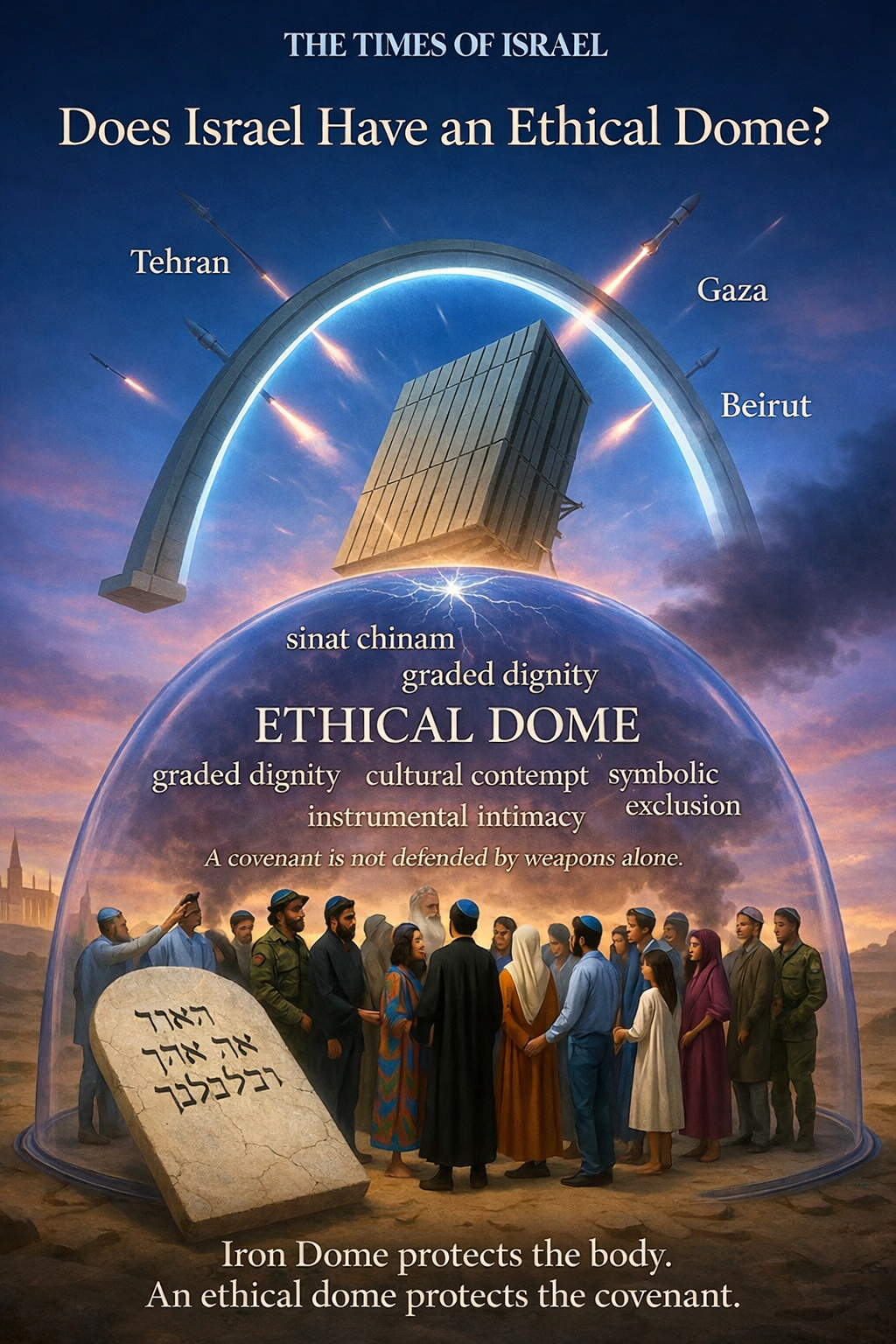
Satirical illustration for “Does Israel Have an Ethical Dome?” The image contrasts Israel’s military shield with the more difficult question of whether a society can defend itself against internal contempt, graded dignity, and sinat chinam.
Credit: Original concept, direction, and image by Yochanan Schimmelpfennig.
Does Israel Have an Ethical Dome?
Iron Dome intercepts rockets. Arrow reaches higher. David’s Sling fills the space in between. Israel has learned, through bitter necessity, how to build layered defenses against dangers coming from outside.
The Ziv Agmon affair forces a harder, more uncomfortable question: does Israel also possess an ethical dome?
Agmon, Prime Minister Benjamin Netanyahu’s spokesman and acting chief of staff, resigned after exposed remarks in which he insulted Mizrahi and Sephardi Likud politicians in crudely contemptuous terms, mocked parts of the ruling camp, and attacked Netanyahu himself. He later acknowledged that the quotes were authentic, argued they were partial and taken out of context, and denied that they reflected racism, pointing to his family’s Moroccan roots.
That matters. It matters not only because the language was ugly, though it was. It matters because the contempt was not random. It attached itself to style, class coding, cultural tone, and a persistent Israeli temptation to treat some Jews as less refined, less serious, less naturally at home in the symbolic center. The language sounded available, as if it had long been waiting in reserve.
And that is the real danger.
It would be too easy to turn this into a familiar morality play: vile words, public recoil, resignation, ritual disgust, and then the quiet fiction that the stain has been removed. This affair asks for a deeper reading, not merely moral, but ethical.
The ethical question is not whether the remarks were offensive. Of course they were. The ethical question is whether the shared names “Jew” and “Israeli” still hold all parts of the people with equal weight, or whether older gradations keep returning in updated forms: less openly ethnic, more cultural, stylistic, political, coded in the language of taste, education, religiosity, and social polish.
Mizrahi Jews are not a footnote to Israeli life. They helped build the state, defend it, govern it, feed it, sing it, and argue with it. They are woven into its center. That is precisely why contempt directed at them from near the administrative core is not a side issue. It is a stress test of peoplehood itself.
And here one must be honest: the problem is not confined to one political camp. Israel’s older secular and cultural elites have often regarded Mizrahi religiosity, emotional register, and political instincts with condescension disguised as sophistication. The right, for its part, can be tempted to treat Mizrahi loyalty as reliable political capital while leaving quieter hierarchies intact beneath the rhetoric of solidarity. One side has often sinned through cultivated disdain; the other through instrumental intimacy. Neither is innocent.
That is why biography offers no absolution. To say, “my family is Moroccan,” is not an ethical defense. Origin is not absolution. A person can emerge from a history of injury and still reproduce its grammar. Power often prefers exactly that arrangement: distance disguised as closeness.
Still, the episode has another side that should not be ignored. The resignation mattered. The broad condemnation mattered. They show that Israel is not ethically numb. Some reflex of resistance remains. Recognition of the breach is not repair, but it is not nothing.
Jewish tradition names this internal danger with unnerving clarity: sinat chinam — baseless hatred. The Talmud teaches that the Second Temple was destroyed not only by Roman power, but because hatred without cause had become ordinary among Jews. That memory still matters. It reminds us that Jewish catastrophe has never come solely from outside. Sometimes the deepest breach begins when internal contempt becomes thinkable, speakable, and then normal.
That is why the question of an ethical dome is not rhetorical flourish. It is a national question. Can Israel intercept not only missiles from the sky, but degradations of mutual standing before they harden into political habit? Can it resist internal diminishment with the same vigilance it shows external threats?
A state can survive rockets and still be weakened by the quiet sorting of its own people.
A people can remain militarily strong while becoming morally thinner, not more humble, but less able to bear one another without hidden gradations of worth.
The decisive question is not whether Ziv Agmon had to resign. Of course he did. That is the administrative minimum.
The real question is whether Israel is content with a dome only over its skies, or whether it also demands discipline over its heart.
Lo tisna et achikha bilvavekha.
You shall not hate your brother in your heart.
Jewish history is severe with those who mistake internal contempt for a private matter.
Yochanan Schimmelpfennig
Yochanan Schimmelpfennig is a Sephardic philosopher and independent researcher with academic training in political science, the social sciences, and philosophy (university level). He developed the Possest–PQF framework (Philosophical–Quantitative Filtration) and is co-author, with Andityas Matos, of Kabbalah Antision. His work examines language as a political instrument, exile and belonging, Jewish identity, and the procedural mechanisms through which modern institutions sort legitimacy, visibility, and dissent. He writes in a deliberately mechanistic register, treating culture and politics less as “opinions” than as operational systems that shape what can still count as real, permissible, and shared.