
Published: 26 March 2026
Last updated: 26 March 2026
On Saturday evening, while watching television reports about two devastating missile strikes, it became difficult for Israelis to dismiss the thought that their country may not be “winning the war” against Iran.
In subsequent days, a wave of further missile strikes saw more than half the entire population ordered into shelters, raising the prospect in people’s minds that Iran may remain an ongoing threat in a protracted war of attrition, even after the war “ends”.
Faced with this distress, the Israeli media has been transmitting conflicting messages: on the one hand thoroughly covering the missile strikes and their impact, while on the other promoting patriotic endurance and statements of army spokesmen and commentators that Israel has the upper hand.
“The stations still see their role as holding up morale but it’s getting harder and harder with these pictures that they have to show to some extent,” Allyn Fisher-Ilan, former news editor at The Jerusalem Post and Haaretz English told The Jewish Independent.
The stations still see their role as holding up morale but it’s getting harder and harder with these pictures.
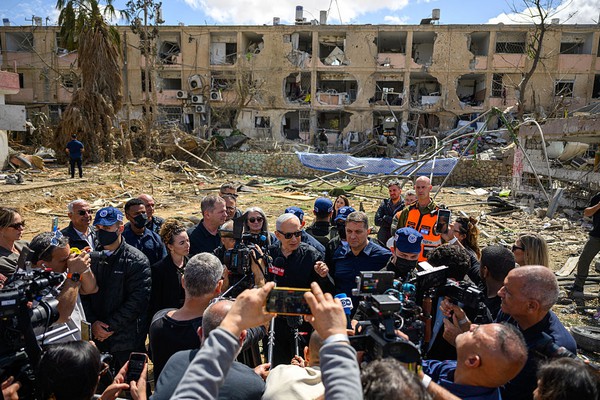
Channel Twelve, the most popular television station, showed shocking footage of a large building from the southern city of Arad whose façade had been blown off, exposing decimated apartments. “Complete devastation. Complete destruction. Why wasn’t the missile shot down?” a journalist asked.
Viewers were told that wounded were still being evacuated, including by helicopter, and rescuers were searching the rubble for survivors. Soon reporting shifted to the deputy director of Soroka Hospital who gave the tally of the wounded who had arrived there and their conditions. “A lot of injuries from fragments, all over the body,” he said.