
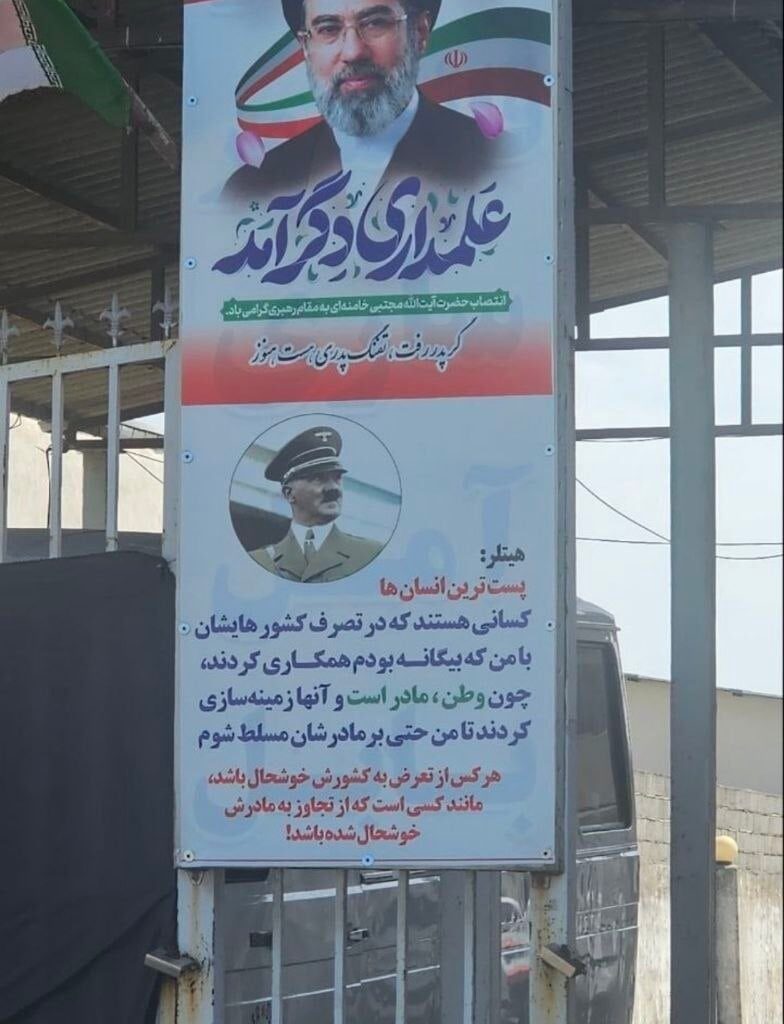
Recently, a couple of propaganda posters used in Iran have gone viral. Some people have interpreted them as a glorification of Adolf Hitler, while others immediately jumped in to “correct” this, arguing that the posters are not glorifying him if you actually read what they say. Instead, they claim the posters contain a misquote attributed to Hitler about how those who helped him invade their countries were such traitors that it was akin to helping someone rape their own mothers, and they conclude that the posters are, in fact, a denunciation of Hitler.
Reading both sides’ commentaries, I was baffled by how neither seems to notice the more obvious point: for whatever reason, using Hitler in any capacity, especially in propaganda posters for a war with Israel, is diabolical! It struck me as a good opportunity to talk about antisemitism and Hitlerism in Iran from the perspective of someone who grew up there.
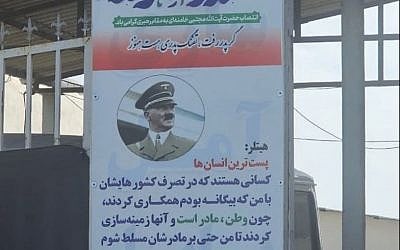
“The lowest kind of people are those who cooperate with a foreigner like me to conquer their homeland. One’s homeland is like one’s mother. Whoever is happy to see their country invaded is like someone who is happy to see their mother raped.”
—Adolf Hitler
Post-1979 Iran has always had an uneasy relationship with, and a cautious flirtation toward, Hitler and, more broadly, Nazism. I am fully aware of Reza Shah’s fascination with Hitler, as well as Iran’s dislocative nationalism and its troubled relationship with Nazism and Aryanism in particular, which seems to be resurging. However, that is not the focus here. Rather, I want to look at the Third Worldist approach of the contemporary ruling class, which has consistently flirted with Hitlerism to different degrees while maintaining a level of plausible deniability.
For example, in 2006, former president Ahmadinejad orchestrated a Holocaust denial conference called the International Conference to Review the Global Vision of the Holocaust, attended by many prominent neo-Nazis, including former Ku Klux Klan Grand Wizard David Duke. Ahmadinejad was, and may still be, clearly antisemitic, using conspiracy theories such as claims that the 9/11 attacks were carried out by Jews, or as he put it, Zionists. However, when questioned, such as in an interview with Larry King, he reframed his rhetoric as being about Palestinian liberation and offered reasonable-sounding criticisms of Zionism that many could sympathize with. Much like Khamenei, Ahmadinejad avoided explicitly targeting Jews as a people and instead insisted that his opposition was directed at Zionists and the state of Israel.
Iran’s entire political apparatus is built on Khomeini’s Islamic Government, a wildly antisemitic book that targets Jews explicitly. Unlike Ahmadinejad and Khamenei, who tend to frame their rhetoric more indirectly, Khomeini, when attacking the apolitical clerics of his time, writes: “The apathy shown by many of us may allow a Jew to rule over us, God forbid!” presenting this as the most dire situation imaginable.
His successors, however, have been more careful about optics. They have long adopted a Third Worldist narrative, casting themselves as defenders of the Global South against Western imperialism. At the same time, the Islamic Republic is neither ruled by a socialist party nor meaningfully left-wing. Instead, it has repackaged left-wing rhetoric and language while pandering to the far right, both at home and abroad.
For example, Mohammad Marandi, a mouthpiece of the Islamic Republic in the English-language press, constantly uses the term “Epstein class” to refer to Western elites who supposedly wage war on Iran. The Baal-burning spectacle that took place prior to the war is part of the same antisemitic narrative, dressed up with plausible deniability.
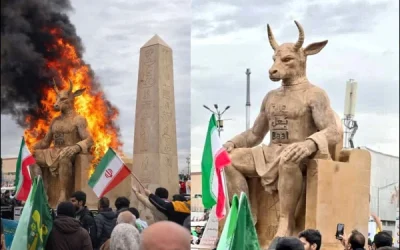
The term “Epstein class,” as opposed to something like the capitalist class, which Iran also has, tells a very specific story about a group of wealthy and powerful people in the West who are allegedly in cahoots with one another, reject God, and instead bow to Baal. This draws on the story of the Children of Israel worshipping the golden calf, which, growing up, I remember was often used to demean and denounce Jews –and of course, Epstein being Jewish is the cherry on top.
But of course, this tactic maintains a level of deniability, especially for those who did not grow up in Iran. They do not catch the reference to the golden calf, or the hidden antisemitic nudge aimed at those who do. The term “Epstein class” invokes, and emerges from, a popular conspiracy theory inside the country: that a group of wealthy, powerful Jews controls everything in the US and Israel. To a left-wing audience, however, it can simply sound like a denunciation of Western capitalism and imperialism.
Iran’s national TV constantly airs clips of Nick Fuentes and Tucker Carlson, and its attempt to capture the hearts and minds of the far right, neo-Nazis, and Nazi-adjacent audiences is very clear. The language used by contemporary Iranian propagandists also constantly includes terms like goyim as a kind of signal.
This is also very similar to the way they used to conduct their brainwashing when I was growing up. They taught us about secret societies such as the Freemasons and the Illuminati, and all the ways they were supposedly manipulating us. They framed it as a war between monotheists, especially Muslims, and Satan-worshippers, while always nudging the audience toward Jews and exposing us to Hitlerites and Hitlerite sources.
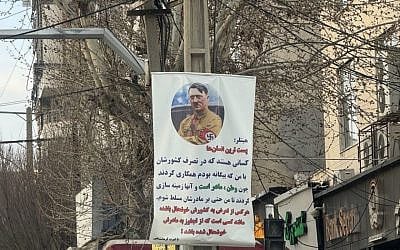
To conclude, the use of Hitler on these posters is not accidental, nor is it without purpose. And the divide between those who immediately see them as pro-Nazi posters and those well-educated people, acting in good faith, who read them as a simple denunciation of foreign intervention, is precisely the point.
The posters do not exactly admire Hitler, but they do not reject him either. They send one message to the far right while maintaining plausible deniability for the left.
Ghorbanpour is a PhD researcher and interested in writing about political economy and political theory.